Therapy handouts and worksheets
Information sheets and worksheets to print on A4 or fill in on screen. They are free to use.
- Core therapy skills 30
- Anxiety and worry 32
- Panic and agoraphobia 15
- Social anxiety 12
- Health anxiety 8
- OCD 17
- Trauma and PTSD 20
- Low mood and depression 20
- Sleep 14
- Stress and burnout 17
- Anger 13
- Emotions 24
- Self-esteem and self-criticism 33
- Perfectionism and procrastination 11
- Relationships and communication 29
- Grief and loss 13
- Habits, urges and alcohol 14
- Body image 6
- Pain, fatigue and health 12
- Values, goals and change 34
- Getting the most from therapy 12
- Staying safe 6
If you need help now
- In an emergency, call 112 or 999, or go to your nearest emergency department.
- Samaritans: freephone 116 123, any time, or email jo@samaritans.ie.
- Text About It: text HELLO to 50808, free, any time.
- Pieta: freephone 1800 247 247, any time, or text HELP to 51444.
- Your GP, or the out-of-hours GP service in your area.
No handouts match that. Try a different word, or clear the filters.
Search results
Core therapy skills 30
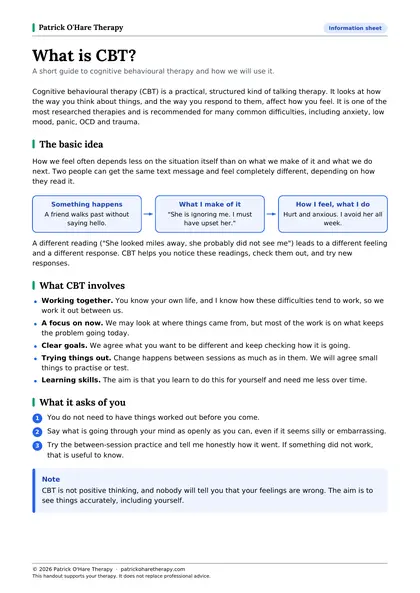 What is CBT?Information sheet, 1 pageA plain-English introduction to CBT: the basic idea, what happens in sessions, and what your part in it is.
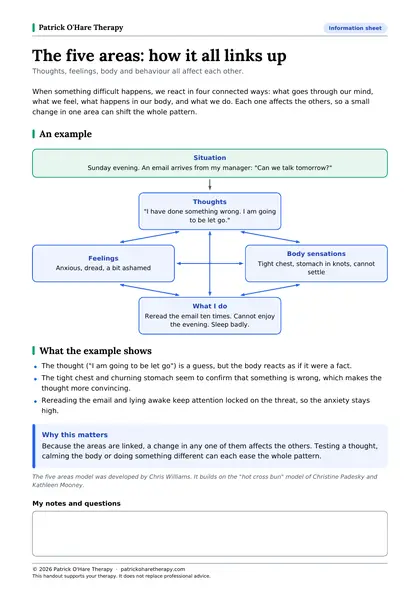 The five areas: how it all links upInformation sheet, 1 pageShows how a situation, your thoughts, feelings, body and actions all feed into each other, with a worked example.
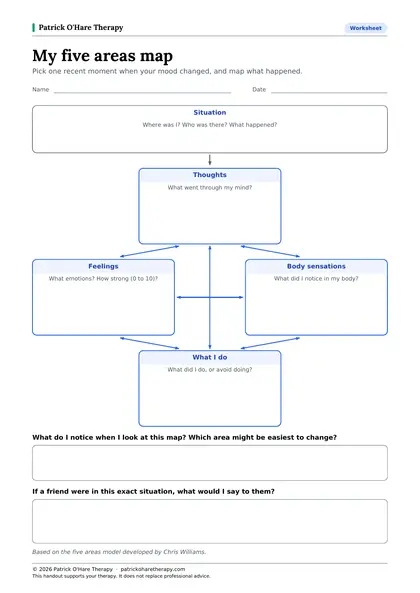 My five areas mapWorksheet, 1 pageA blank map for one recent situation. Fill in what happened, what you thought, how you felt, what your body did and what you did.
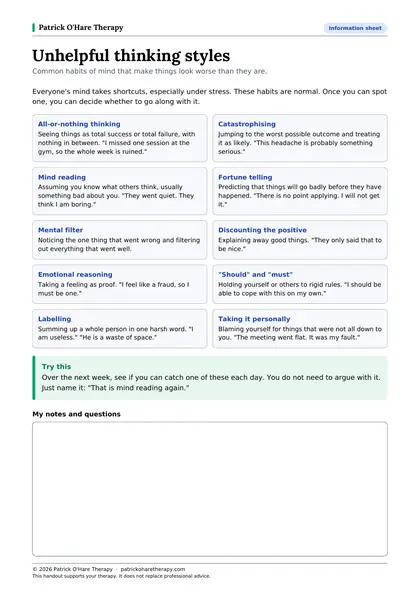 Unhelpful thinking stylesInformation sheet, 1 pageTen common thinking habits with everyday examples. Handy for putting a name on your own thoughts when you fill in a thought record.
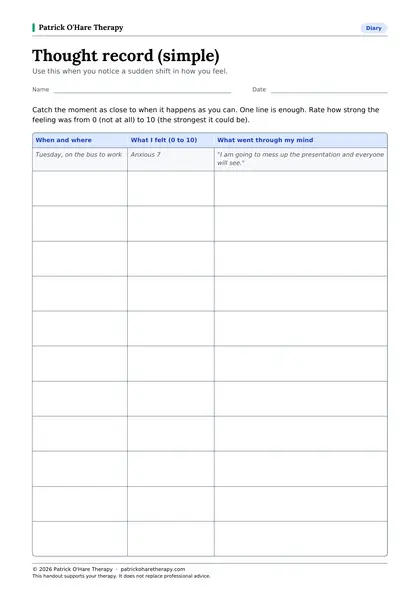 Thought record (simple)Diary, 1 pageA three-column log for catching thoughts: what was happening, how you felt and what went through your mind. No challenging yet, just noticing.
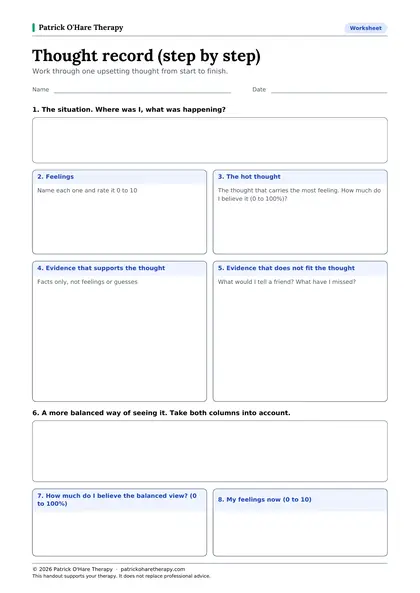 Thought record (step by step)Worksheet, 1 pageA one-page form that takes one upsetting thought from start to finish: the situation, the evidence for and against, and a fairer view at the end.
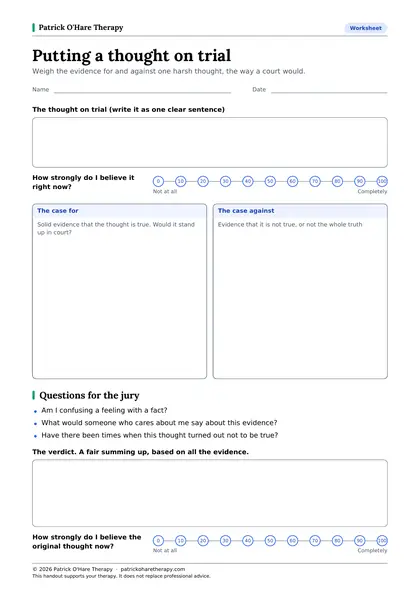 Putting a thought on trialWorksheet, 1 pagePuts a harsh thought in the dock and weighs the evidence the way a court would. A good one if ordinary thought records feel dry, or if you are hard on yourself.
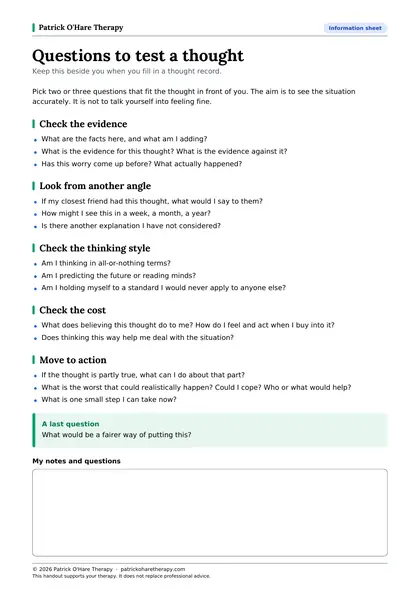 Questions to test a thoughtInformation sheet, 1 pageA list of questions to ask yourself about an upsetting thought. Keep it beside any thought record.
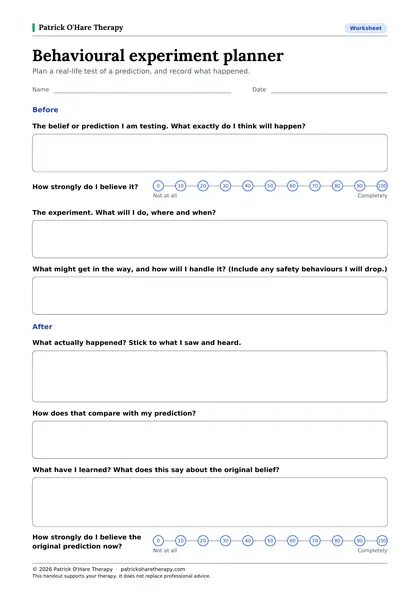 Behavioural experiment plannerWorksheet, 1 pagePlan one real-life test of a worrying prediction: what you expect, what you will do, what happened and what you learned.
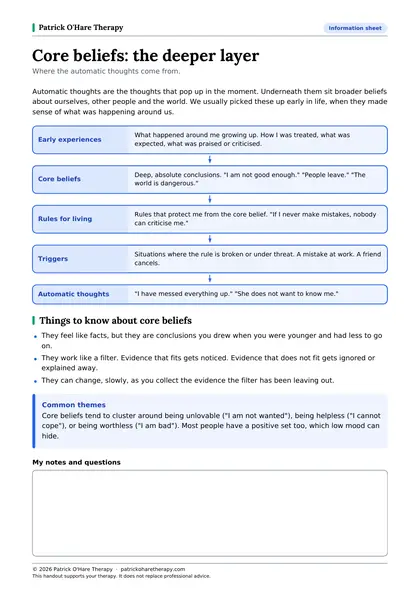 Core beliefs: the deeper layerInformation sheet, 1 pageExplains the deeper beliefs and rules that sit underneath everyday thoughts, with a layered diagram.
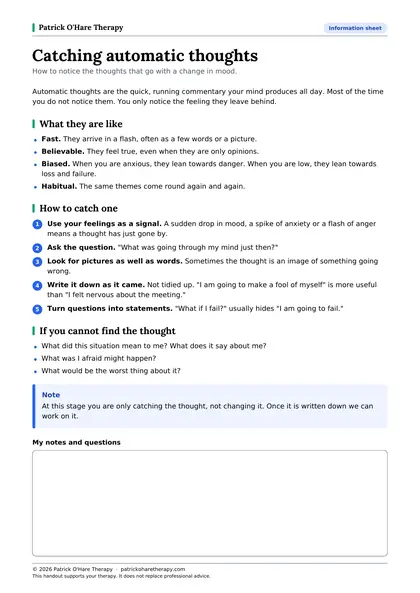 Catching automatic thoughtsInformation sheet, 1 pageWhat automatic thoughts are and how to catch them as they happen, with questions to ask yourself in the moment.
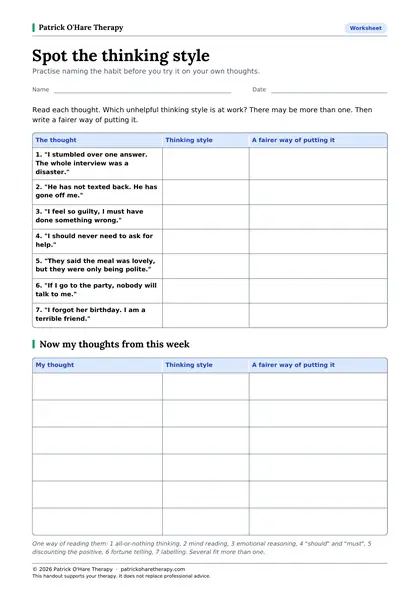 Spot the thinking styleWorksheet, 1 pageA practice sheet of example thoughts. Name the thinking habit in each one and write a fairer version.
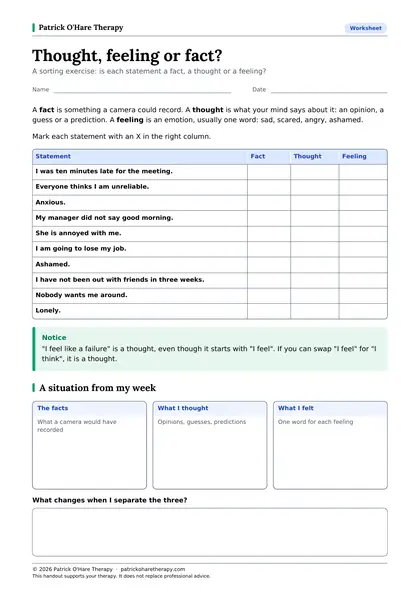 Thought, feeling or fact?Worksheet, 1 pageA sorting exercise for telling facts apart from thoughts and feelings. Worth doing before you start on thought records.
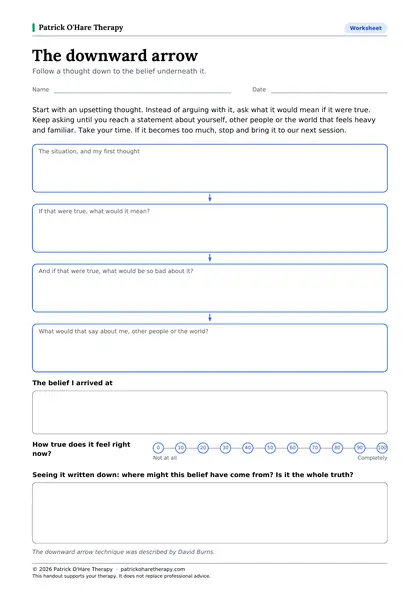 The downward arrowWorksheet, 1 pageA guided way to follow one thought down, step by step, to the belief or rule underneath it.
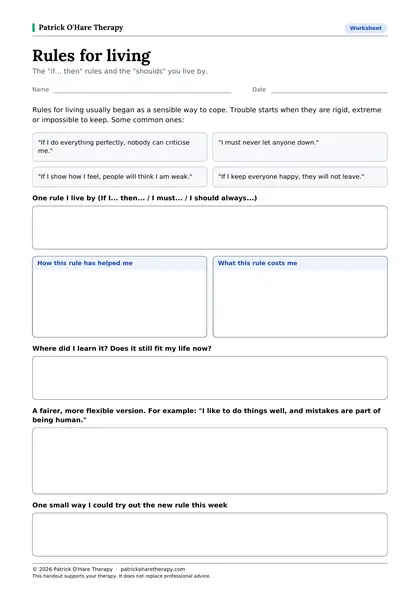 Rules for livingWorksheet, 1 pagePick one rule you live by, weigh what it gives you against what it costs, and write a more flexible version to try out.
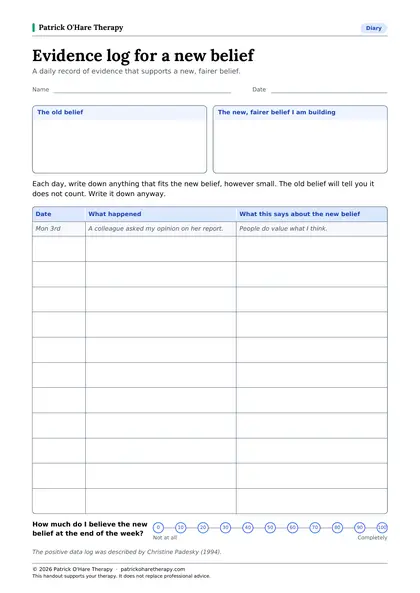 Evidence log for a new beliefDiary, 1 pageA daily log for collecting evidence, however small, for a new and fairer belief about yourself. Keep it going for a few weeks.
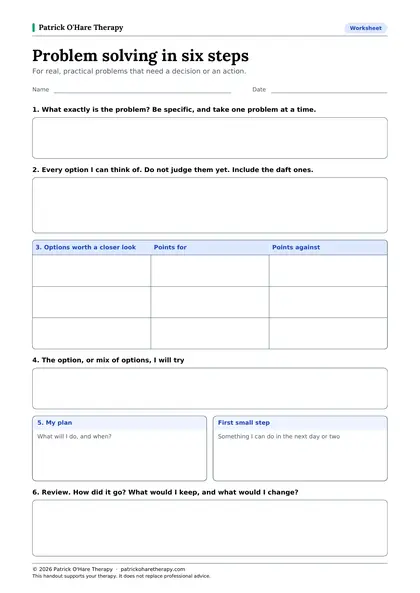 Problem solving in six stepsWorksheet, 1 pageSix steps for a real, practical problem: define it, list the options, weigh them up, choose, plan and review.
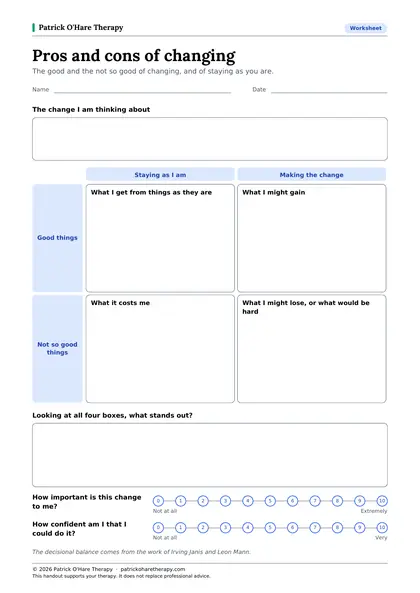 Pros and cons of changingWorksheet, 1 pageA four-box look at a change you are in two minds about: the good and the not so good of changing, and of staying as you are.
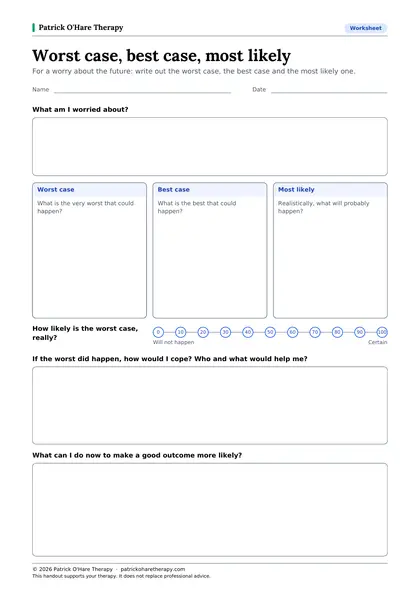 Worst case, best case, most likelyWorksheet, 1 pageFor when your mind jumps to disaster. Spell out the worst case, the best case and the most likely one, then plan how you would cope.
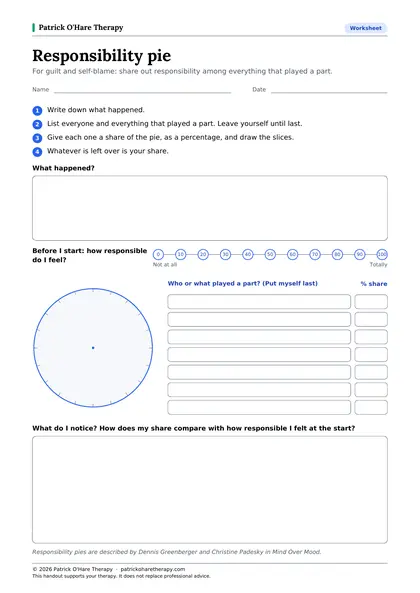 Responsibility pieWorksheet, 1 pageFor guilt and self-blame. List everything that played a part, share out the pie, and see what your own slice really looks like.
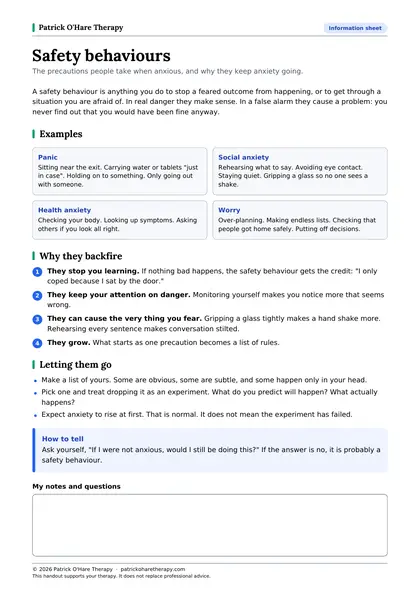 Safety behavioursInformation sheet, 1 pageExplains the precautions we take to feel safer, why they backfire, and how to drop them bit by bit. With examples from panic, social anxiety, health anxiety and worry.
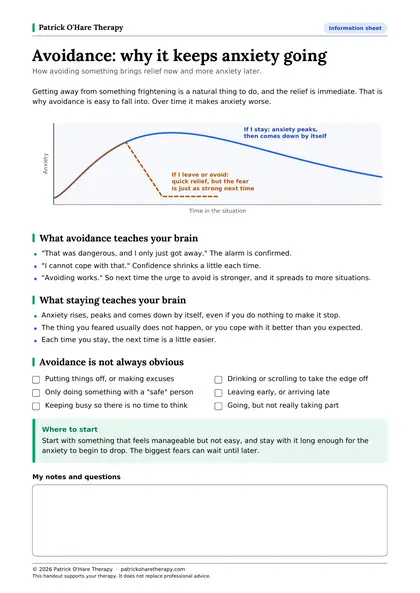 Avoidance: why it keeps anxiety goingInformation sheet, 1 pageA graph showing how escaping brings relief now and more fear later, and what happens when you stay instead.
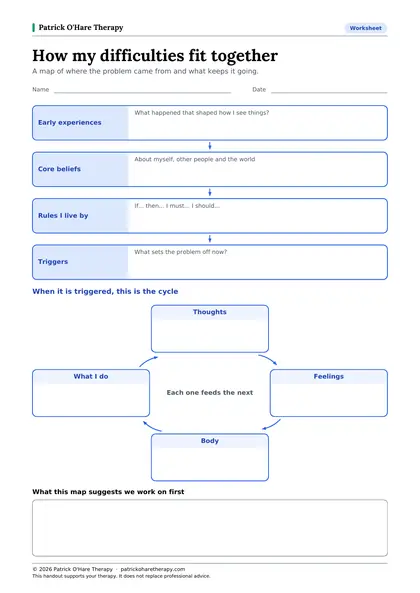 How my difficulties fit togetherWorksheet, 1 pageA map of how your difficulties fit together: early experiences, the beliefs and rules that grew from them, what sets things off now and what keeps them going.
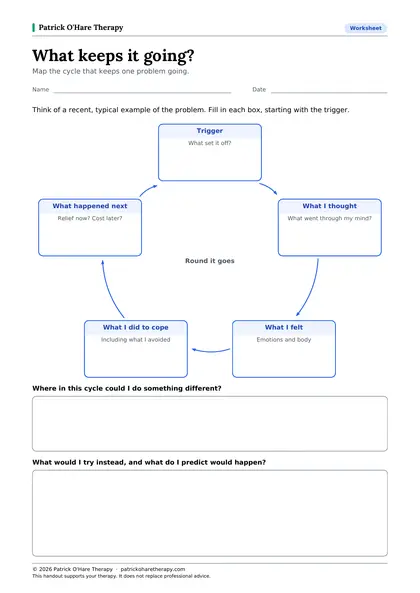 What keeps it going?Worksheet, 1 pageA blank cycle to fill in: the trigger, your thoughts and feelings, what you do, and what happens next. Shows where the loop could be broken.
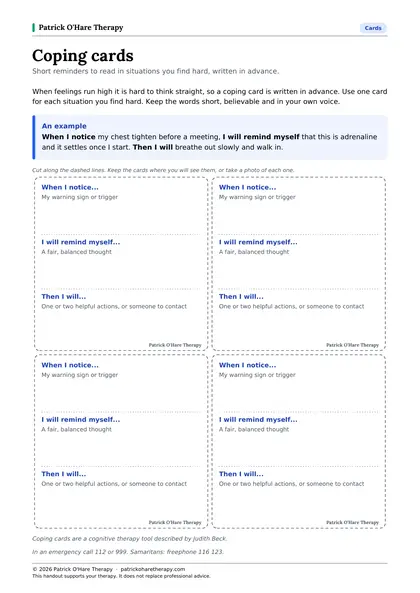 Coping cardsCards, 1 pageFour cut-out cards, one for each situation you find hard: what you notice, what you will remind yourself and what you will do. Write them on a calm day.
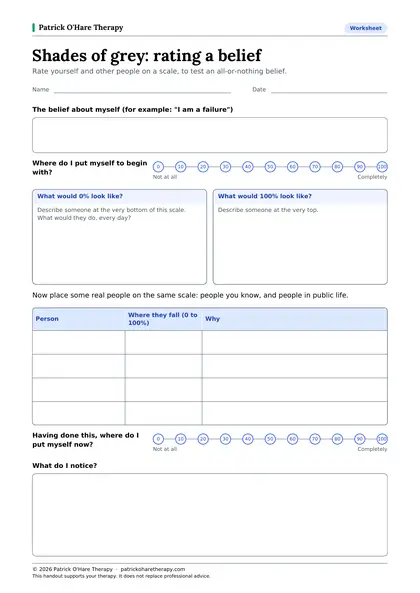 Shades of grey: rating a beliefWorksheet, 1 pageFor black-and-white beliefs about yourself. Define both ends of the scale, then place yourself and other people along it.
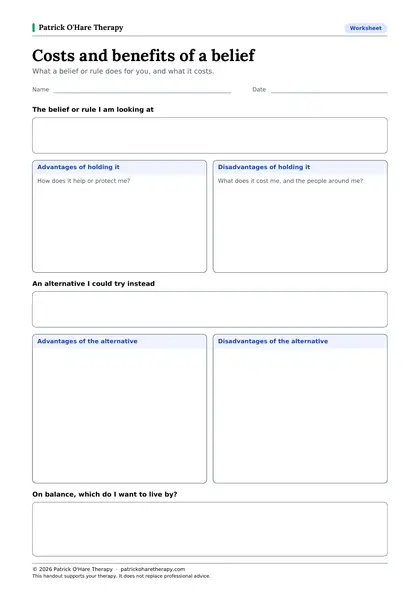 Costs and benefits of a beliefWorksheet, 1 pageWeigh up what holding a belief or rule does for you and what it costs, then do the same for a kinder alternative.
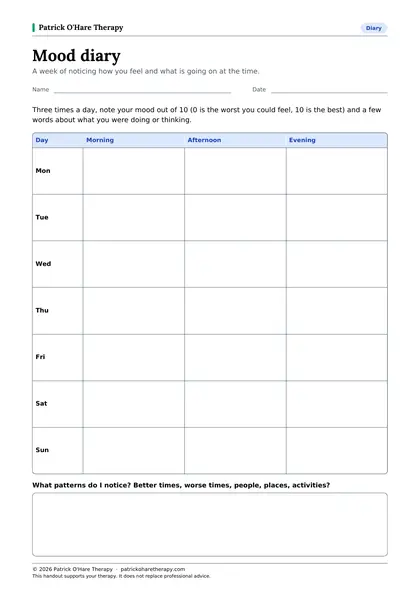 Mood diaryDiary, 1 pageA one-week diary with three check-ins a day. Good for spotting patterns in how you feel and what sets it off.
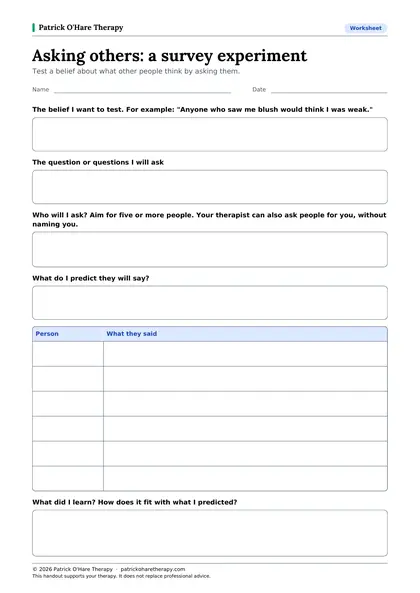 Asking others: a survey experimentWorksheet, 1 pageA planner for asking other people what they really think, to test a belief about how you come across.
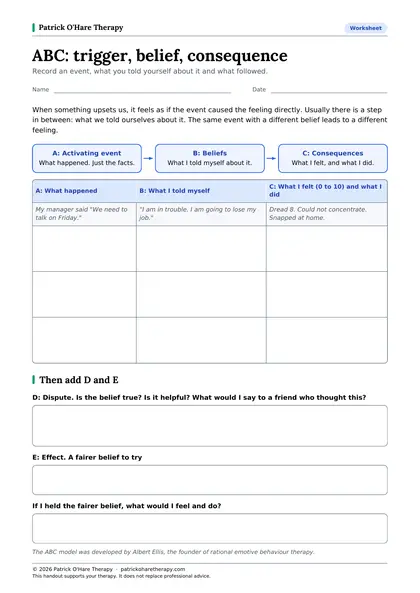 ABC: trigger, belief, consequenceWorksheet, 1 pageThe classic ABC form: what happened, what you told yourself, and what you felt and did, with space to question the belief and try a fairer one. Works well for anger, anxiety and low mood.
Anxiety and worry 32
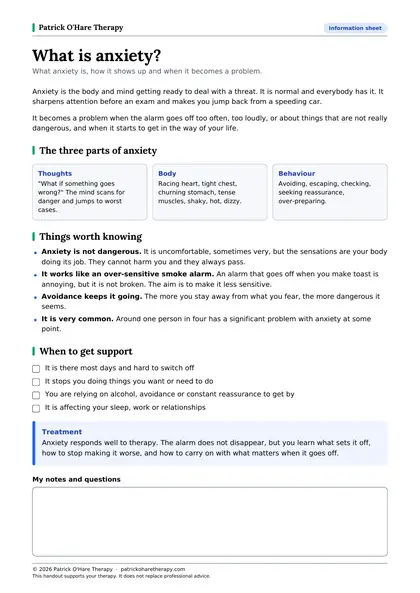 What is anxiety?Information sheet, 1 pageA first read on anxiety: what it is, how it shows up in thoughts, body and behaviour, when it becomes a problem, and why it can get better.
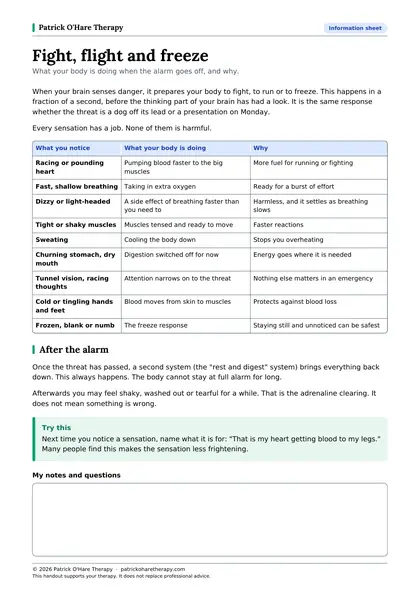 Fight, flight and freezeInformation sheet, 1 pageExplains the body's alarm response and what each sensation is for, from a racing heart to shaky legs. None of them is harmful.
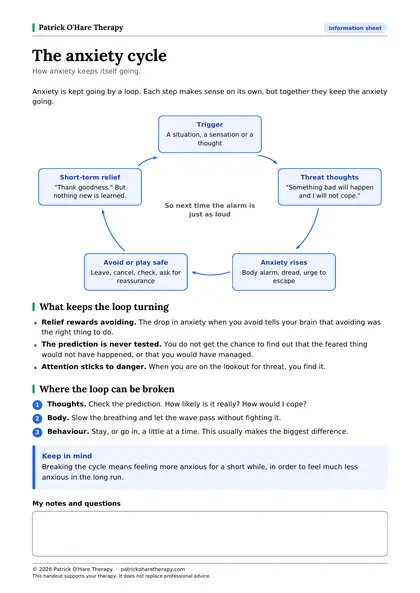 The anxiety cycleInformation sheet, 1 pageA diagram of how anxiety keeps going: trigger, threat thoughts, body sensations, avoidance and relief, with a short explanation of each link.
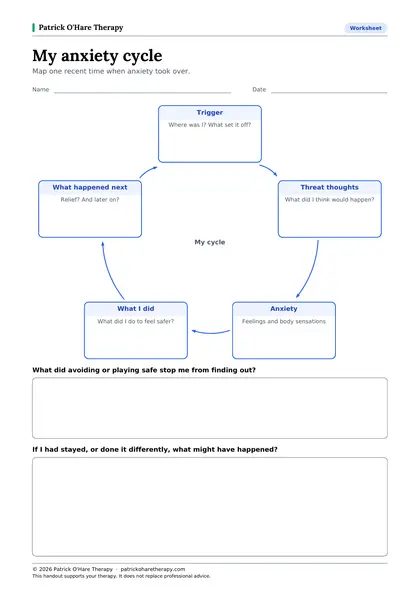 My anxiety cycleWorksheet, 1 pageA fill-in version of the anxiety cycle for an example of your own, with prompts on where you could break the loop.
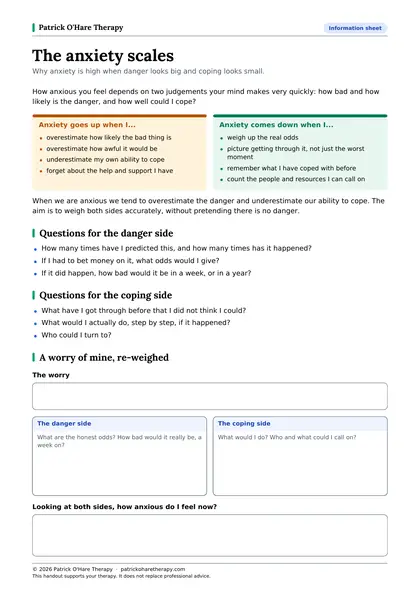 The anxiety scalesInformation sheet, 1 pageShows anxiety as a set of scales: how big the danger looks against how well you think you would cope. With questions to rebalance each side.
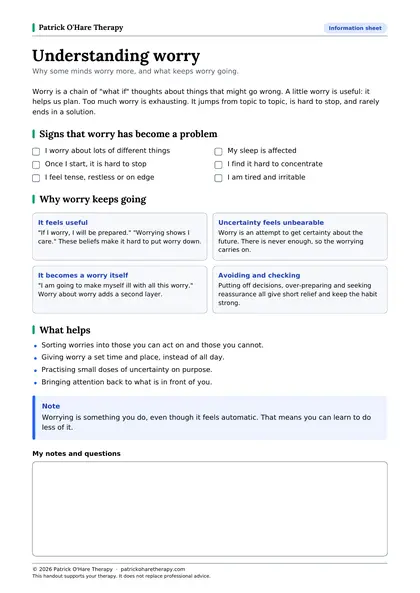 Understanding worryInformation sheet, 1 pageWhat worry is, why it can feel useful, and what keeps it going. For anyone who worries a lot of the time.
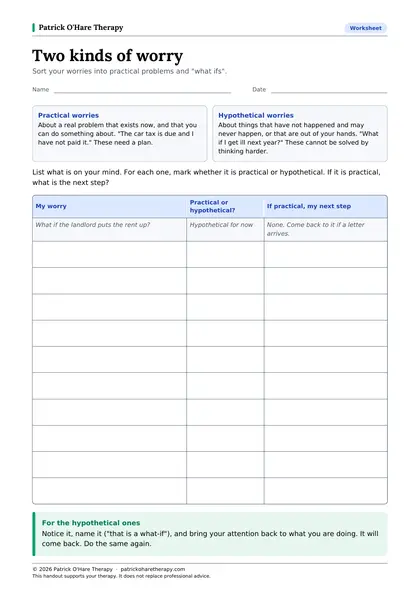 Two kinds of worryWorksheet, 1 pageSome worries are practical problems and some are "what ifs". Learn to tell them apart, then sort your own list.
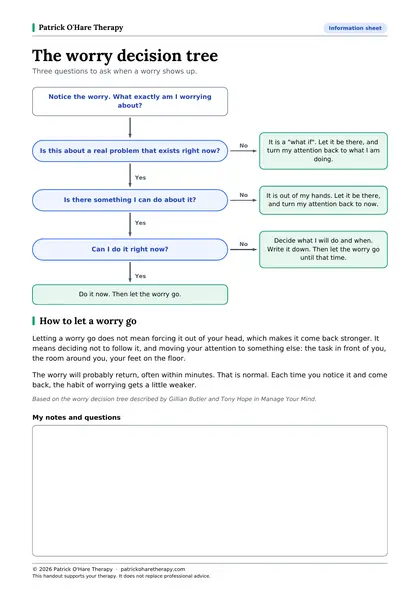 The worry decision treeInformation sheet, 1 pageThree questions for when a worry shows up: is it real, can I do something, can I do it now? Small enough for the fridge door or your phone.
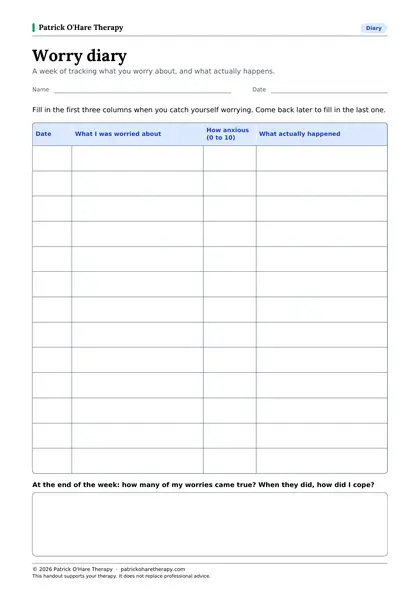 Worry diaryDiary, 1 pageWrite down what you worry about, what you predict and, later, what really happened. Over a week it shows how often the predictions come true.
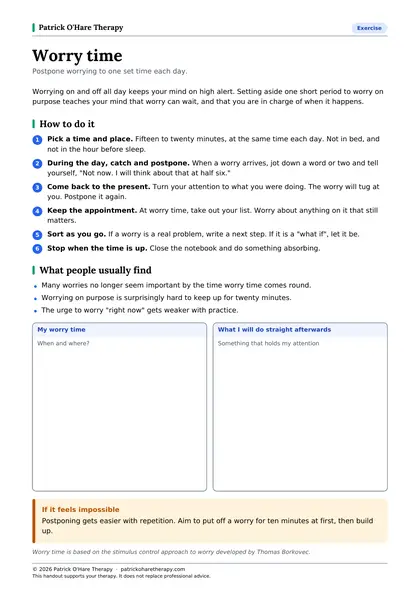 Worry timeExercise, 1 pageStep-by-step instructions for putting worries off until a set time each day, so they stop running all day long.
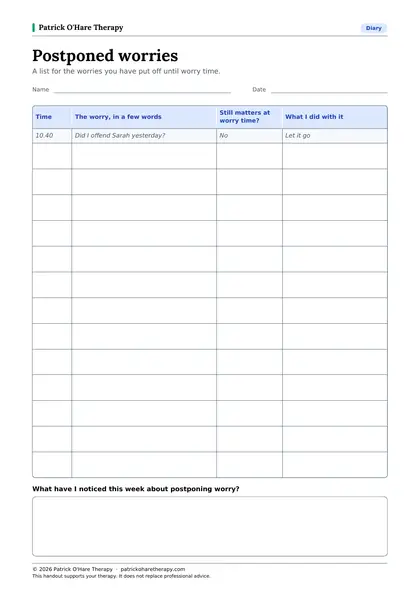 Postponed worriesDiary, 1 pageThe list that goes with worry time. Park worries here during the day and look at them at the time you set.
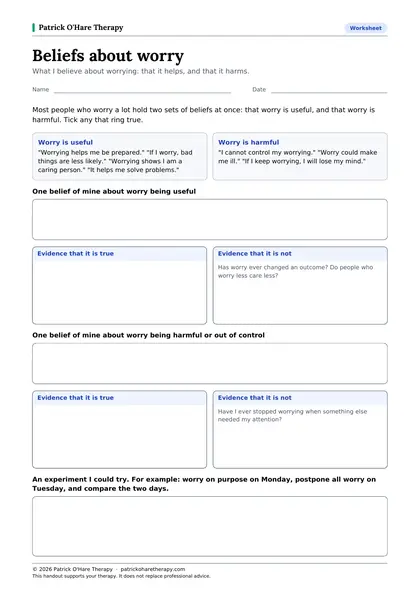 Beliefs about worryWorksheet, 1 pageLooks at what you believe about worry itself (it helps me cope, I cannot control it, it will harm me) and sets up ways to test those beliefs.
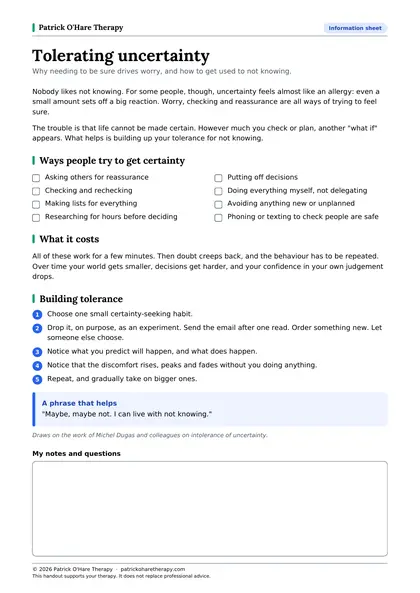 Tolerating uncertaintyInformation sheet, 1 pageExplains how needing to be certain drives worry and checking, lists the common ways people chase certainty, and suggests small steps towards living without it.
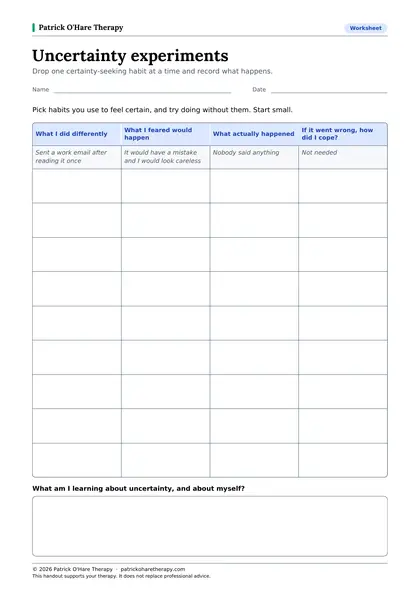 Uncertainty experimentsWorksheet, 1 pageA planner and record for small experiments in not knowing: drop one certainty-seeking habit and see what happens.
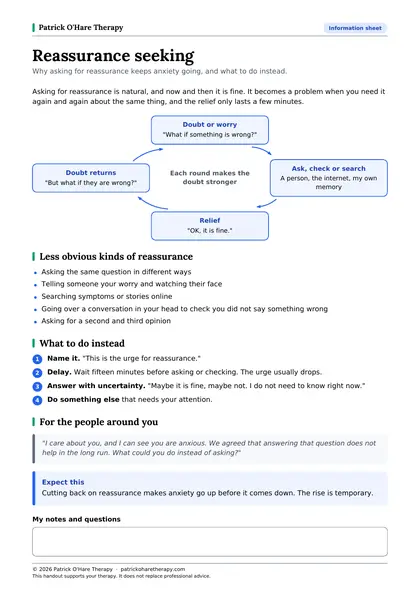 Reassurance seekingInformation sheet, 1 pageExplains why reassurance stops working, including less obvious forms like Googling, and what to do instead. Useful for the people around you as well.
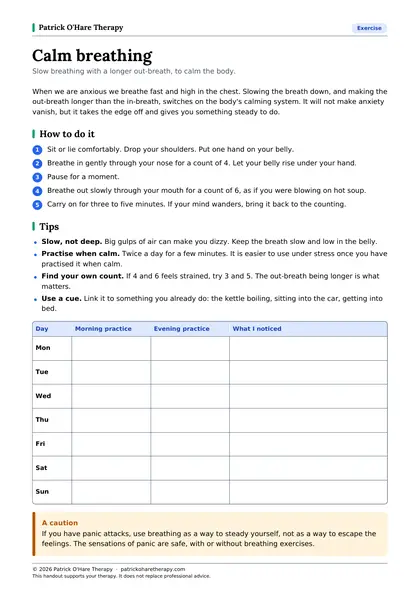 Calm breathingExercise, 1 pageHow to breathe slowly from the belly with a longer out-breath, plus a record for daily practice.
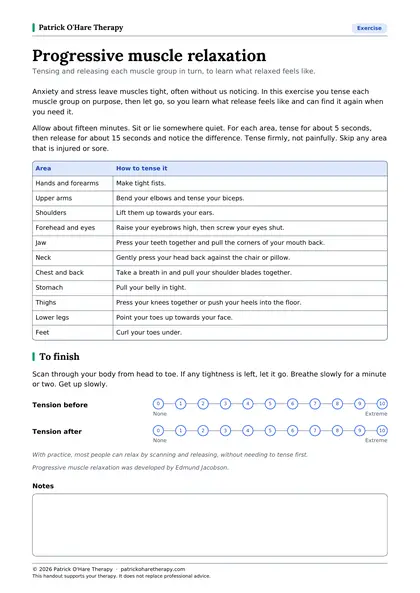 Progressive muscle relaxationExercise, 1 pageA full script for tensing and releasing each muscle group in turn, with a practice record.
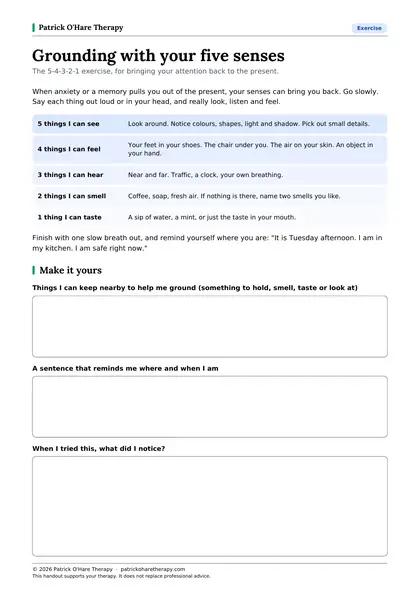 Grounding with your five sensesExercise, 1 pageThe 5-4-3-2-1 exercise on one page: five things you see, four you feel, three you hear, two you smell, one you taste. For anxiety, panic, and feeling overwhelmed or spaced out.
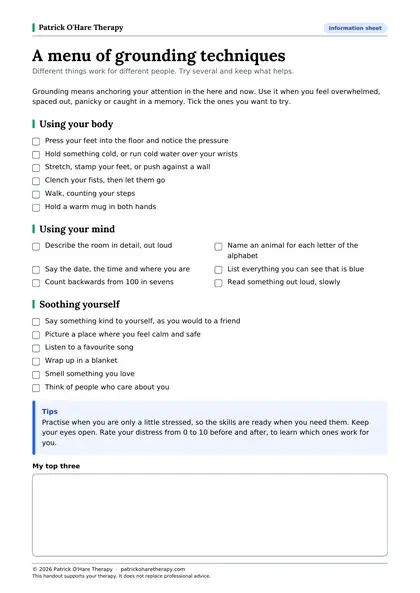 A menu of grounding techniquesInformation sheet, 1 pageA menu of physical, mental and soothing ways to ground yourself. Mark the ones that work for you.
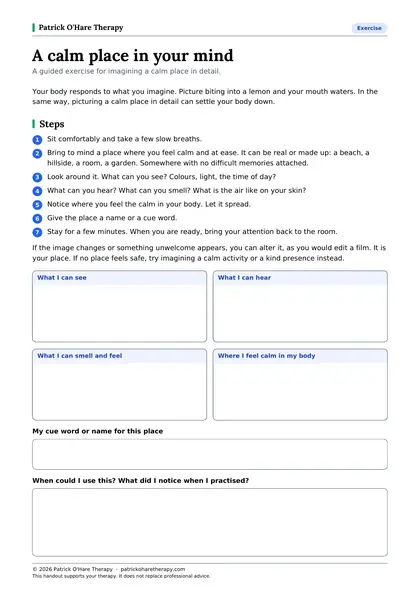 A calm place in your mindExercise, 1 pageA guided script for building a calm place in your mind, with prompts to capture the details. Good for settling yourself, and before sleep.
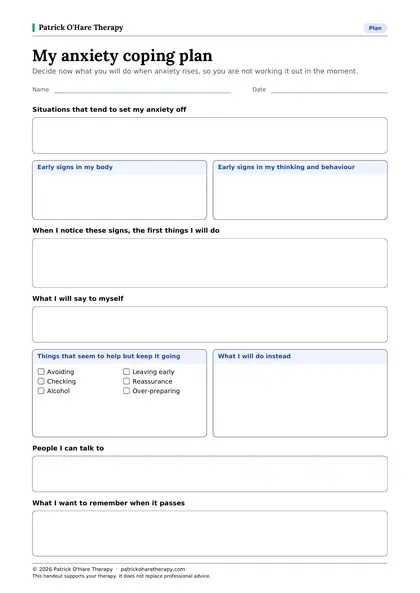 My anxiety coping planPlan, 1 pageA one-page plan in your own words: your triggers, early signs, what helps, the habits to drop and the people who can support you.
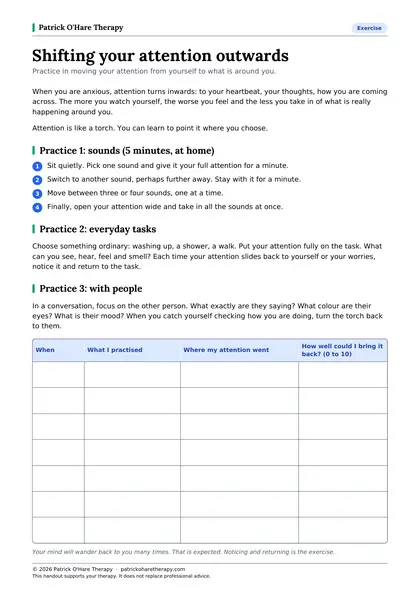 Shifting your attention outwardsExercise, 1 pageExplains how anxiety turns attention inwards, with graded practice in moving it back out to sights, sounds and the task in hand.
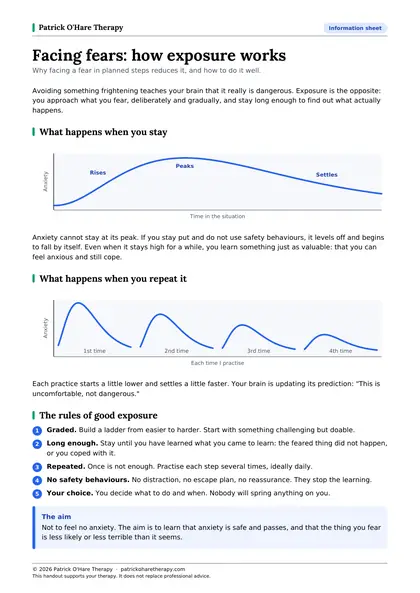 Facing fears: how exposure worksInformation sheet, 1 pageWhy facing a fear in planned steps works, shown in two graphs, and the rules for doing it well.
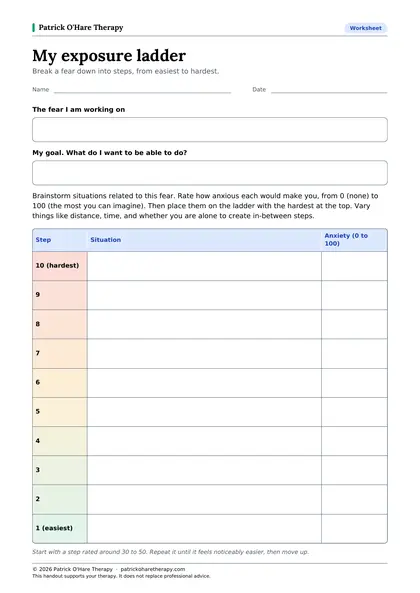 My exposure ladderWorksheet, 1 pageA ten-step ladder for one fear, from easiest to hardest, with a rating of how anxious you expect each step to be.
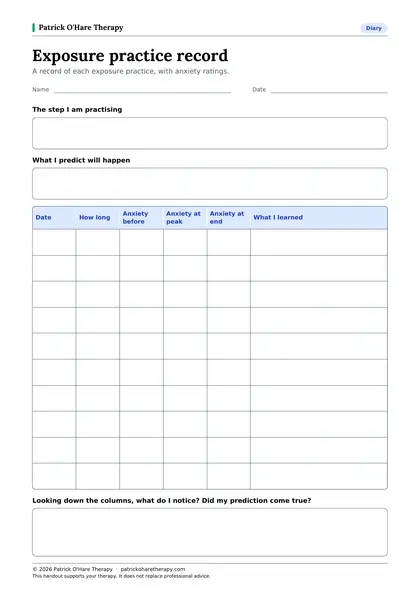 Exposure practice recordDiary, 1 pageA log for repeated practice at facing a fear, with anxiety ratings before, at the peak and after, and a note of what you learned.
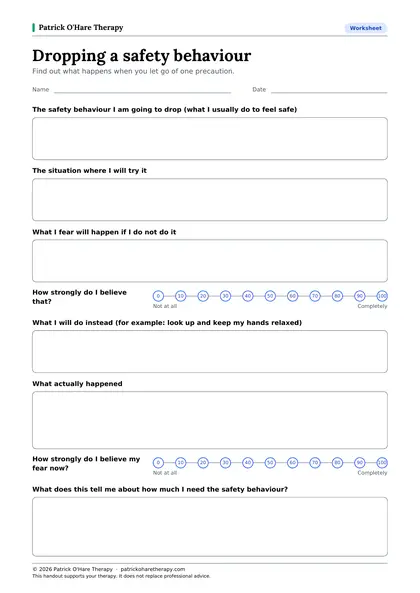 Dropping a safety behaviourWorksheet, 1 pageAn experiment sheet for letting go of one precaution: what you predict will happen, and what really did.
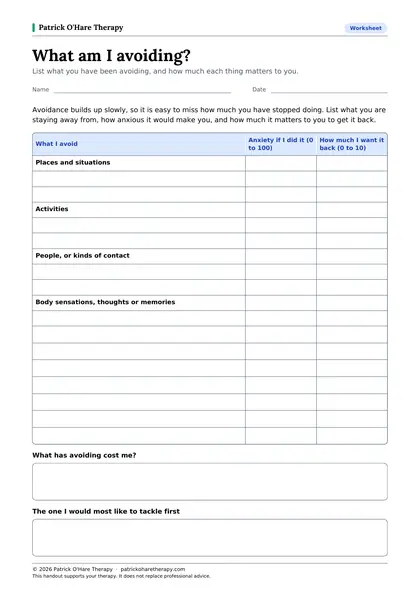 What am I avoiding?Worksheet, 1 pageA stocktake of the situations, activities, sensations and thoughts you have been avoiding, and how much each one matters to you.
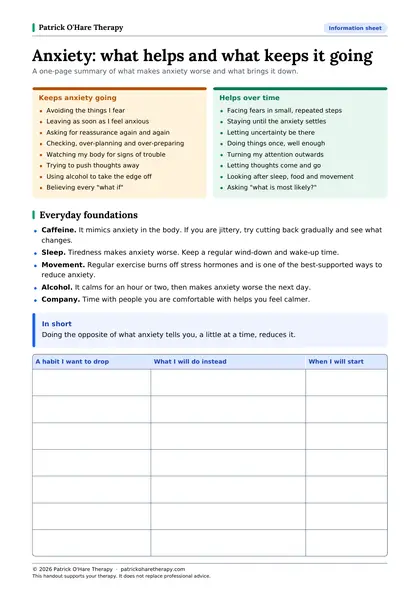 Anxiety: what helps and what keeps it goingInformation sheet, 1 pageOne page on the habits that keep anxiety going and the responses that bring it down over time. A good reminder to keep.
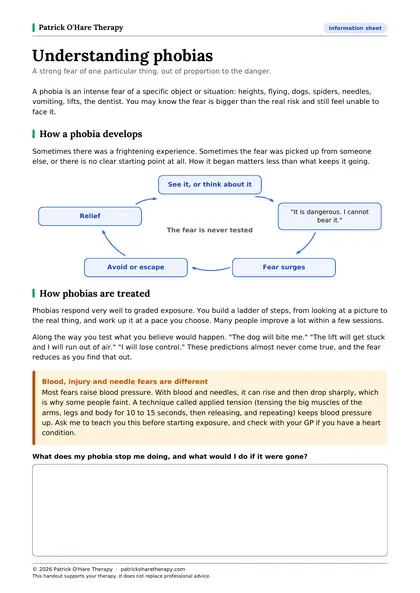 Understanding phobiasInformation sheet, 1 pageWhat phobias are, what keeps them going and how facing the fear in steps treats them, with a note on blood and needle phobia.
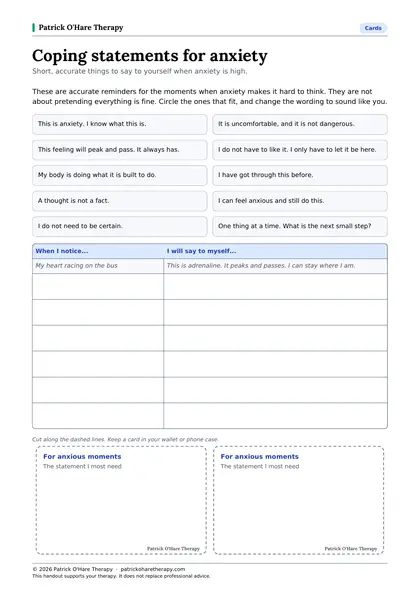 Coping statements for anxietyCards, 1 pageRealistic things to say to yourself when anxiety is high, with space to plan what you will say and two cards for your wallet. Accurate reminders, not empty reassurance.
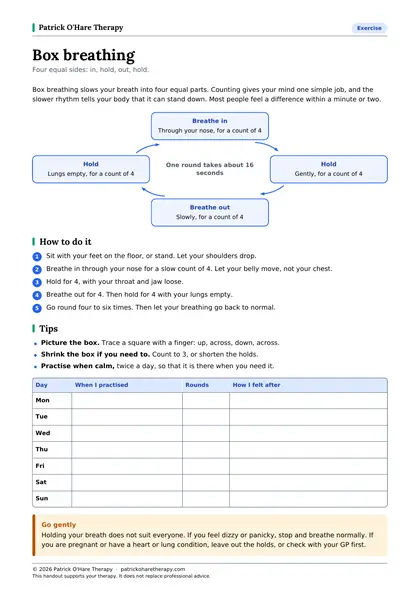 Box breathingExercise, 1 pageA four-count breathing pattern with short holds. Easy to remember, and you can use it anywhere without anyone noticing.
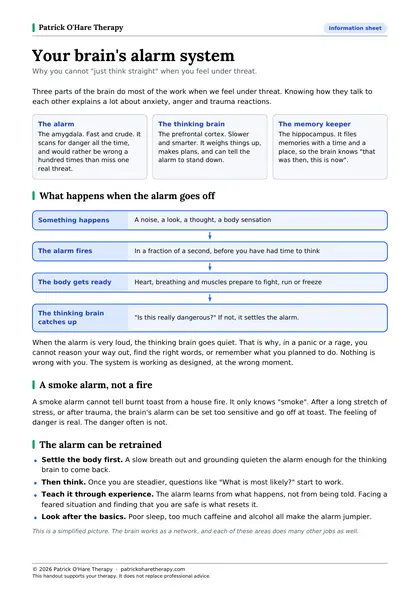 Your brain's alarm systemInformation sheet, 1 pageA plain-language picture of the brain under threat: the alarm, the thinking brain and the memory keeper. Explains why you cannot reason clearly when the alarm is loud, and how it can be retrained.
Panic and agoraphobia 15
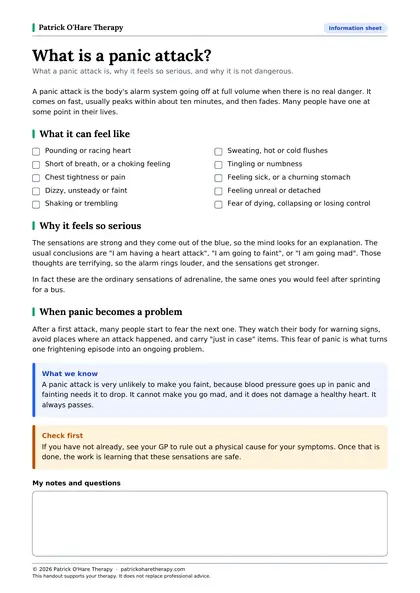 What is a panic attack?Information sheet, 1 pageWhat happens in a panic attack, why it feels so serious, and how the fear of the next one keeps panic going.
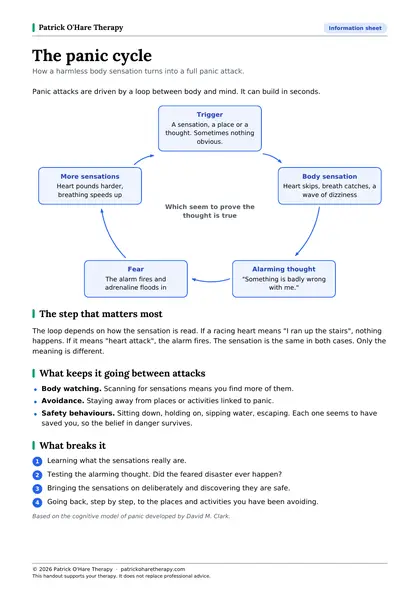 The panic cycleInformation sheet, 1 pageA diagram of how a harmless body sensation gets read as danger, which brings fear and more sensations, and what breaks the loop.
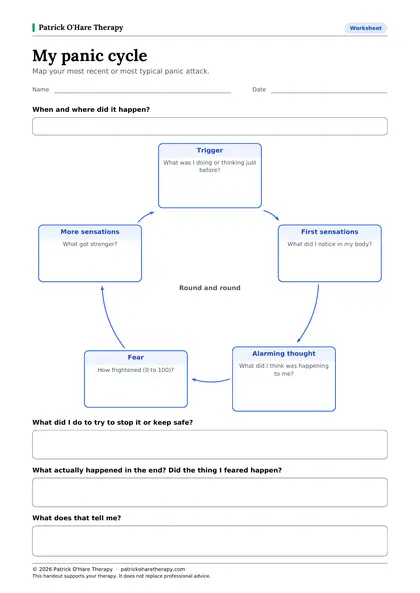 My panic cycleWorksheet, 1 pageA fill-in panic cycle for one attack of your own: the sensations, the frightening thought, what you did to stay safe, and what you learned.
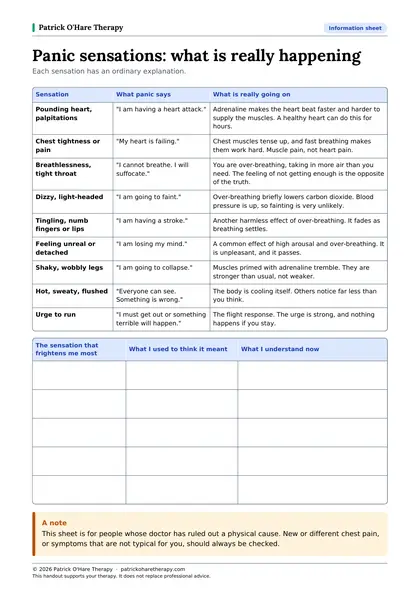 Panic sensations: what is really happeningInformation sheet, 1 pageSets each common panic sensation beside what people fear it means and what is really going on in the body.
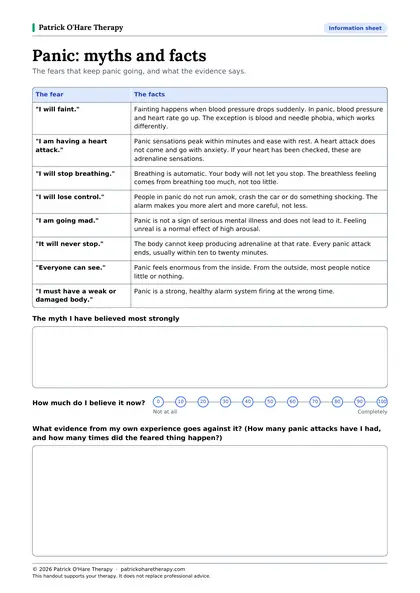 Panic: myths and factsInformation sheet, 1 pageA myth-and-fact table on fainting, heart attacks, losing control, going mad and panic lasting forever.
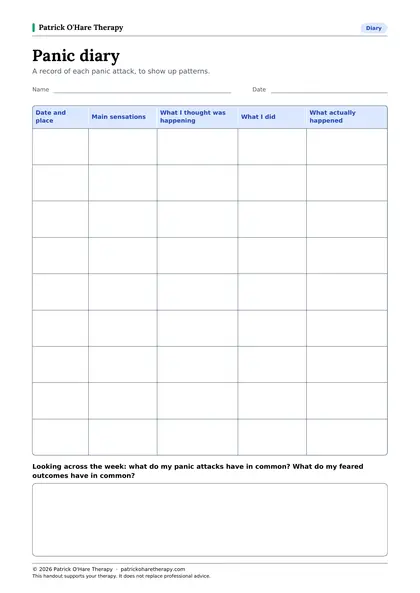 Panic diaryDiary, 1 pageA log for each panic attack: where you were, what you felt, the worst thought, what you did and what really happened.
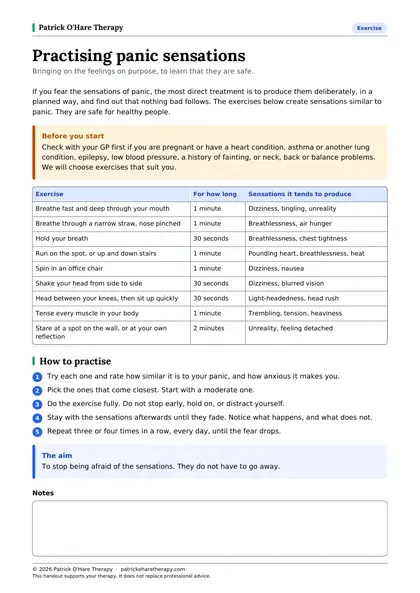 Practising panic sensationsExercise, 1 pageA menu of safe exercises that bring on panic-like sensations on purpose, with timings, so you can learn that they are not dangerous. Start these with your therapist.
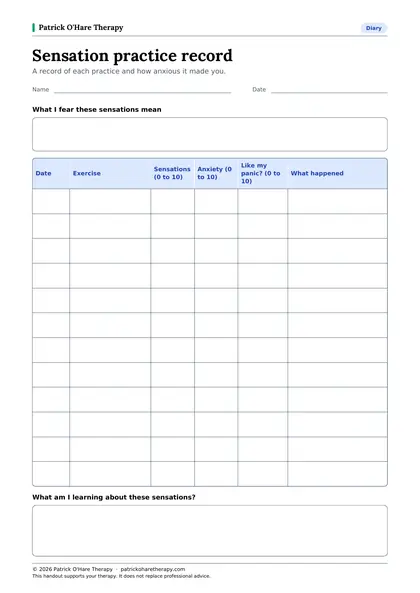 Sensation practice recordDiary, 1 pageA record for sensation practice: how strong the sensations were, how anxious you felt, and how like panic it was.
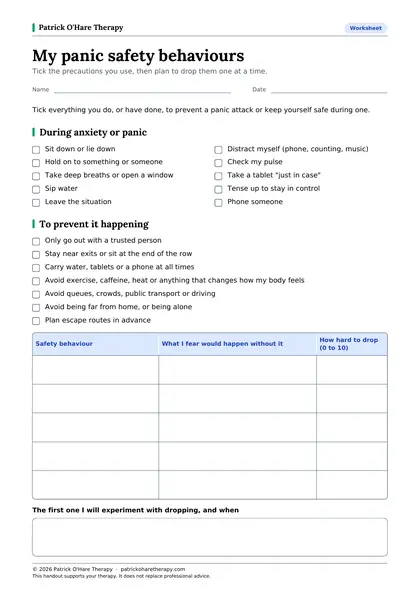 My panic safety behavioursWorksheet, 1 pageA checklist of the precautions and avoidance that go with panic, and a plan for dropping them one at a time.
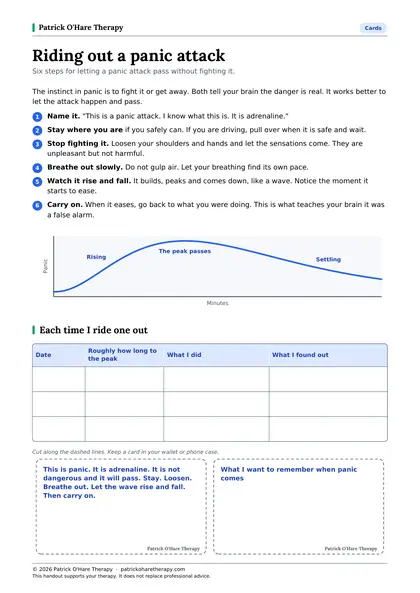 Riding out a panic attackCards, 1 pageA few steps for the moment panic arrives, based on letting it pass instead of fighting it, with a short log and a card for your wallet.
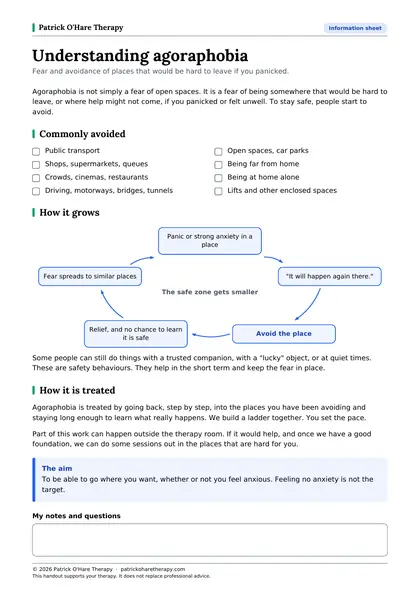 Understanding agoraphobiaInformation sheet, 1 pageExplains agoraphobia as fear and avoidance of places where escape or help might be hard, and how practice in real-world steps brings life back.
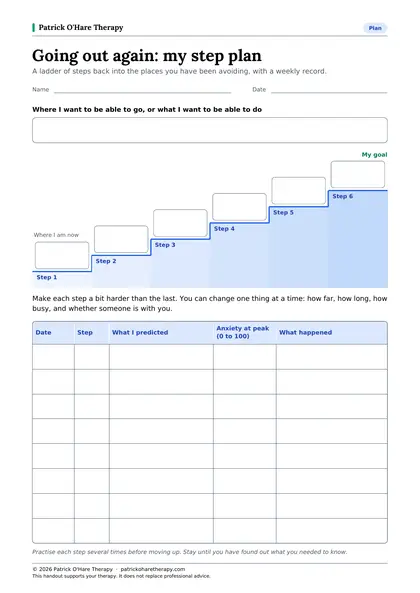 Going out again: my step planPlan, 1 pageA staircase of steps from where you are now to where you want to be, with a weekly practice record.
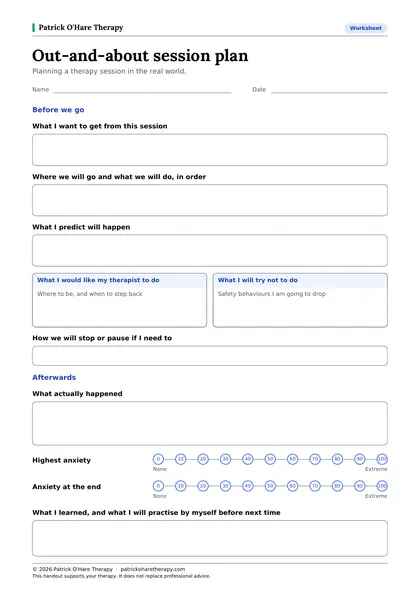 Out-and-about session planWorksheet, 1 pageA plan and review for a therapy session out in the real world: the goal, the steps, who does what, and what you learned.
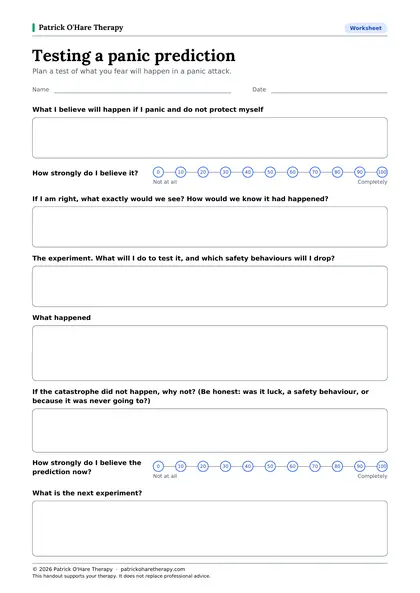 Testing a panic predictionWorksheet, 1 pageAn experiment sheet for panic: the catastrophe you fear, how you will test it, and what you found.
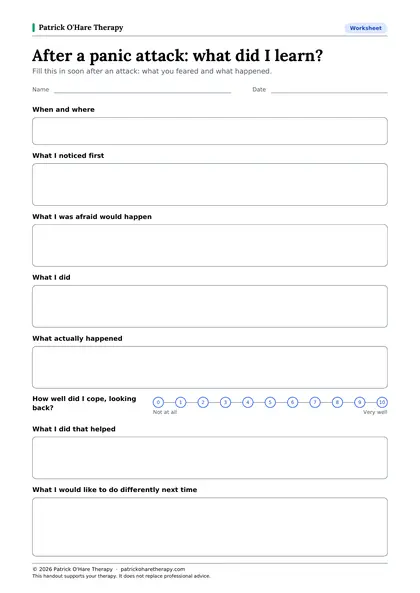 After a panic attack: what did I learn?Worksheet, 1 pageA short sheet to fill in after a panic attack, comparing what you feared with what happened.
Social anxiety 12
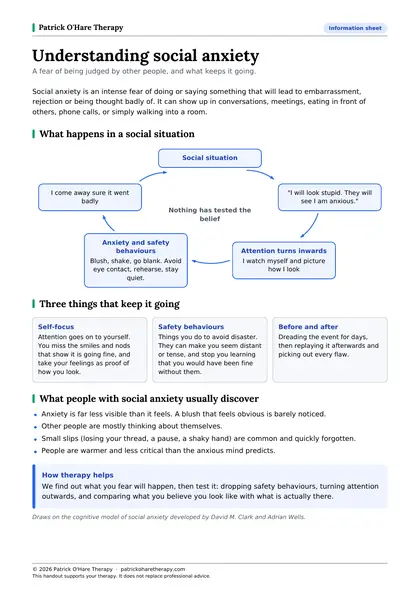 Understanding social anxietyInformation sheet, 1 pageHow social anxiety works: attention turning inwards, a harsh picture of how you come across, the things you do to get by, and going over it all afterwards.
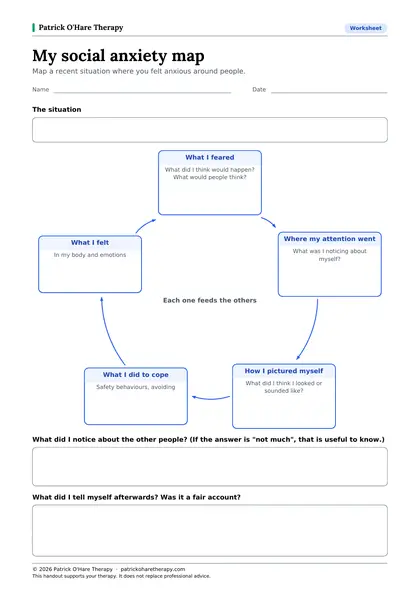 My social anxiety mapWorksheet, 1 pageA fill-in map of one social situation: your thoughts, the picture you had of yourself, what you did to cope and how you felt.
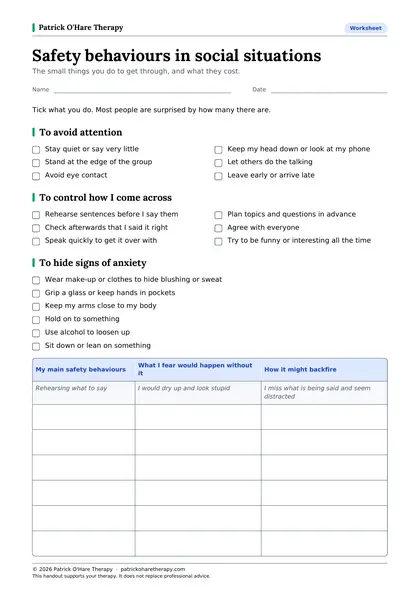 Safety behaviours in social situationsWorksheet, 1 pageA checklist of the small things people do to get through social situations, with space to note what each one is meant to prevent and what it costs.
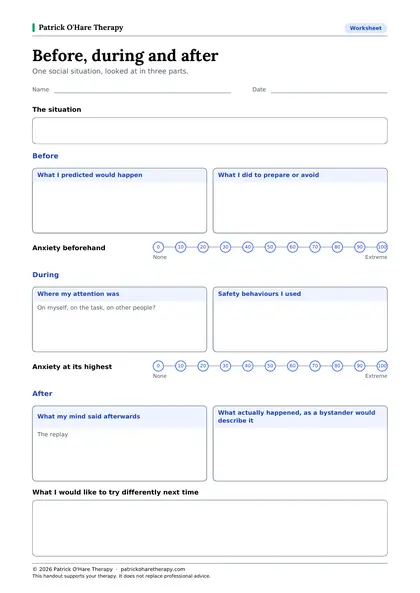 Before, during and afterWorksheet, 1 pageA record of one social event in three parts: what you expected beforehand, what happened during it, and how you went over it afterwards.
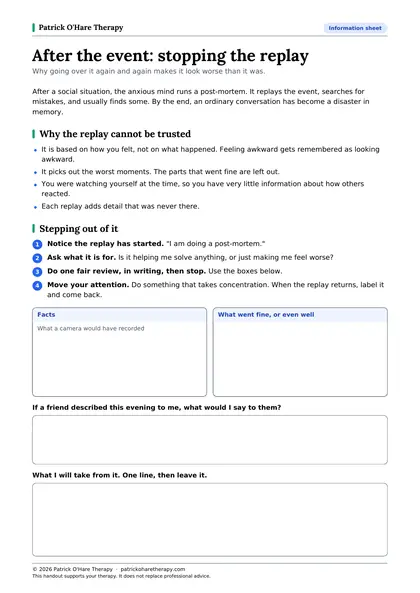 After the event: stopping the replayInformation sheet, 1 pageWhy replaying a social event makes it look worse than it was, a short routine for stepping out of the replay, and a fairer way to review.
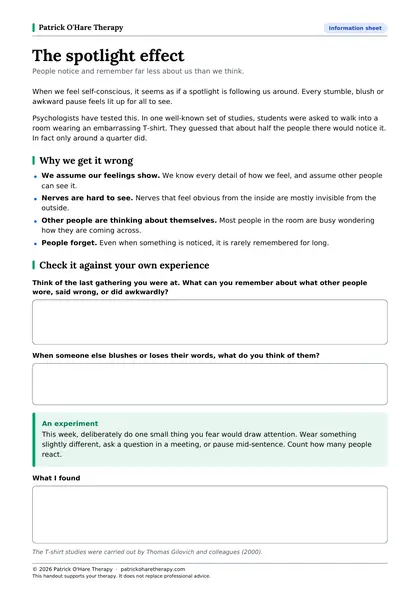 The spotlight effectInformation sheet, 1 pageA short explainer on how much we overestimate what other people notice and remember about us, with an experiment to try.
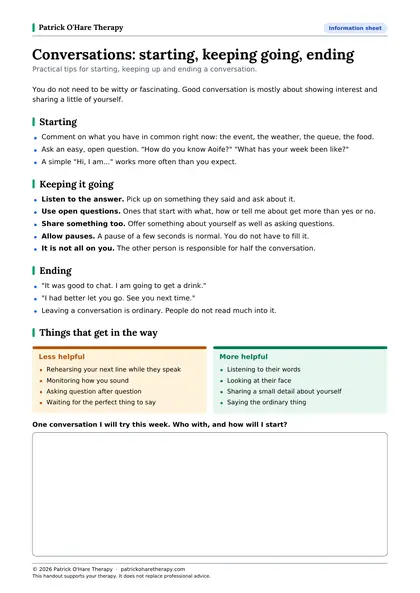 Conversations: starting, keeping going, endingInformation sheet, 1 pagePractical tips for starting, keeping up and ending conversations. Things to try out, not rules to follow anxiously.
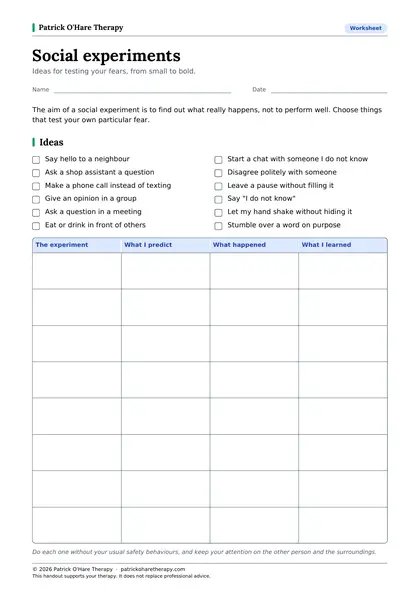 Social experimentsWorksheet, 1 pageA menu of social experiments from small to bold, including being imperfect on purpose, with a planning table.
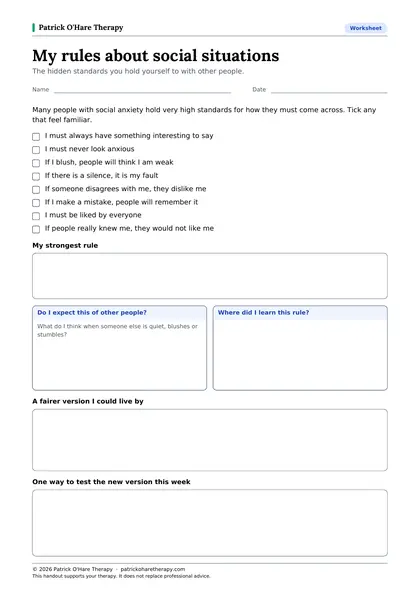 My rules about social situationsWorksheet, 1 pageUncover the high standards you hold yourself to with other people, compare them with what you expect of others, and draft kinder ones.
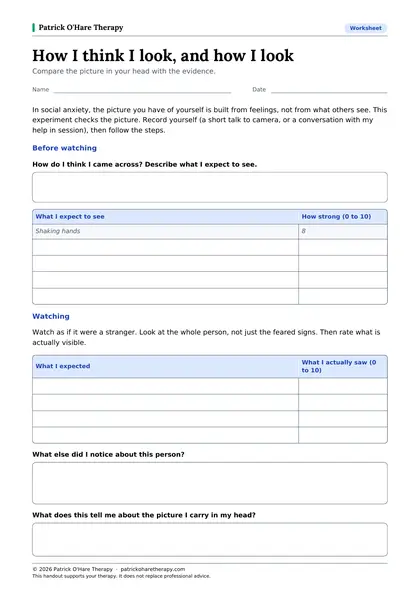 How I think I look, and how I lookWorksheet, 1 pageAn experiment with a video or audio recording: predict how you will come across, then rate the recording as a neutral observer would.
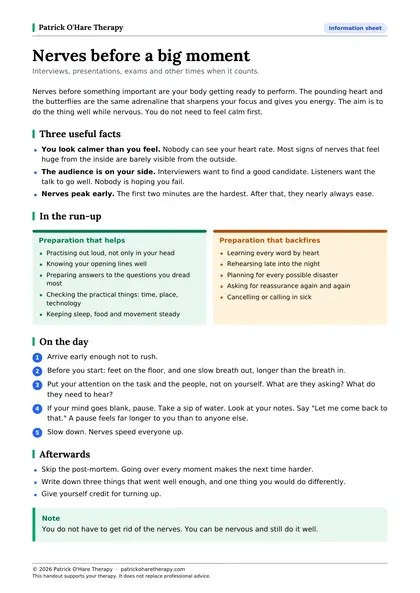 Nerves before a big momentInformation sheet, 1 pageExplains nerves before interviews, presentations, exams and auditions: what helps in the run-up, on the day and afterwards, and which kinds of preparation backfire.
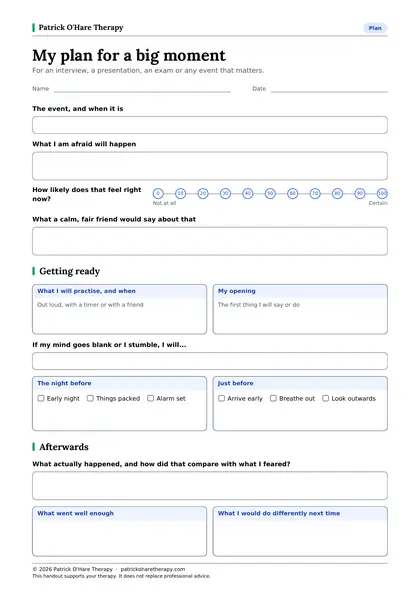 My plan for a big momentPlan, 1 pageA one-page plan for one event: what you fear, how you will prepare, what you will do if you wobble, and a review afterwards of what really happened.
Health anxiety 8
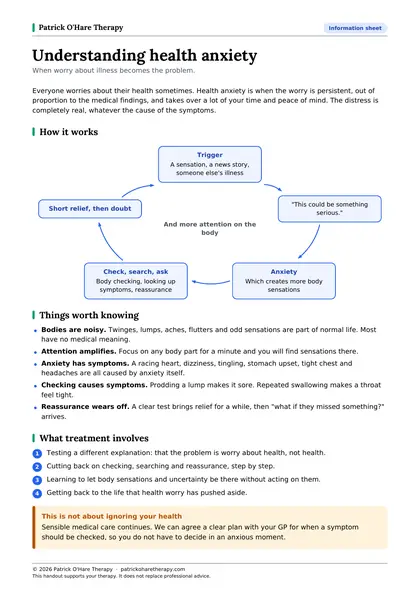 Understanding health anxietyInformation sheet, 1 pageHow health anxiety works: normal body sensations, alarming explanations, checking and reassurance, and how the cycle is treated.
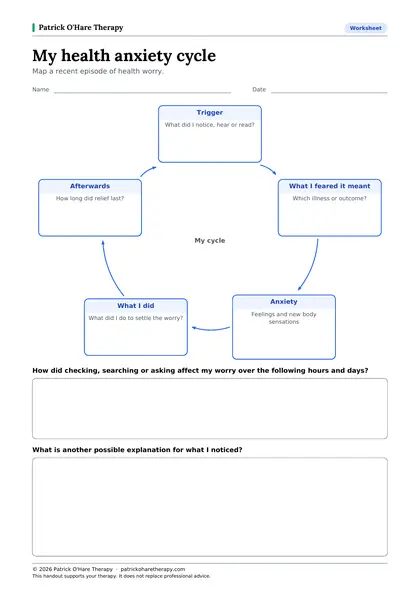 My health anxiety cycleWorksheet, 1 pageA fill-in cycle for one episode of health worry: the trigger, the illness you feared, the checking and reassurance, and the after-effects.
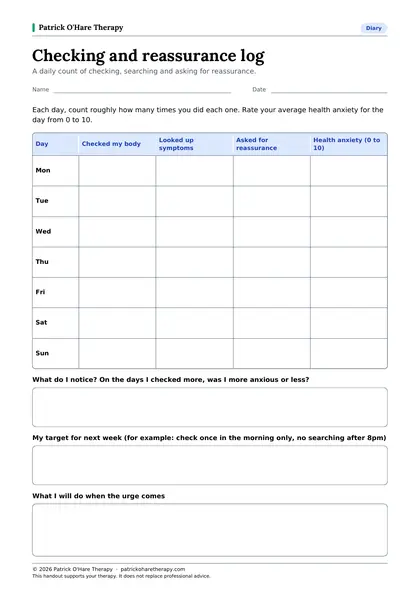 Checking and reassurance logDiary, 1 pageA daily tally of body checking, symptom searching and asking for reassurance, with anxiety ratings. Count it first, then cut it down.
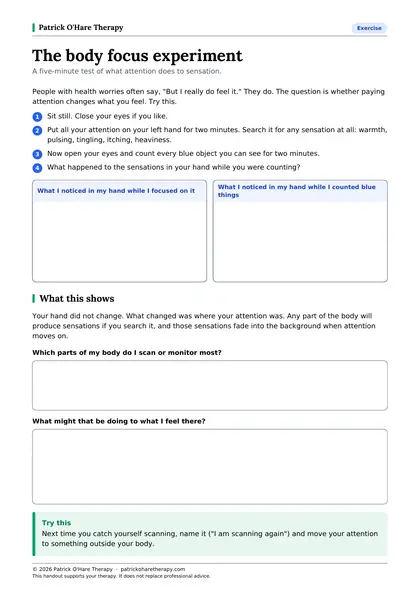 The body focus experimentExercise, 1 pageA five-minute experiment that shows how paying attention to one part of your body produces sensations there.
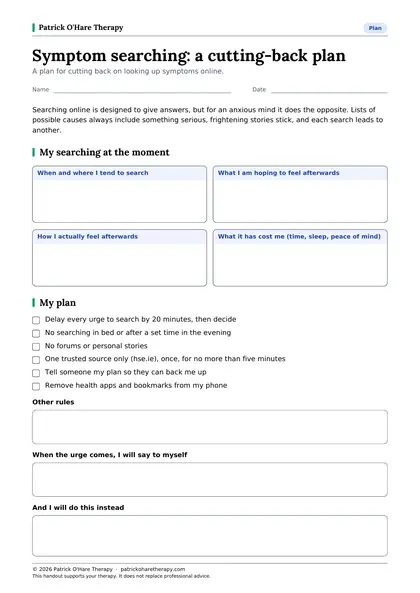 Symptom searching: a cutting-back planPlan, 1 pageA plan for cutting back on looking up symptoms online, with rules, ways to delay, and alternatives you choose yourself.
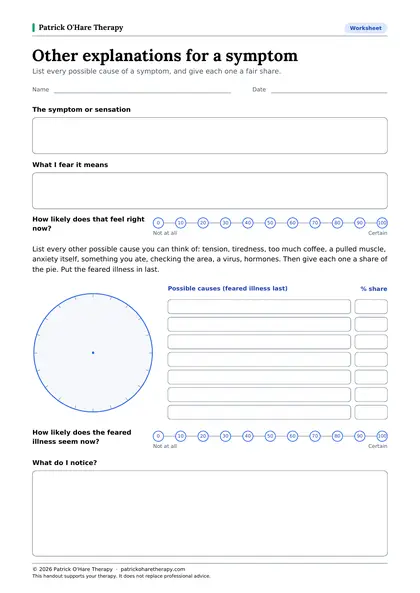 Other explanations for a symptomWorksheet, 1 pageA pie chart exercise: list every possible explanation for a symptom, including the ordinary ones, and give each a fair share.
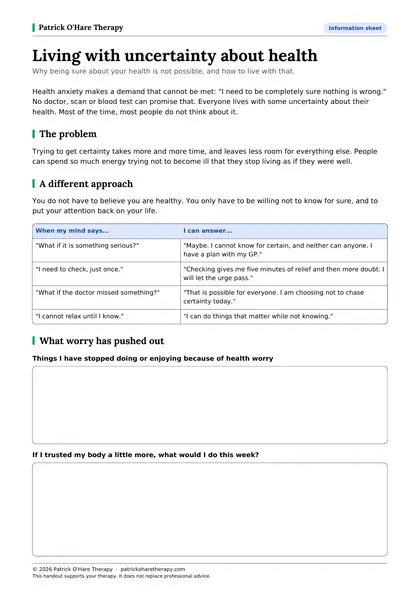 Living with uncertainty about healthInformation sheet, 1 pageLooks at the wish for certainty that drives health anxiety, with replies to common "what if" thoughts and a prompt about what matters to you.
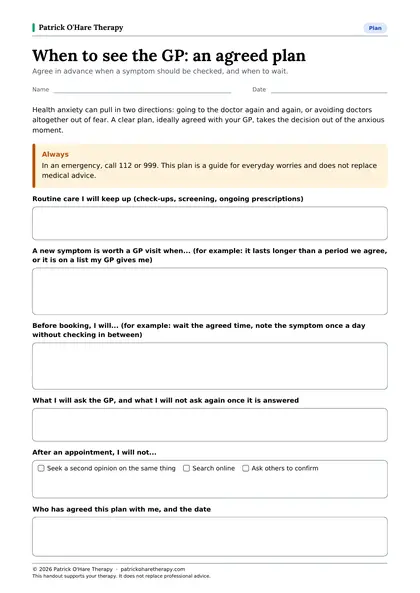 When to see the GP: an agreed planPlan, 1 pageA template for agreeing sensible rules about when to see the GP, so that you neither avoid check-ups nor overuse them.
OCD 17
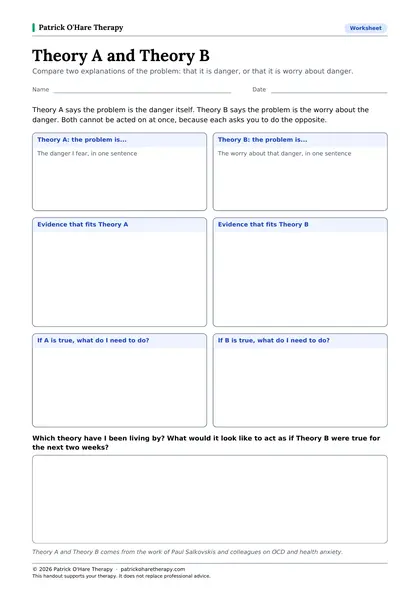 Theory A and Theory BWorksheet, 1 pageSets two explanations side by side: the problem is danger, or the problem is worry. Each calls for a very different way of living. Used for OCD and health anxiety.
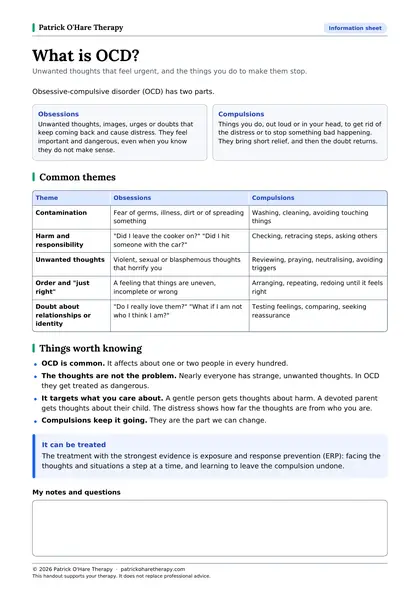 What is OCD?Information sheet, 1 pageAn introduction to OCD: obsessions, compulsions, the common themes, and why it says nothing about your character.
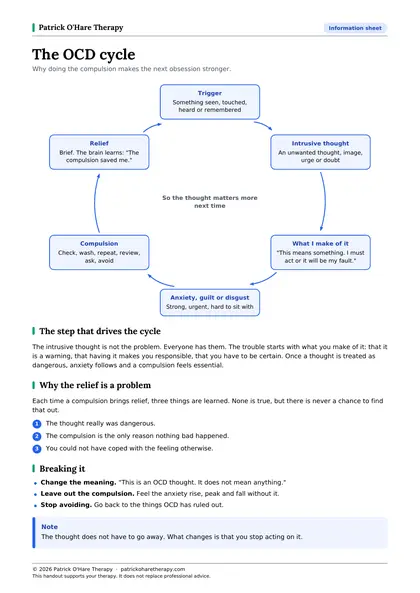 The OCD cycleInformation sheet, 1 pageA diagram of how OCD keeps going: the thought, what you take it to mean, the anxiety, the compulsion and the relief. Shows where treatment breaks in.
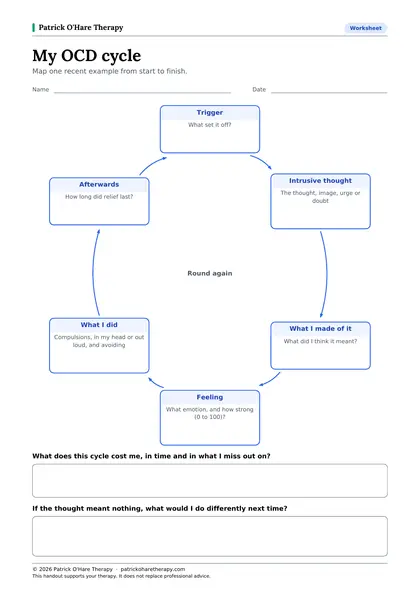 My OCD cycleWorksheet, 1 pageA fill-in OCD cycle for one example of your own, including what you took the thought to mean and what the compulsion cost you afterwards.
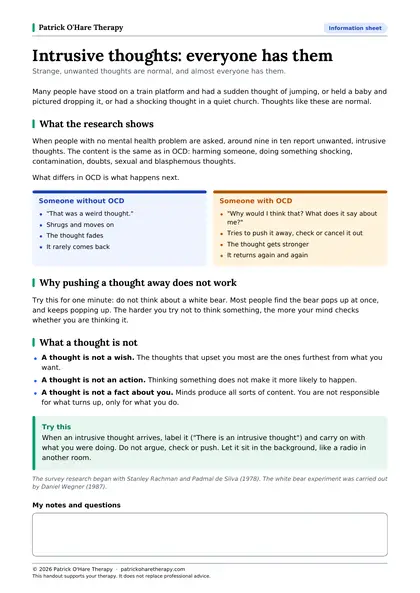 Intrusive thoughts: everyone has themInformation sheet, 1 pageShows how common strange, unwanted thoughts are, why pushing them away backfires, and how OCD differs only in how the thought is treated.
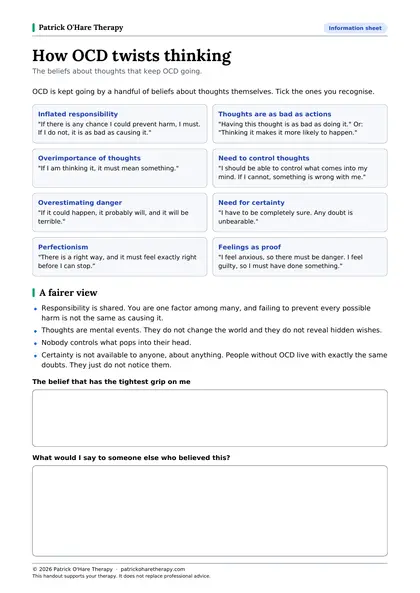 How OCD twists thinkingInformation sheet, 1 pageDescribes the ways of thinking that keep OCD going, such as feeling over-responsible, treating a thought like an action, and needing to be certain. With a self-check.
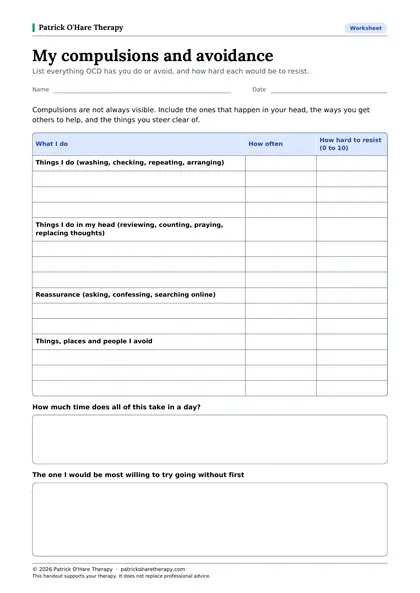 My compulsions and avoidanceWorksheet, 1 pageA list to fill in of everything OCD has you do: visible compulsions, mental rituals, asking for reassurance and avoiding, with a rating of how hard each would be to resist.
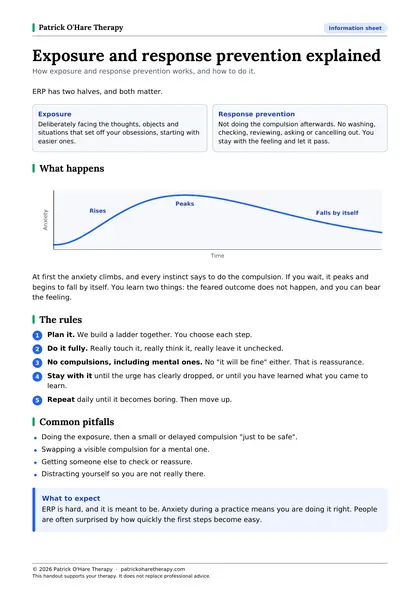 Exposure and response prevention explainedInformation sheet, 1 pageExplains how exposure and response prevention works, what to expect from the anxiety, and the common pitfalls. Read it before building a ladder.
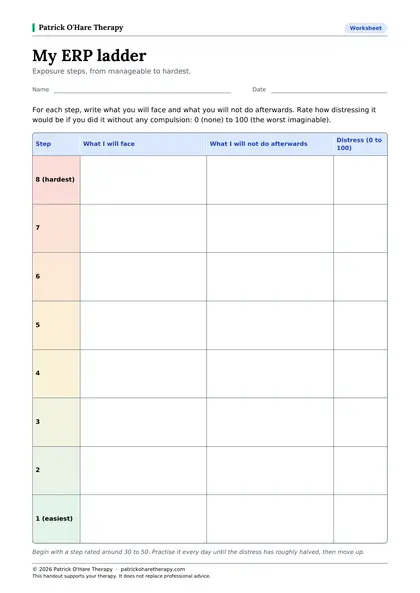 My ERP ladderWorksheet, 1 pageA ladder of exposure steps from manageable to hardest. Each step lists what you will face and the compulsion you will resist, with a distress rating.
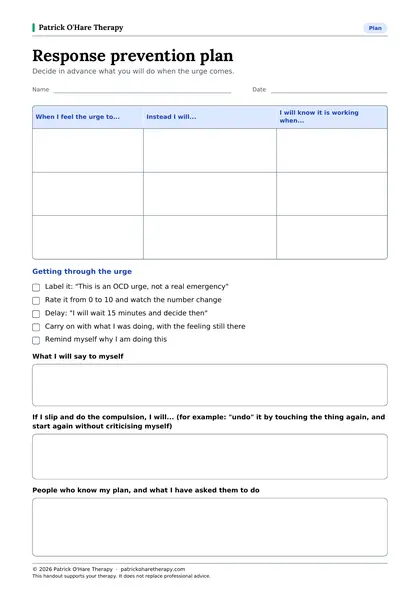 Response prevention planPlan, 1 pageA plan for resisting specific compulsions: the urge, what you will do instead, what you will tell yourself and how others can help.
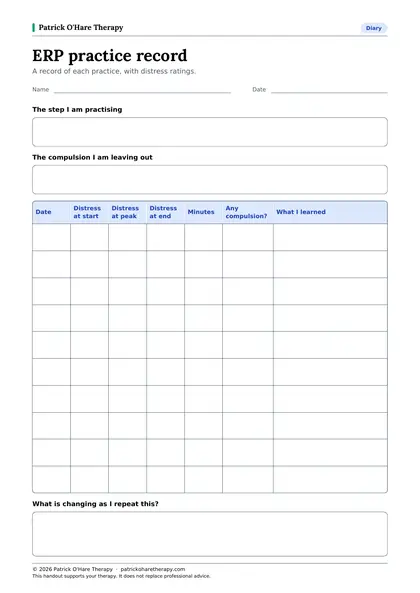 ERP practice recordDiary, 1 pageA log for daily practice: your distress at its peak and at the end, how long it took, and whether you did any compulsion.
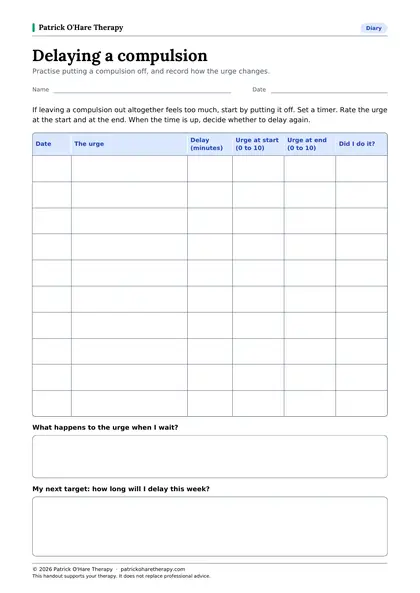 Delaying a compulsionDiary, 1 pageA log for practising putting a compulsion off, as a stepping stone to dropping it. Track how the urge changes while you wait.
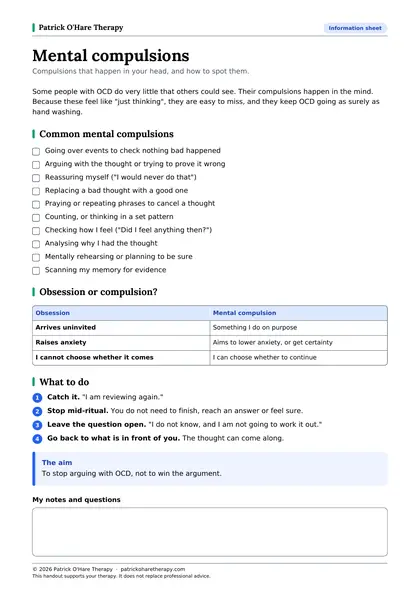 Mental compulsionsInformation sheet, 1 pageExplains the rituals that happen in your head (reviewing, reassuring yourself, cancelling out, checking your feelings) and how to tell them from the obsession itself.
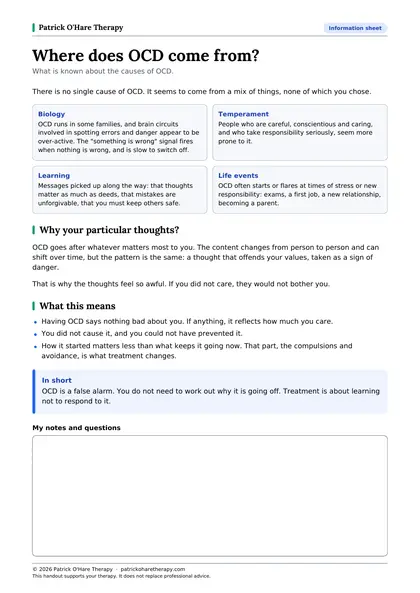 Where does OCD come from?Information sheet, 1 pageA plain account of what causes OCD: biology, temperament, learning and life events. It is not your fault.
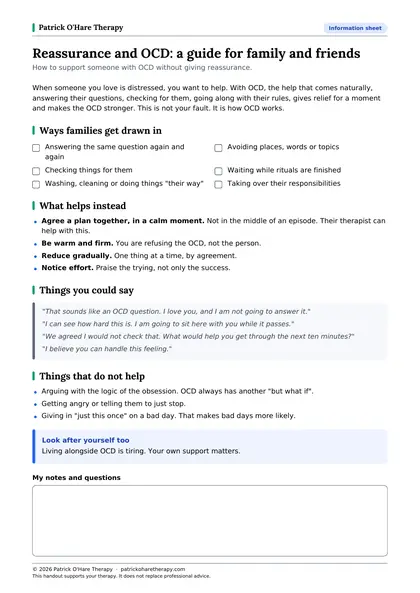 Reassurance and OCD: a guide for family and friendsInformation sheet, 1 pageFor partners, family and friends. Explains how going along with OCD keeps it going, and gives supportive things to say in place of reassurance.
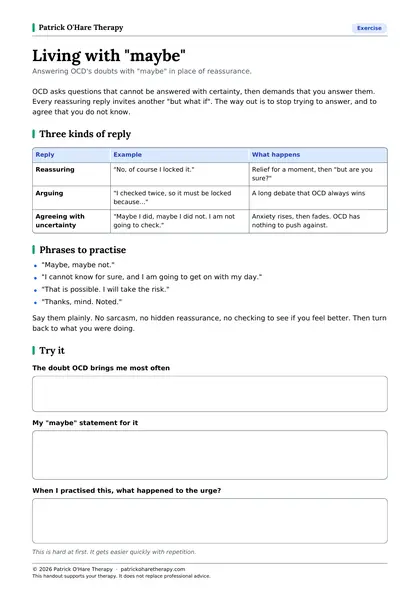 Living with "maybe"Exercise, 1 pageTeaches a way of answering OCD's doubts without arguing with them, with space to write your own "maybe" statements for daily practice.
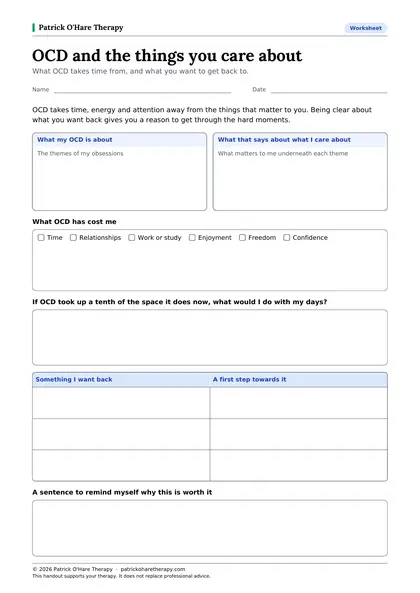 OCD and the things you care aboutWorksheet, 1 pageLinks your OCD to the things you care about most, and sets goals for a life with fewer rituals in it.
Trauma and PTSD 20
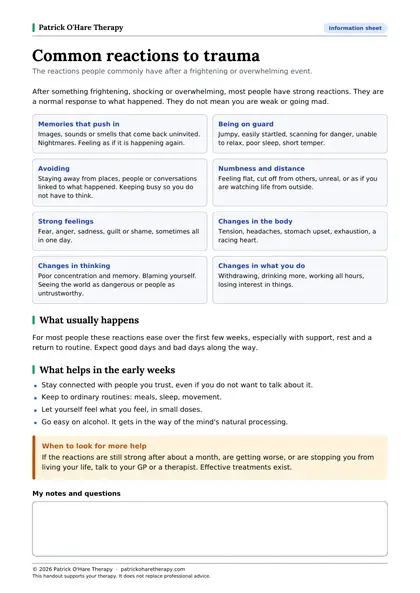 Common reactions to traumaInformation sheet, 1 pageDescribes the emotional, physical and mental reactions that are common after a traumatic event, with guidance on when to look for more help.
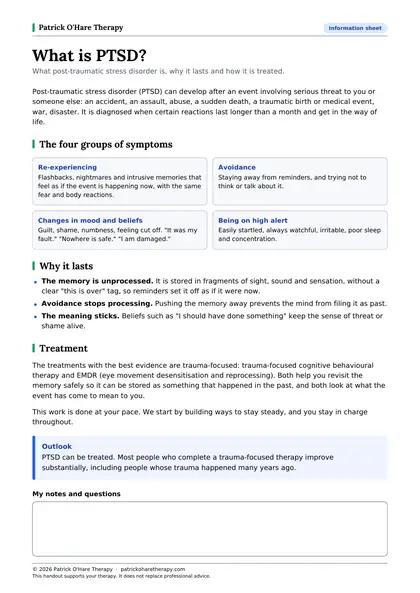 What is PTSD?Information sheet, 1 pageExplains post-traumatic stress disorder: the four groups of symptoms, why it lasts and the treatments that are recommended.
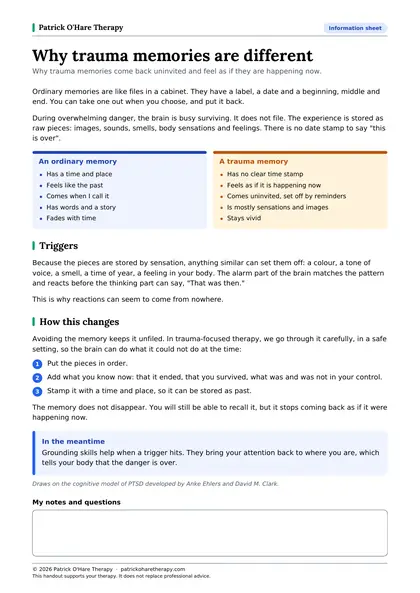 Why trauma memories are differentInformation sheet, 1 pageUses a filing picture to explain why trauma memories come back in fragments and feel like now, what triggers are, and how therapy changes the memory.
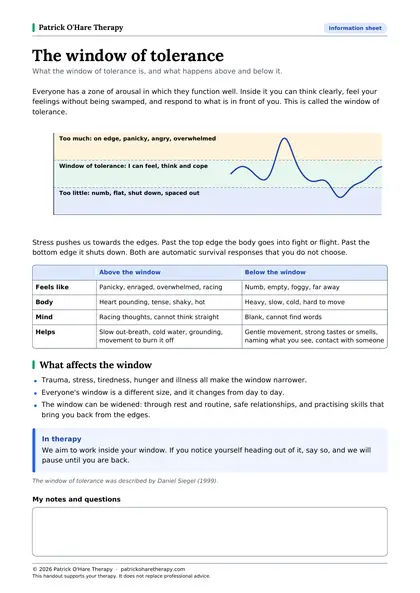 The window of toleranceInformation sheet, 1 pageExplains the zone where you can think and feel at once, what it is like to be above it (wound up) or below it (shut down), and what widens the window.
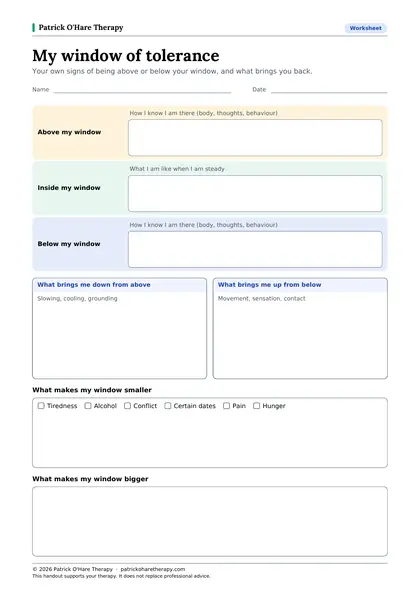 My window of toleranceWorksheet, 1 pageYour own version of the window: your signs of being wound up or shut down, and what helps you back in each case.
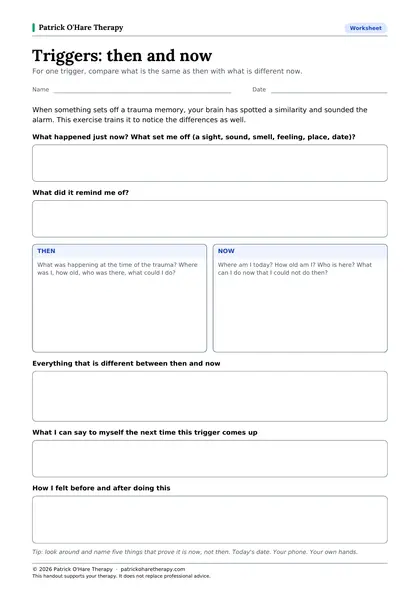 Triggers: then and nowWorksheet, 1 pageA worksheet for one trigger: what it has in common with what happened then and, more importantly, all the ways that now is different.
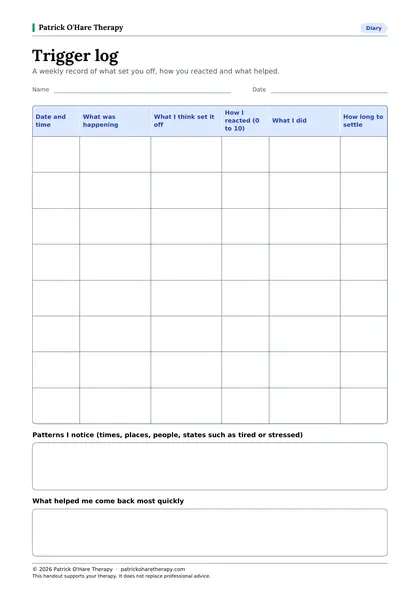 Trigger logDiary, 1 pageA weekly log of triggers, how you reacted, what you did to cope and how long it took to settle. Patterns show up quickly.
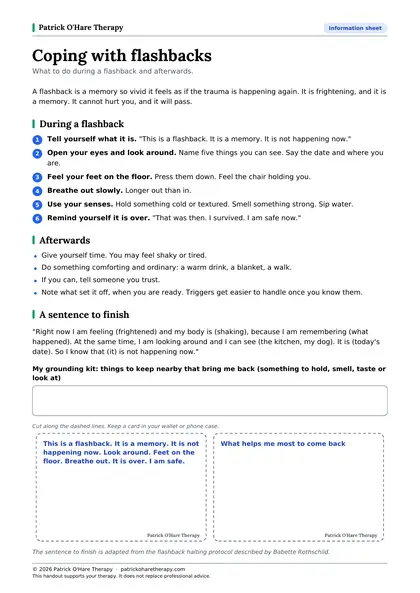 Coping with flashbacksInformation sheet, 1 pageStep-by-step help for a flashback, with a card for your wallet: get your bearings in the present and remind yourself that it is over.
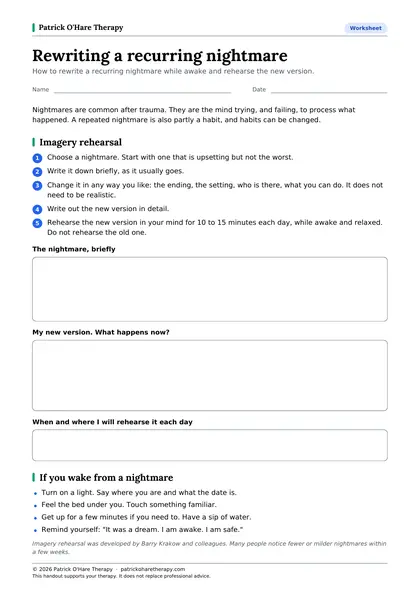 Rewriting a recurring nightmareWorksheet, 1 pageExplains nightmares after trauma and guides you through rewriting a recurring dream while awake, then rehearsing the new version each day.
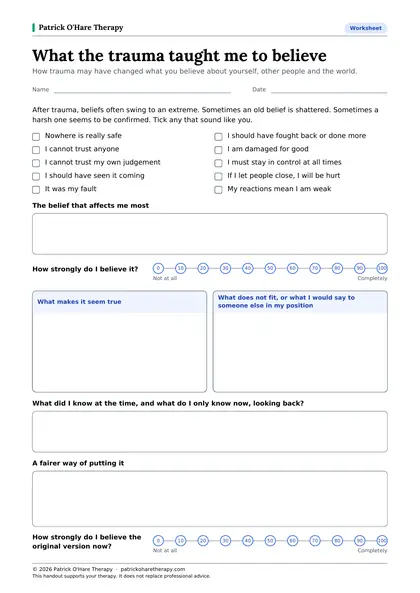 What the trauma taught me to believeWorksheet, 1 pageLooks at how trauma can change what you believe about safety, trust, control, your own worth and closeness, then examines one belief in detail.
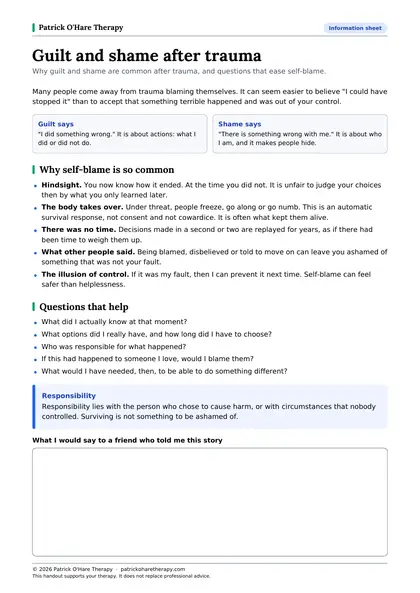 Guilt and shame after traumaInformation sheet, 1 pageWhy guilt and shame are so common after trauma, including hindsight and the freeze response, with questions that ease self-blame.
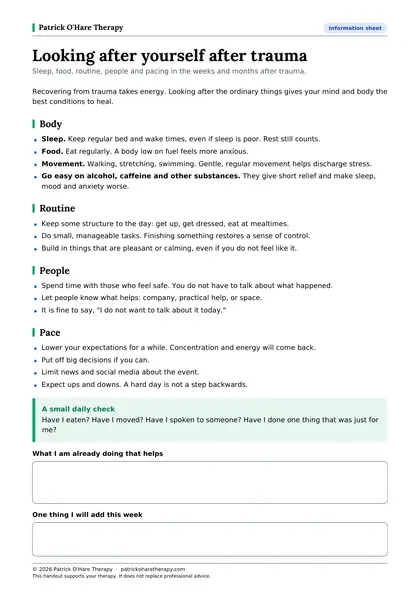 Looking after yourself after traumaInformation sheet, 1 pagePractical guidance for the weeks and months after trauma: routine, your body, other people, pacing yourself, and what to go easy on.
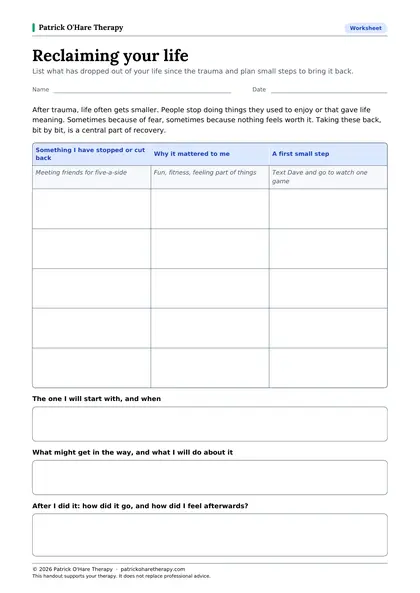 Reclaiming your lifeWorksheet, 1 pageList the things that mattered to you and have dropped away since the trauma, and plan small steps to take them back.
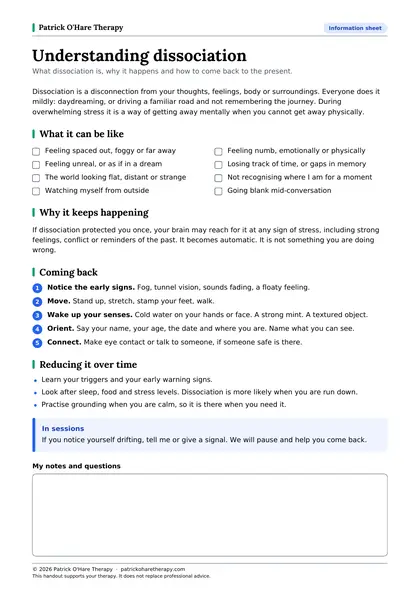 Understanding dissociationInformation sheet, 1 pageExplains spacing out and feeling unreal as the mind's way of protecting you, describes the common experiences, and gives practical ways to come back to the present.
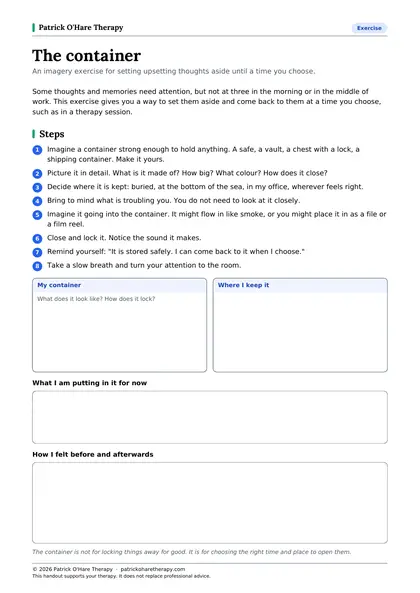 The containerExercise, 1 pageA guided imagery exercise for putting upsetting material away until you are ready for it. It is a way of choosing when to deal with it. It is not for avoiding it.
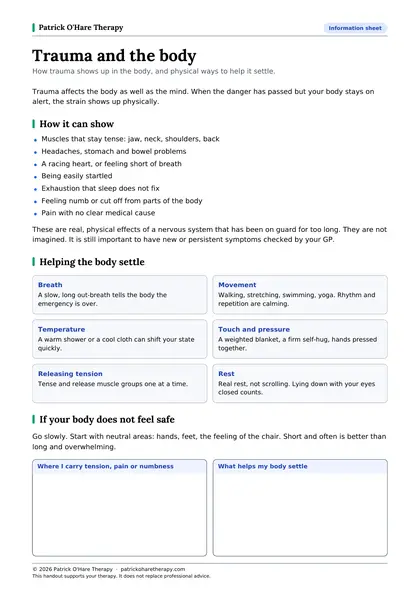 Trauma and the bodyInformation sheet, 1 pageHow living on high alert shows up in the body after trauma, and body-based ways to help your nervous system settle.
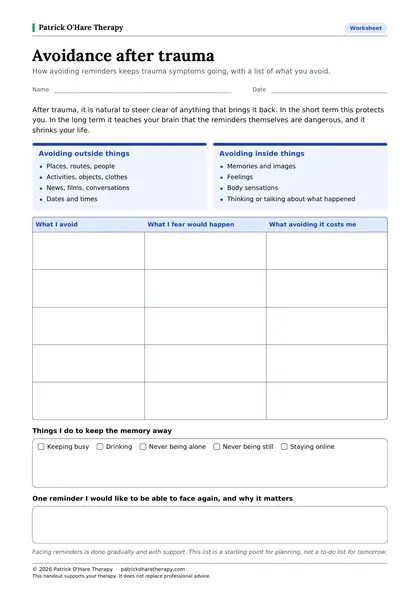 Avoidance after traumaWorksheet, 1 pageExplains how avoidance keeps trauma symptoms going, with space to list what you avoid, outside and inside, as a starting point for facing things in steps.
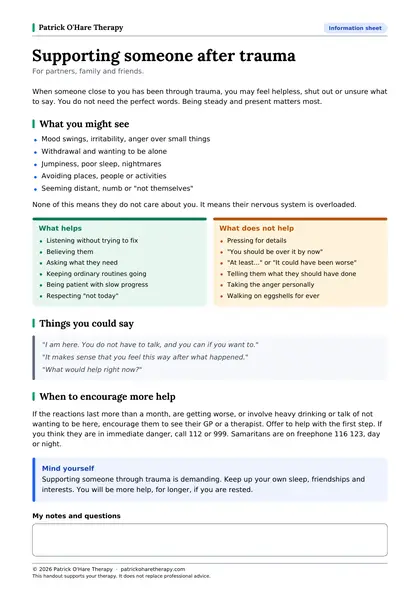 Supporting someone after traumaInformation sheet, 1 pageFor partners, family and friends: what to expect, what helps, what not to say, and looking after yourself as well.
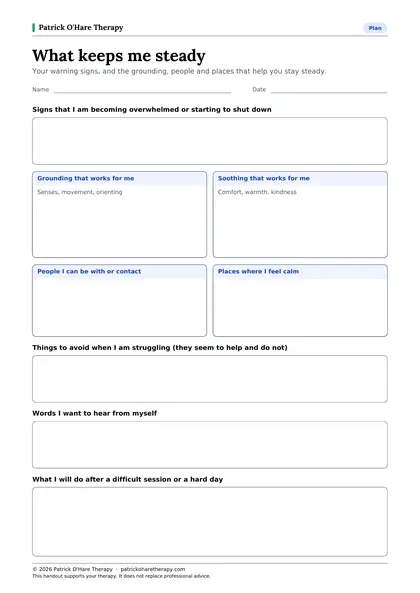 What keeps me steadyPlan, 1 pageOne page for everything that keeps you steady: your warning signs, grounding and soothing strategies, people, places and reminders.
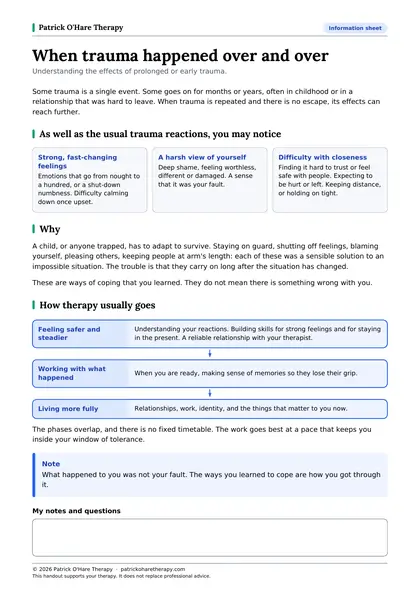 When trauma happened over and overInformation sheet, 1 pageDescribes the extra difficulties that can follow repeated or childhood trauma, with emotions, self-image and relationships, and how therapy is paced in stages.
Low mood and depression 20
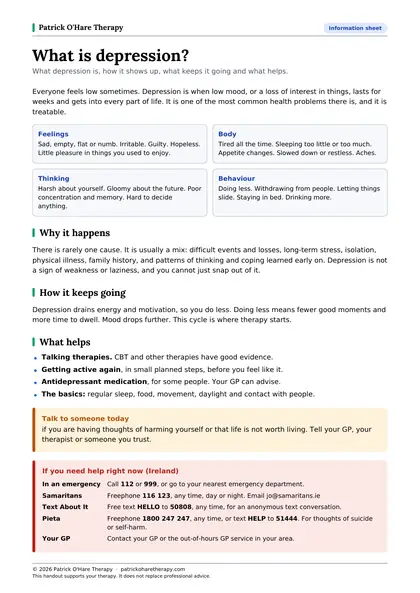 What is depression?Information sheet, 1 pageAn introduction to depression: how it shows in mood, body, thinking and behaviour, what feeds into it, what helps, and when to get urgent help.
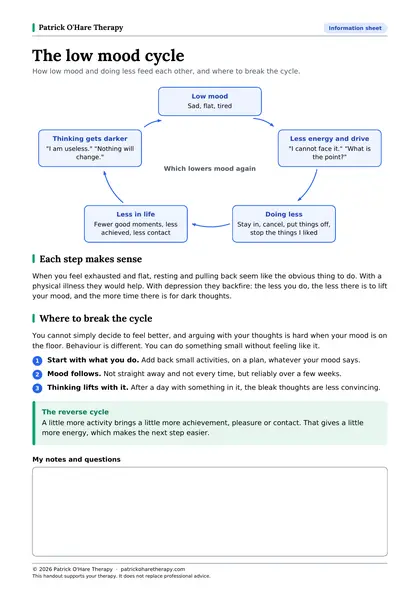 The low mood cycleInformation sheet, 1 pageA diagram of how doing less and seeing fewer people keeps low mood going, and why changing what you do is the easiest place to start.
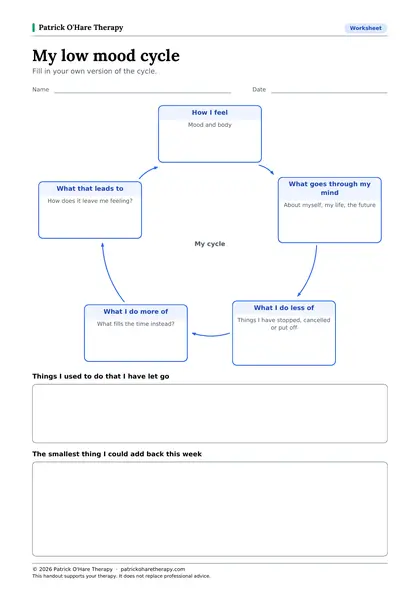 My low mood cycleWorksheet, 1 pageA fill-in low mood cycle, with prompts about what you have stopped doing and where you could begin.
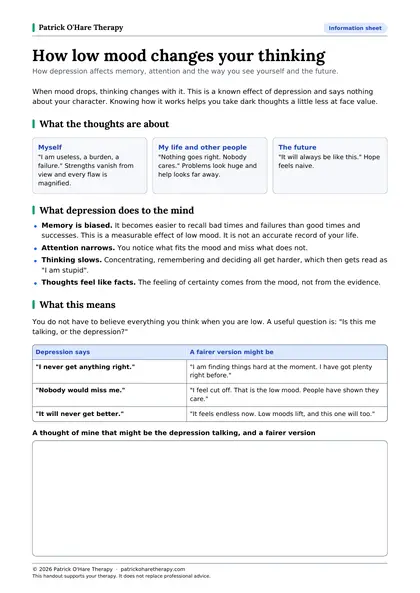 How low mood changes your thinkingInformation sheet, 1 pageExplains how depression colours your view of yourself, the world and the future, tilts your memory, and makes bleak thoughts feel true.
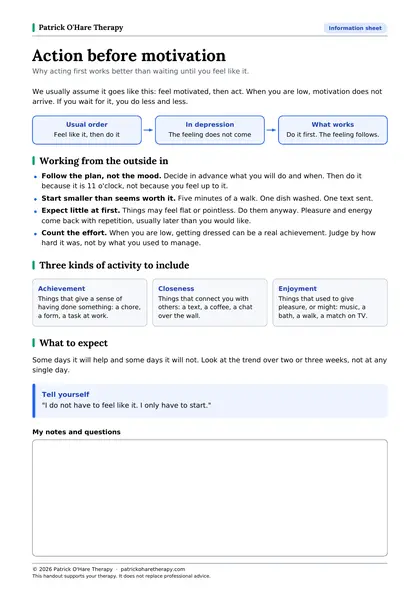 Action before motivationInformation sheet, 1 pageWhy acting first works better than waiting to feel like it: start small, work from the outside in, and follow a plan instead of a mood.
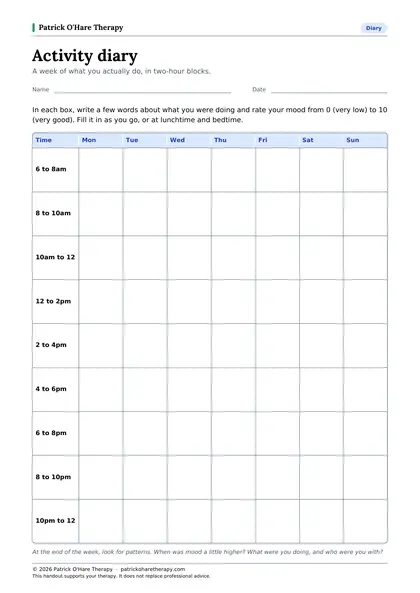 Activity diaryDiary, 1 pageA week in two-hour blocks. Note what you did and rate your mood in each block, to see what your days really look like.
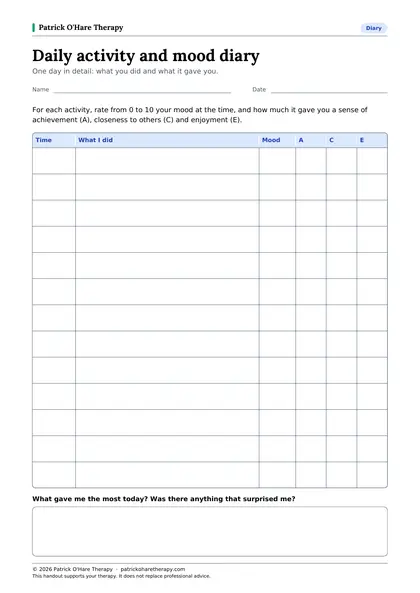 Daily activity and mood diaryDiary, 1 pageA one-day log of what you did, with ratings for mood, achievement, closeness and enjoyment. A few sample days show what helps.
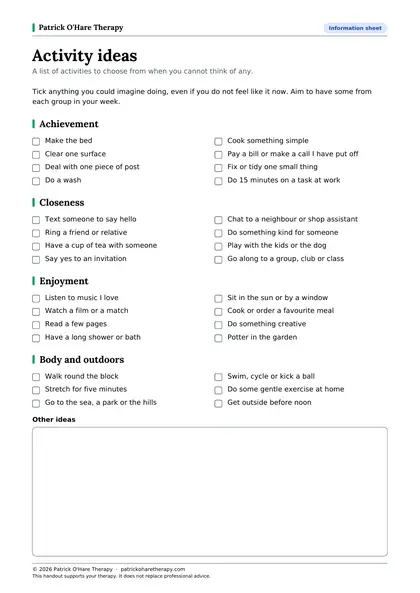 Activity ideasInformation sheet, 1 pageA menu of small activities grouped by achievement, closeness, enjoyment and body. Tick the ones to try and add more ideas.
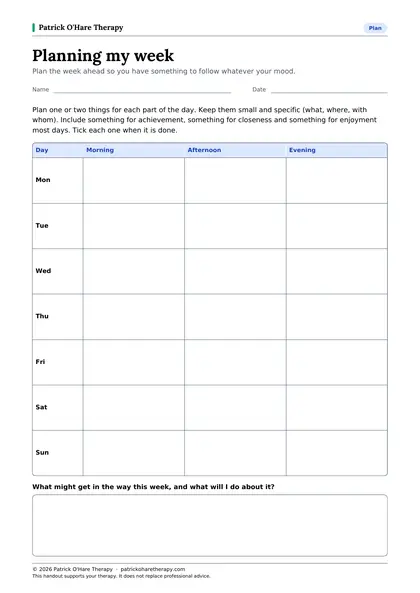 Planning my weekPlan, 1 pageA weekly planner with morning, afternoon and evening slots, for building activity back into your days.
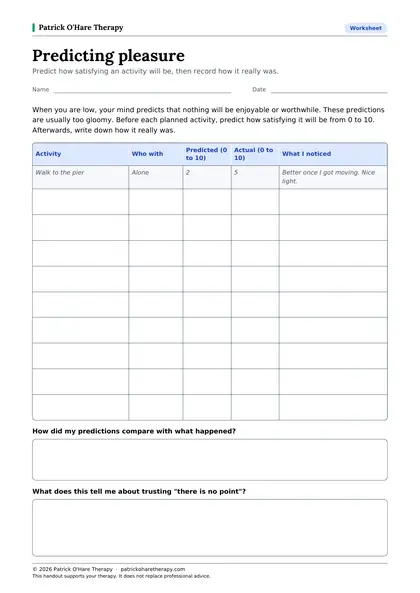 Predicting pleasureWorksheet, 1 pageAn experiment: predict how enjoyable or satisfying an activity will be, do it, rate it afterwards and compare the two.
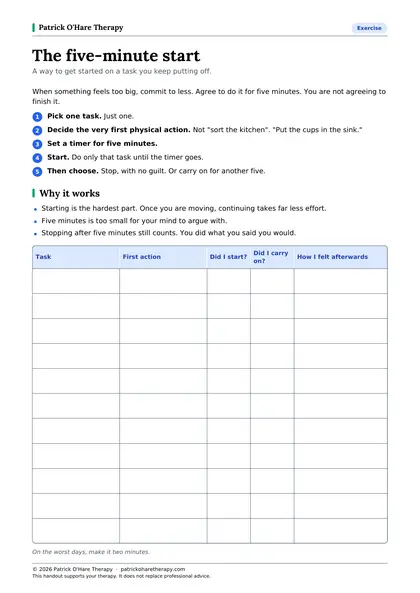 The five-minute startExercise, 1 pageA way to get started: commit to five minutes only, then decide. With a practice log.
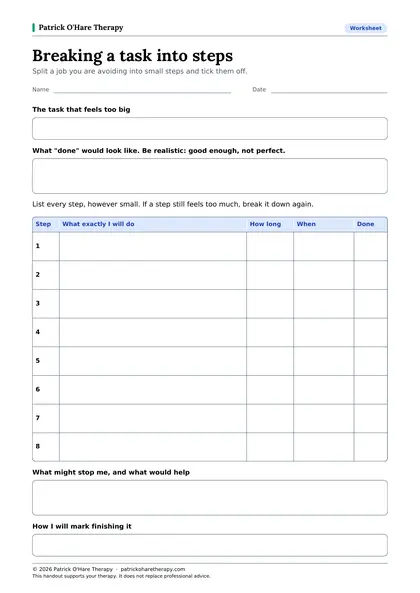 Breaking a task into stepsWorksheet, 1 pageFor jobs that feel too big: say what "done" looks like, list the steps, estimate the time and plan the first one.
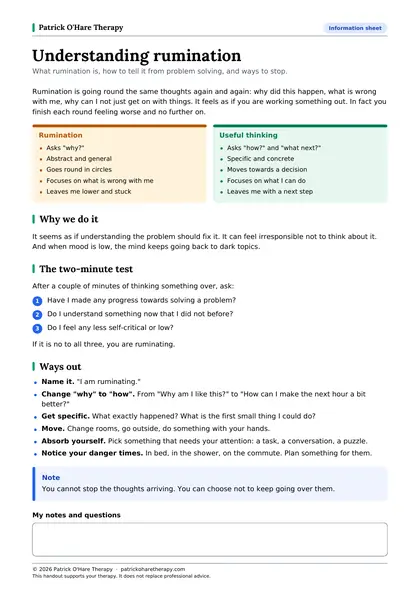 Understanding ruminationInformation sheet, 1 pageExplains going over and over things, how it differs from useful reflection, why it deepens low mood and practical ways to step out of it.
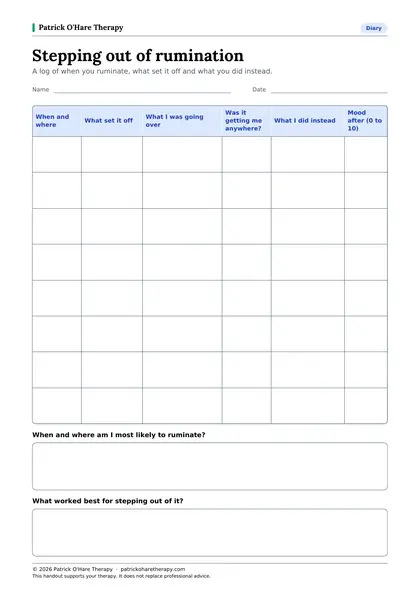 Stepping out of ruminationDiary, 1 pageA log for catching rumination, spotting what sets it off, and practising the switch to action or to something absorbing.
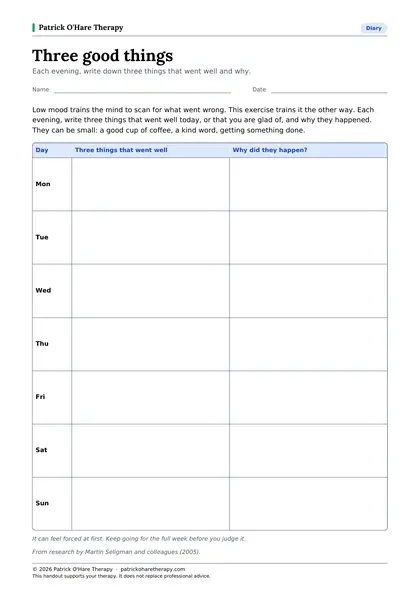 Three good thingsDiary, 1 pageA week of writing down three things that went well each day, and why. A short, well-researched habit that shifts what you notice.
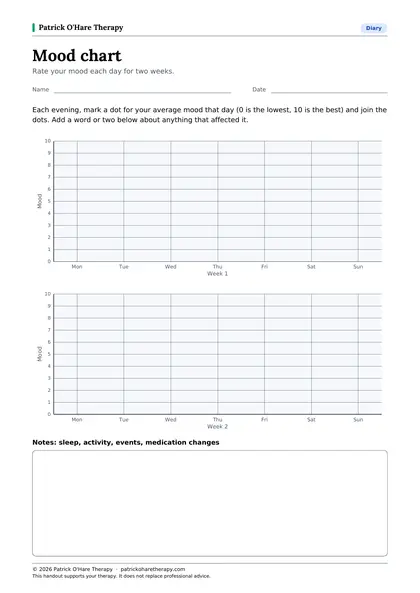 Mood chartDiary, 1 pageA two-week graph to plot your mood each day, with space for notes on events, sleep and activity.
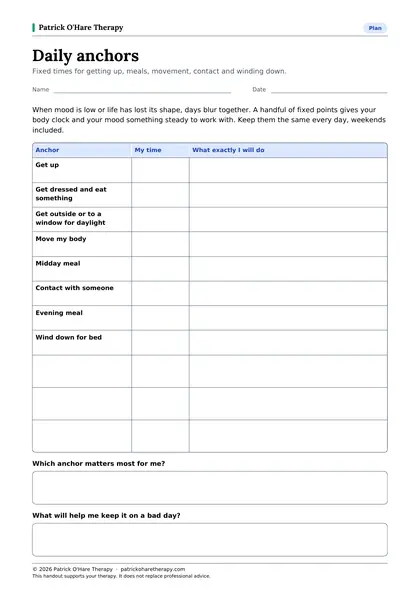 Daily anchorsPlan, 1 pageSet fixed times for waking, meals, movement, contact and winding down. For when your days have lost their shape.
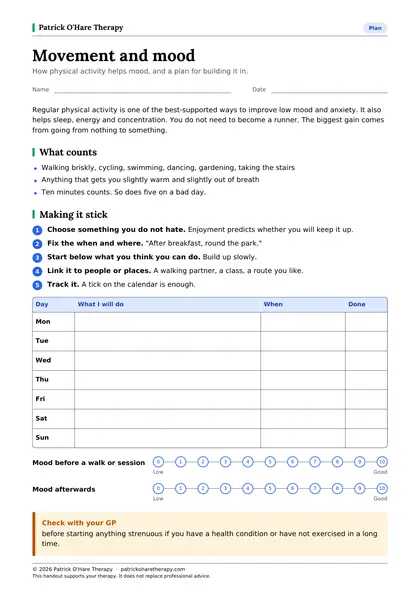 Movement and moodPlan, 1 pageSums up what physical activity does for low mood and anxiety, and helps you build a realistic weekly plan.
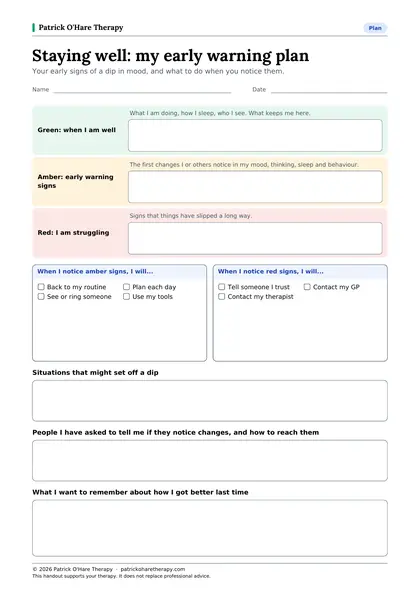 Staying well: my early warning planPlan, 1 pageA traffic-light plan for staying well: what "well" looks like for you, your early warning signs, and what you will do at each stage.
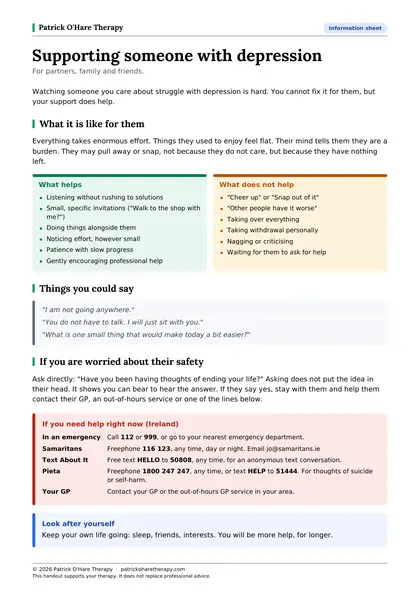 Supporting someone with depressionInformation sheet, 1 pageFor partners, family and friends: what depression is like from the inside, what helps, what to avoid, and when to get urgent help.
Sleep 14
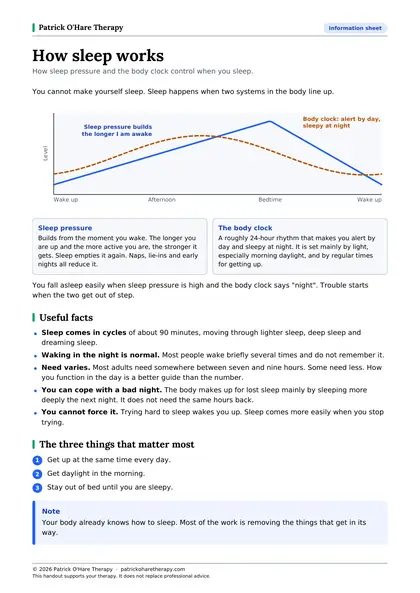 How sleep worksInformation sheet, 1 pageExplains sleep pressure and the body clock with a graph, why waking in the night is normal, and how much sleep people need.
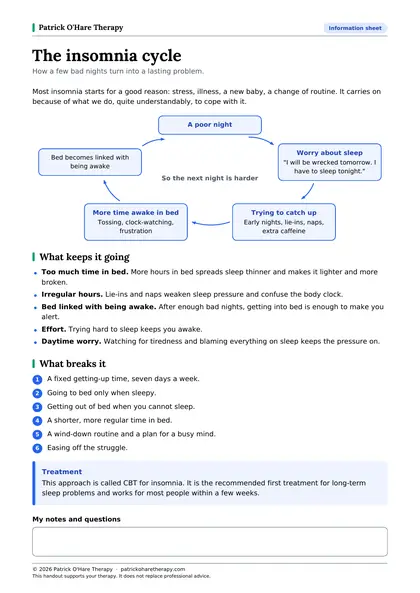 The insomnia cycleInformation sheet, 1 pageA diagram of how worry about sleep, efforts to catch up and time awake in bed keep insomnia going, and what breaks the cycle.
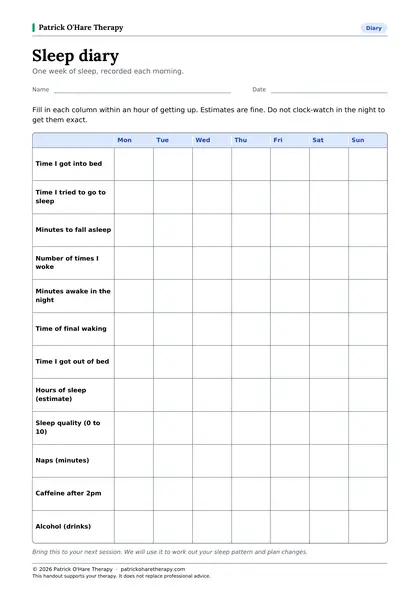 Sleep diaryDiary, 1 pageA standard one-week sleep diary: bedtime and getting-up time, how long it took to fall asleep, wakings, sleep quality and what the day was like.
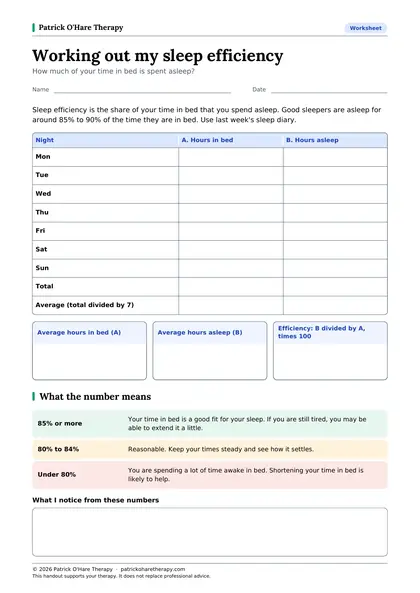 Working out my sleep efficiencyWorksheet, 1 pageA sheet for working out, from a week of your sleep diary, how much of your time in bed you spend asleep.
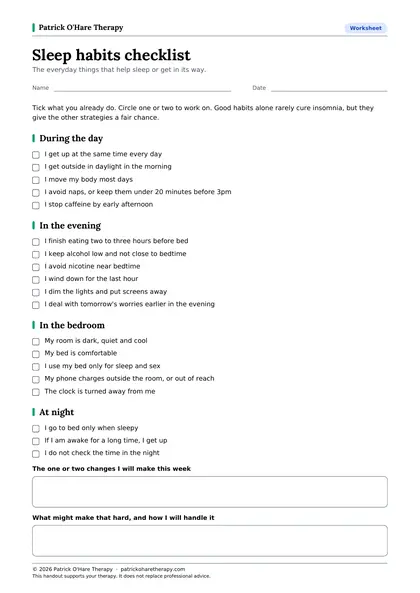 Sleep habits checklistWorksheet, 1 pageA check of your daytime, evening, bedroom and night-time habits. Useful groundwork alongside the main insomnia strategies.
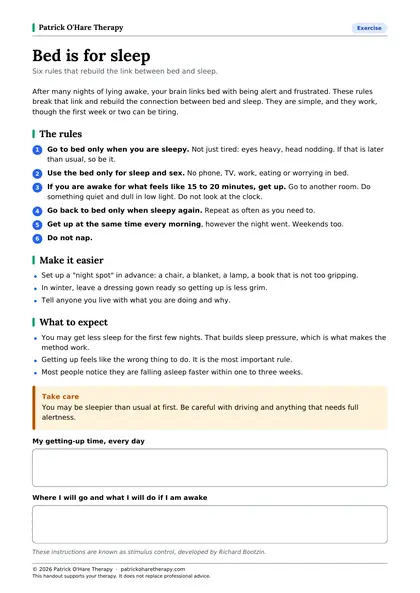 Bed is for sleepExercise, 1 pageStep-by-step rules for re-linking bed with sleep, one of the most effective insomnia treatments, with tips for when it gets hard.
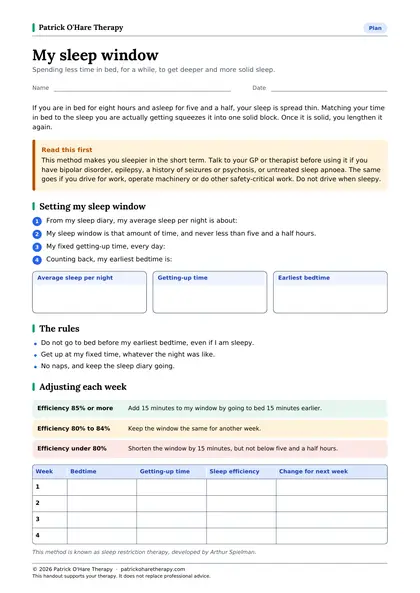 My sleep windowPlan, 1 pageA guided plan for spending less time in bed for a while to get deeper, more solid sleep, with safety cautions and weekly adjustment rules. Do this one with your therapist.
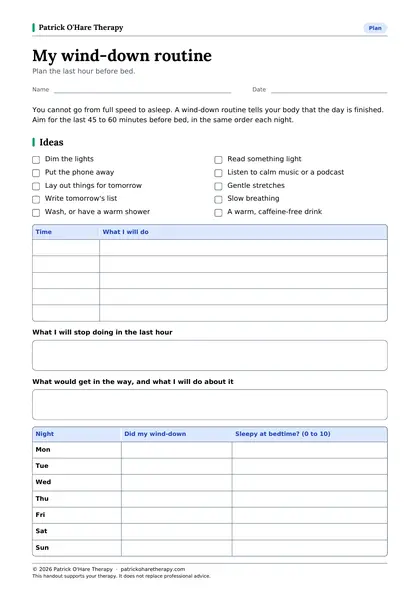 My wind-down routinePlan, 1 pageA planner for the same wind-down every night, with ideas and a nightly checklist to build the habit.
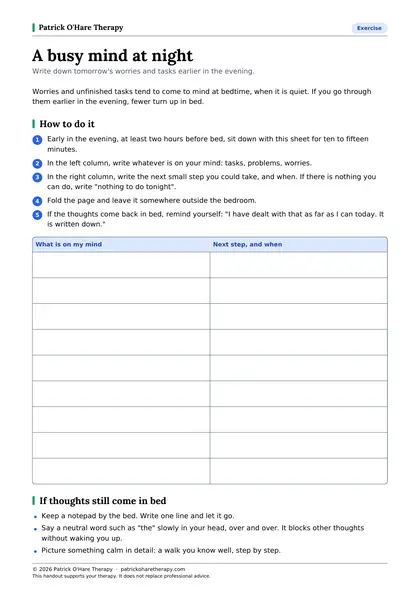 A busy mind at nightExercise, 1 pageAn early-evening exercise: write down what is on your mind and the next step for each, so it does not need solving at 3am.
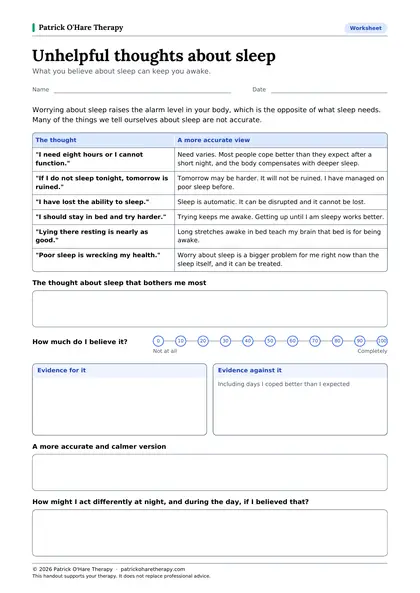 Unhelpful thoughts about sleepWorksheet, 1 pageLists common beliefs about sleep that keep people awake, with more accurate versions, then helps you rework your own.
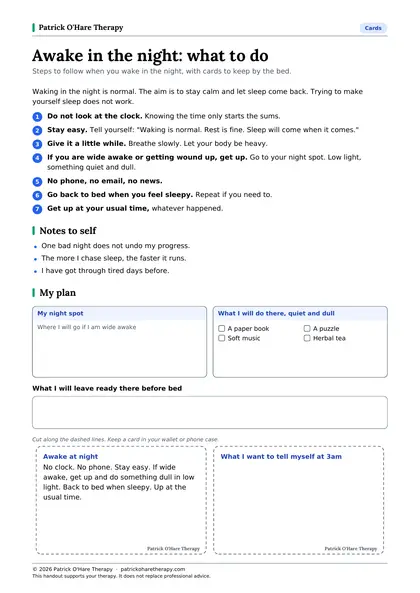 Awake in the night: what to doCards, 1 pageA short plan for when you wake in the small hours and cannot get back to sleep, with space to set up your own and a card for the bedside.
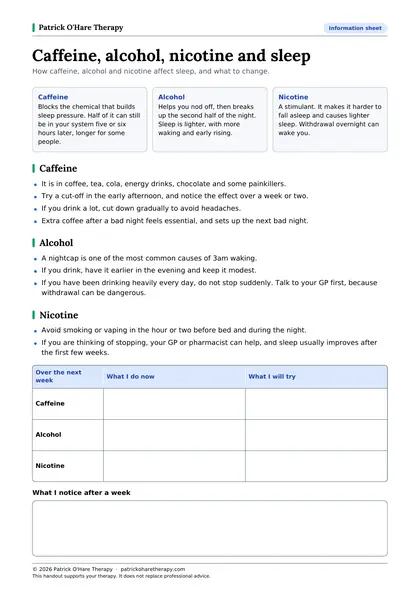 Caffeine, alcohol, nicotine and sleepInformation sheet, 1 pageHow caffeine, alcohol and nicotine affect sleep, with practical guidance on timing and cutting back.
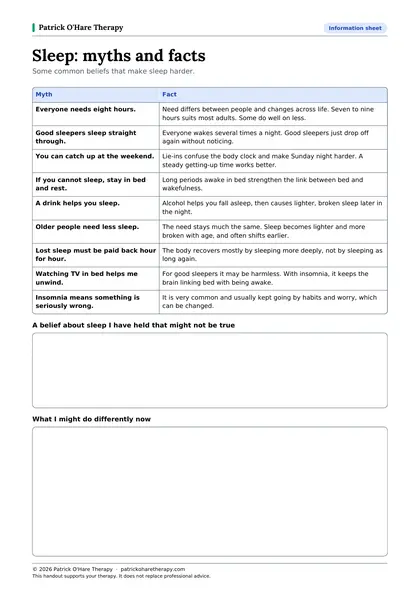 Sleep: myths and factsInformation sheet, 1 pageA myth-and-fact sheet on how much sleep you need, waking in the night, catching up, alcohol and getting older.
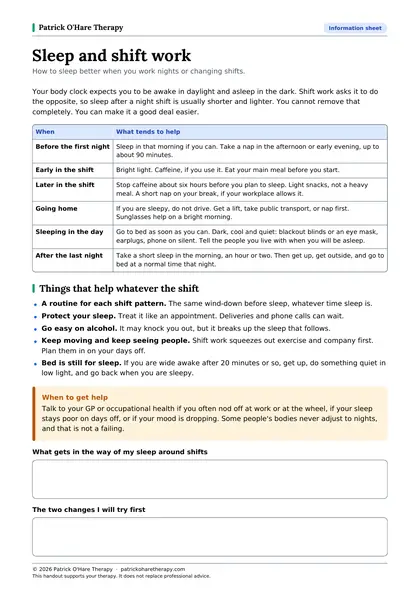 Sleep and shift workInformation sheet, 1 pagePractical advice for nights and rotating shifts: before, during and after a night shift, sleeping in the day, and getting back to normal on days off.
Stress and burnout 17
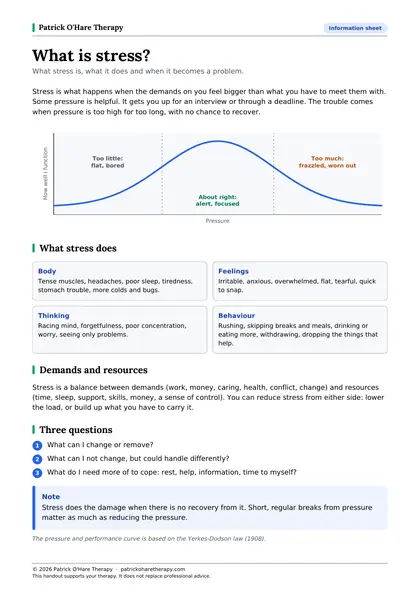 What is stress?Information sheet, 1 pageAn introduction to stress: how pressure affects performance, the signs of overload, and the difference between pressures you can change and those you cannot.
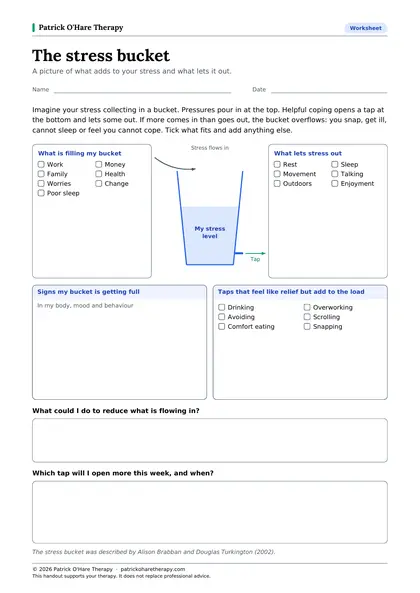 The stress bucketWorksheet, 1 pageThe stress bucket as a worksheet: what flows in, the helpful and unhelpful ways you let it out, and the signs that it is overflowing.
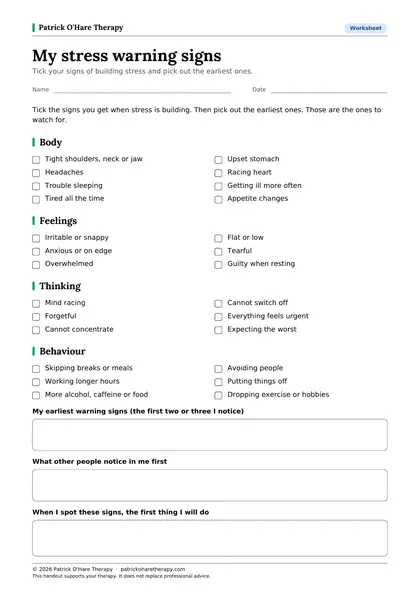 My stress warning signsWorksheet, 1 pageA checklist of stress signs in four areas, with space for your own earliest signals and what you will do first.
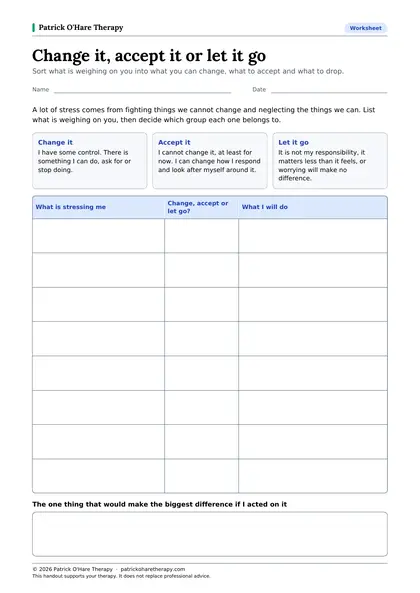 Change it, accept it or let it goWorksheet, 1 pageSort your stresses into three piles: those to act on, those to accept or handle differently, and those to drop.
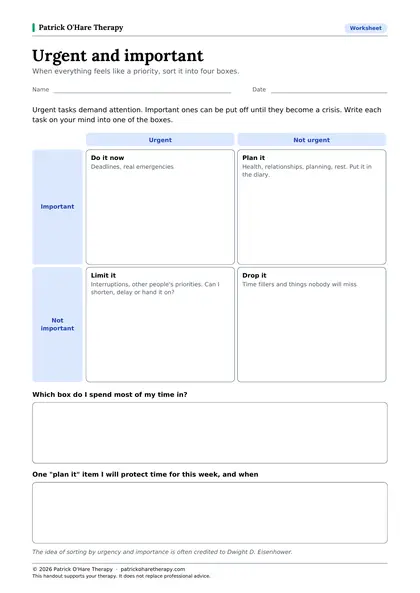 Urgent and importantWorksheet, 1 pageA four-box grid for sorting tasks by how urgent and how important they are, with a reminder to protect time for what matters but can wait.
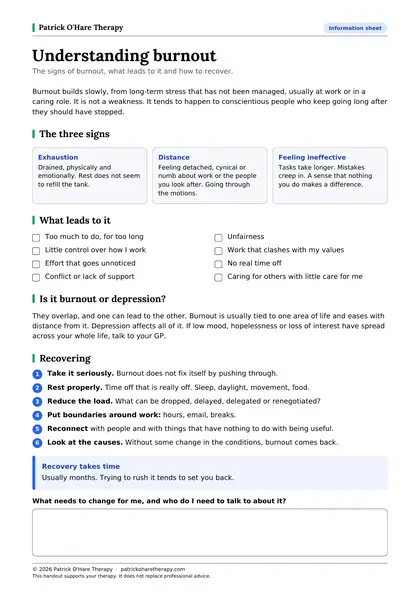 Understanding burnoutInformation sheet, 1 pageDescribes burnout (exhaustion, detachment, getting less done), how it differs from ordinary tiredness and from depression, and the steps to recovery.
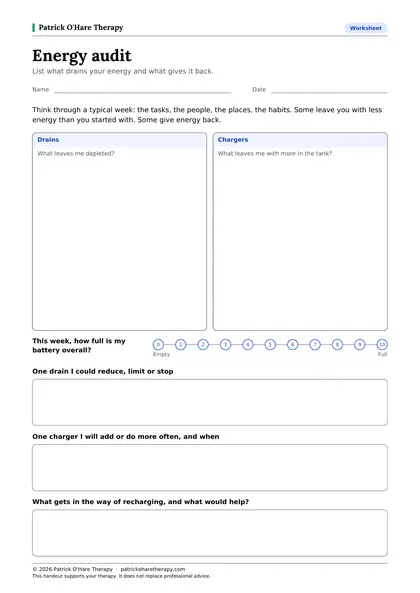 Energy auditWorksheet, 1 pageList what drains you and what recharges you across a typical week, then choose one thing to cut back and one to add.
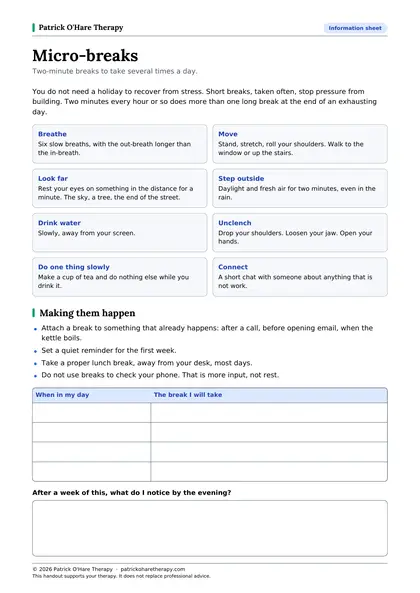 Micro-breaksInformation sheet, 1 pageA menu of two-minute breaks for the working day, with a plan for building them in.
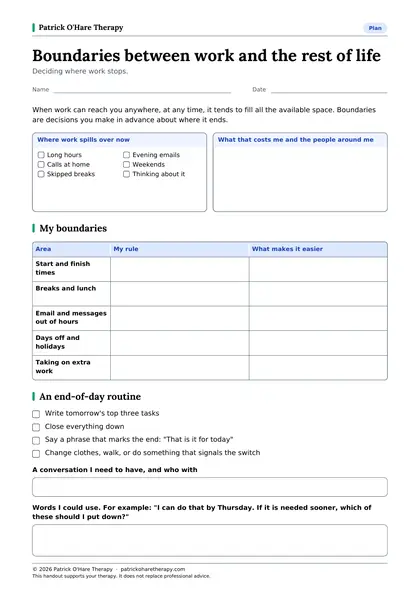 Boundaries between work and the rest of lifePlan, 1 pageA planning sheet for setting limits on working hours, being reachable and switching off, with wording for the awkward conversations.
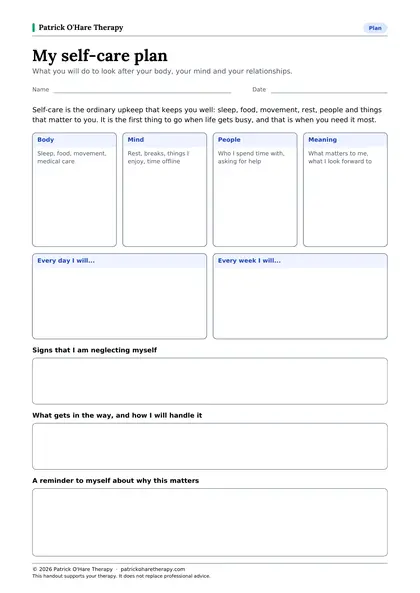 My self-care planPlan, 1 pageA practical plan across body, mind, people and meaning, with daily and weekly commitments and your early warning signs.
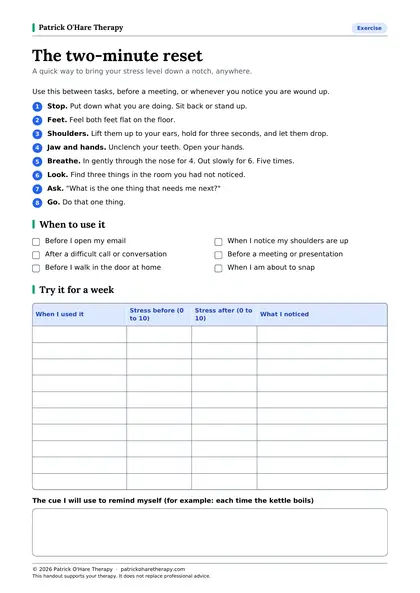 The two-minute resetExercise, 1 pageA short stop-and-settle routine: posture, breath, loosening your muscles and one next step, with a log for a week of practice. For the desk, the car, or just before a hard moment.
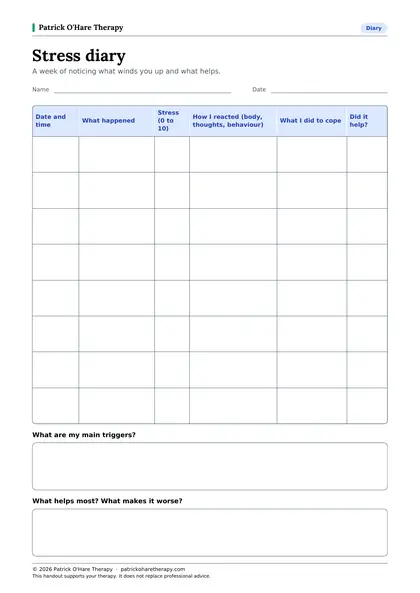 Stress diaryDiary, 1 pageA week of noting what stressed you, how you reacted, what you did and how well it worked. Shows patterns and what really helps.
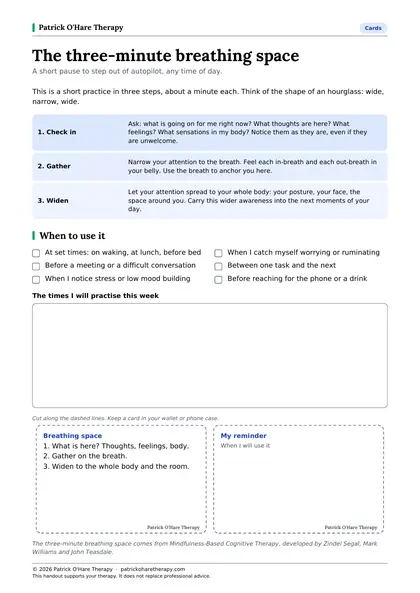 The three-minute breathing spaceCards, 1 pageThe three-step breathing space from mindfulness-based cognitive therapy, with a card for your wallet and ideas for when to use it.
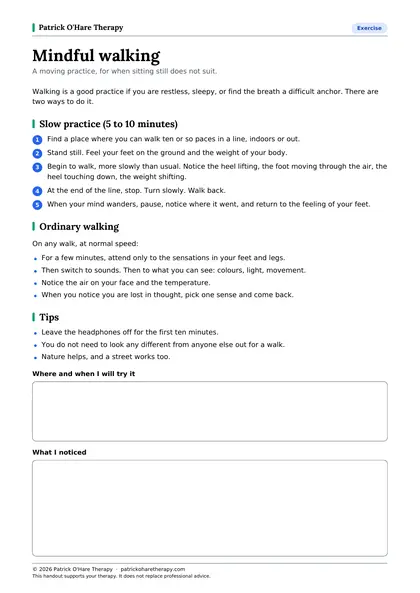 Mindful walkingExercise, 1 pageInstructions for slow, deliberate walking practice, and for bringing mindfulness to an ordinary walk outdoors.
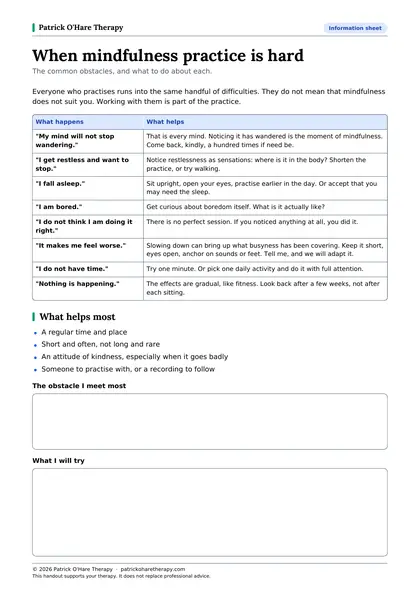 When mindfulness practice is hardInformation sheet, 1 pageHelp with the common obstacles: a wandering mind, restlessness, sleepiness, doubt, strong emotion and having no time.
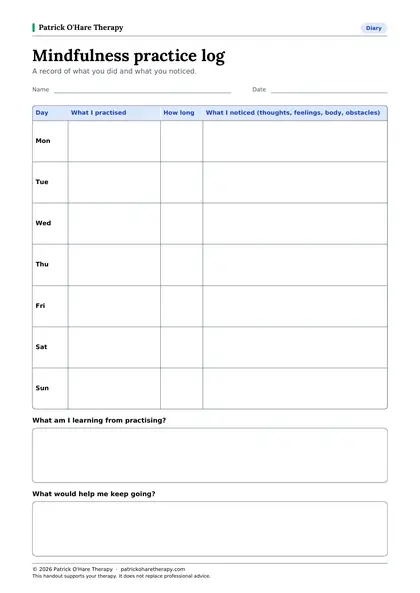 Mindfulness practice logDiary, 1 pageA weekly log for your mindfulness practice, formal and everyday, with space for what you noticed.
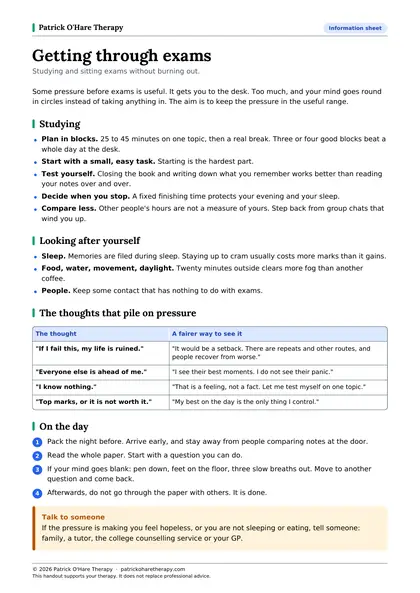 Getting through examsInformation sheet, 1 pagePractical guidance for exam time: studying in blocks, protecting sleep, handling "what if I fail" thoughts, and what to do on the day and afterwards. For students of any age.
Anger 13
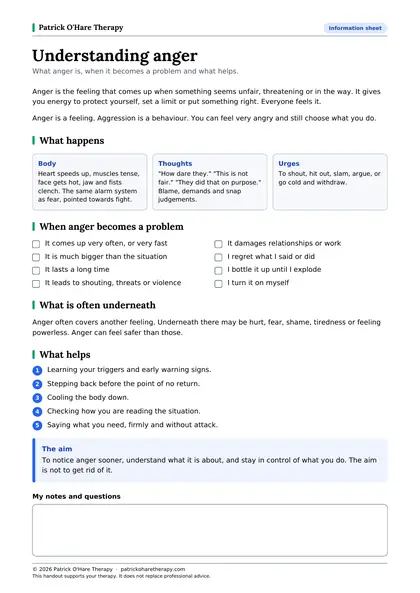 Understanding angerInformation sheet, 1 pageWhat anger is for, how it shows in body, thoughts and behaviour, when it becomes a problem, and the difference between anger and aggression.
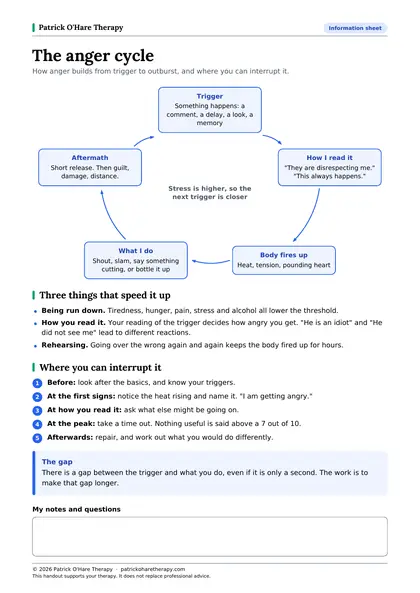 The anger cycleInformation sheet, 1 pageA diagram of how anger builds from trigger to blow-up and aftermath, marking the points where you can step off.
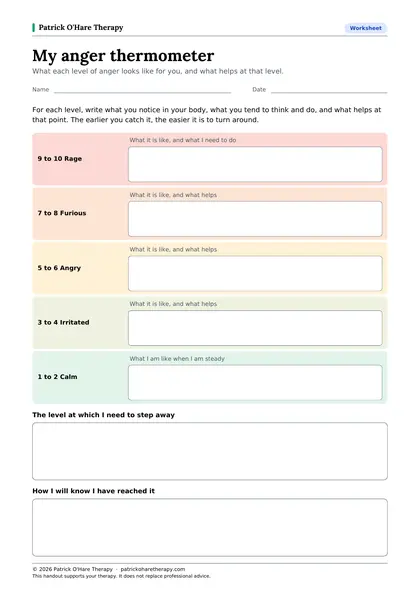 My anger thermometerWorksheet, 1 pageA scale of anger from mild to boiling. Describe your body signs, thoughts and behaviour at each level, and what helps there.
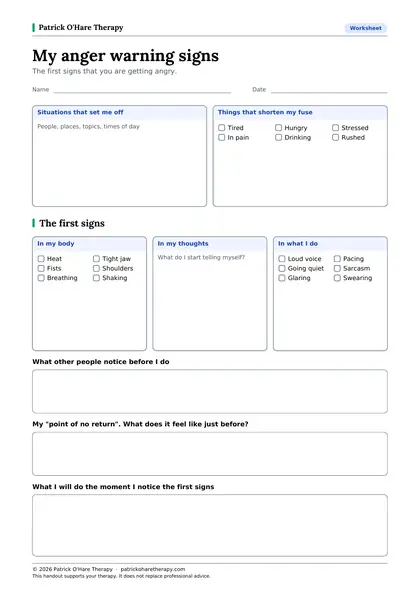 My anger warning signsWorksheet, 1 pageWork out the situations that set you off, what makes you more likely to snap, and your earliest body, thought and behaviour signs.
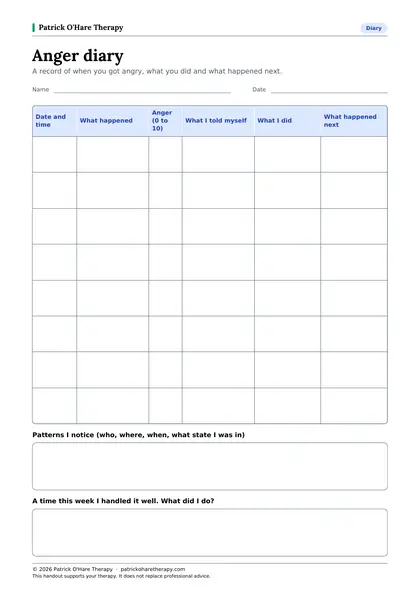 Anger diaryDiary, 1 pageA log for each time anger shows up: the trigger, how strong it was, what you thought, what you did and what followed.
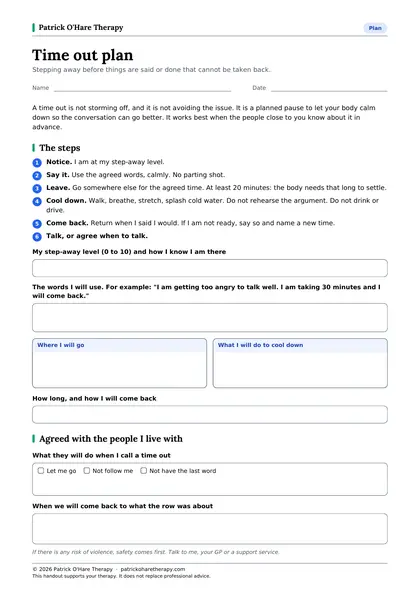 Time out planPlan, 1 pageA plan for stepping away before things escalate, including how to explain it to a partner or family so that leaving is not taken as walking out.
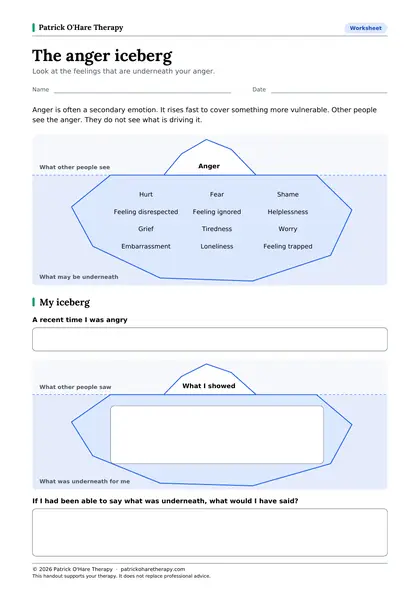 The anger icebergWorksheet, 1 pageThe anger iceberg, with the feelings that usually sit underneath, plus a blank one for an example of your own.
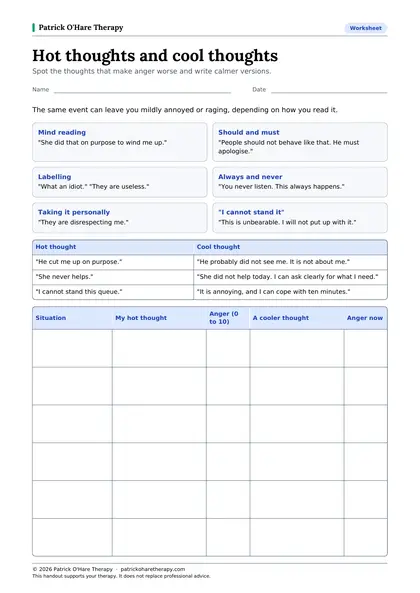 Hot thoughts and cool thoughtsWorksheet, 1 pageSpot the kinds of thoughts that fuel anger, then write cooler versions for your own triggers.
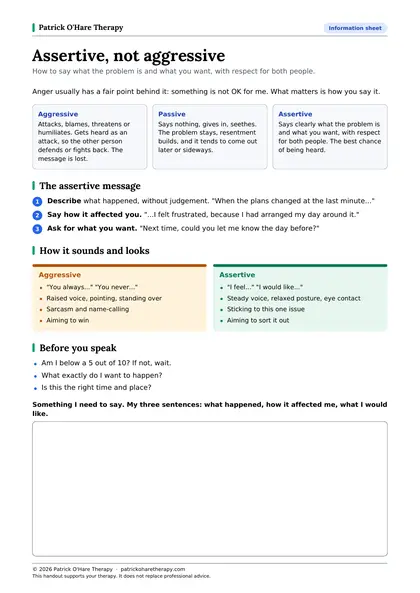 Assertive, not aggressiveInformation sheet, 1 pageCompares aggressive, passive and assertive ways of responding when you are angry, with a structure for saying what you need.
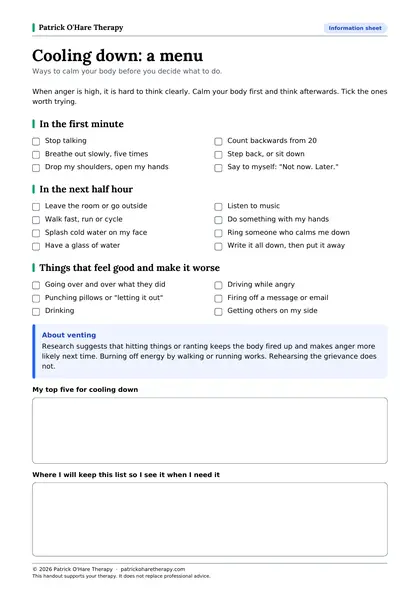 Cooling down: a menuInformation sheet, 1 pageA menu of quick and slower ways to bring anger down, with space to pick your own top five.
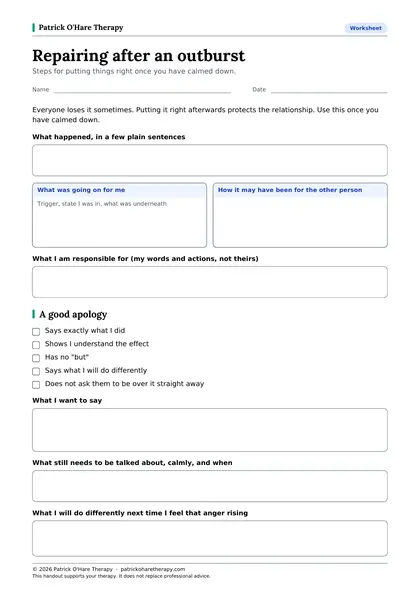 Repairing after an outburstWorksheet, 1 pageFor after an outburst: understand what happened, take responsibility, apologise well and plan for next time.
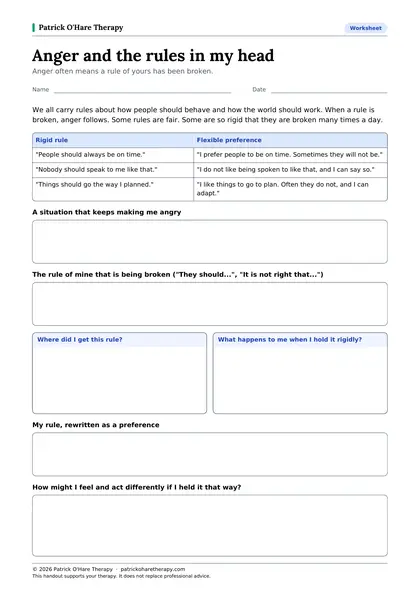 Anger and the rules in my headWorksheet, 1 pageLooks at the personal rules and expectations behind anger that keeps coming back, and helps you turn rigid demands into preferences.
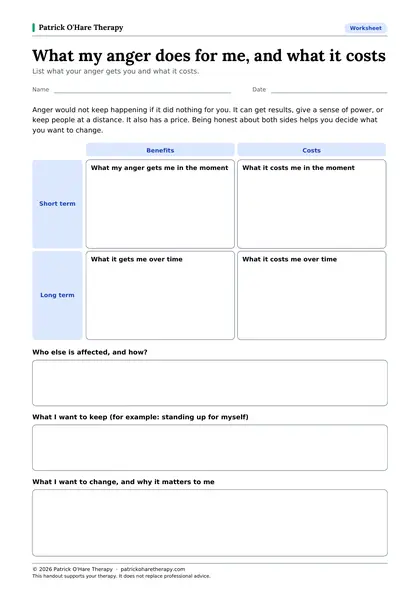 What my anger does for me, and what it costsWorksheet, 1 pageA look at what your anger gets you and what it costs, in the moment and over time.
Emotions 24
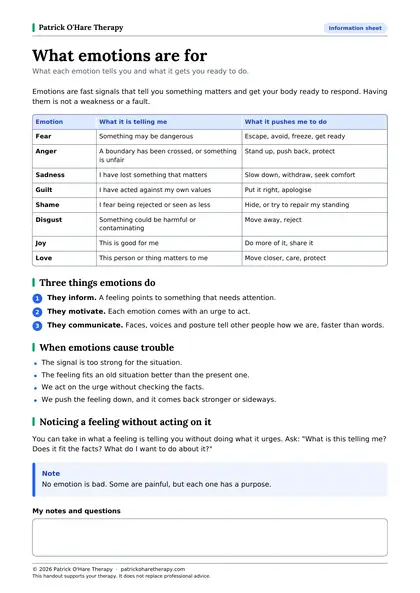 What emotions are forInformation sheet, 1 pageExplains what each of the main emotions is for and what it pushes us to do, and why pushing feelings down tends to backfire.
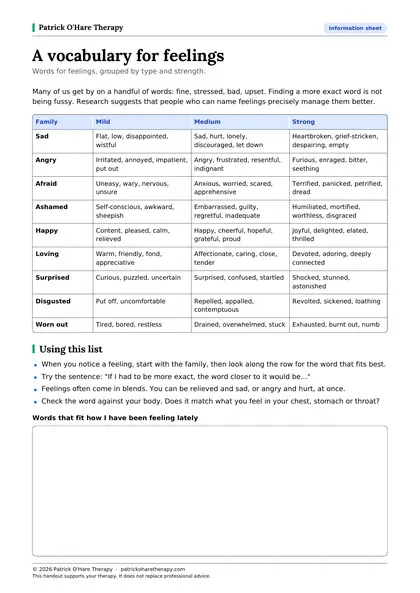 A vocabulary for feelingsInformation sheet, 1 pageA list of feeling words grouped by family and by strength, to help you name what you feel more exactly.
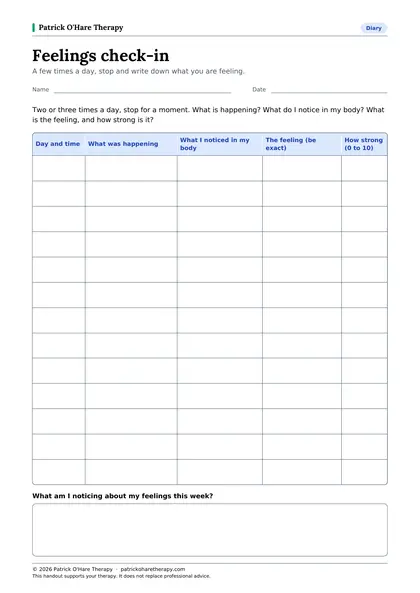 Feelings check-inDiary, 1 pageA daily check-in: what was happening, what you noticed in your body, the word for the feeling and how strong it was.
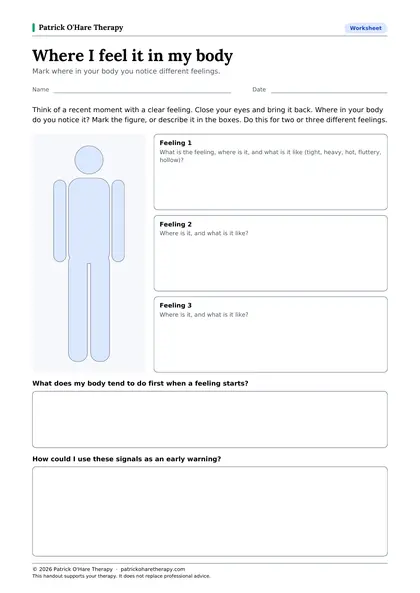 Where I feel it in my bodyWorksheet, 1 pageA body map for marking where you feel emotions as physical sensations. Helpful if you find it hard to say what you are feeling.
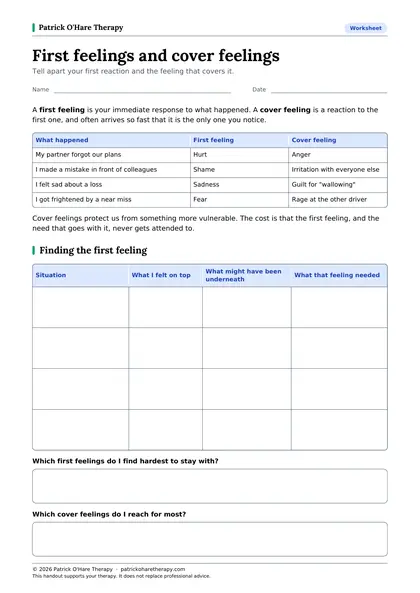 First feelings and cover feelingsWorksheet, 1 pageExplains how one feeling can cover another, with examples, and a log for practising finding the feeling underneath.
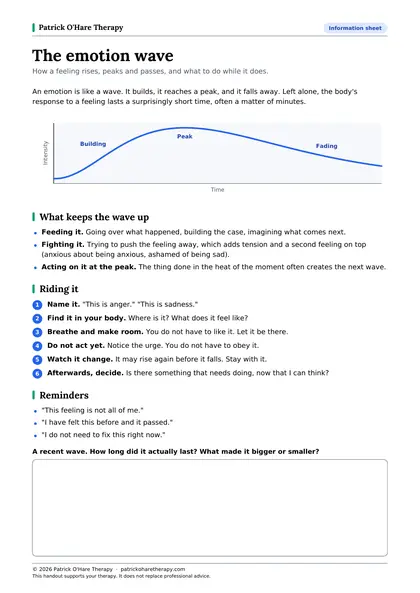 The emotion waveInformation sheet, 1 pageShows that feelings rise, peak and pass when they are not fed or fought, with a wave graph and steps for riding one out.
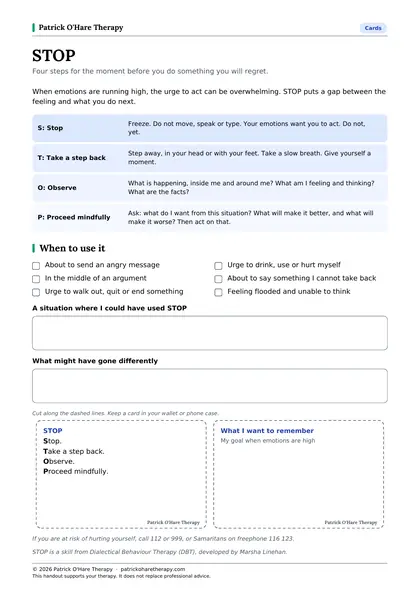 STOPCards, 1 pageThe STOP skill on one page with a card for your wallet: stop, take a step back, observe, proceed mindfully. For when emotion is high and you are about to react.
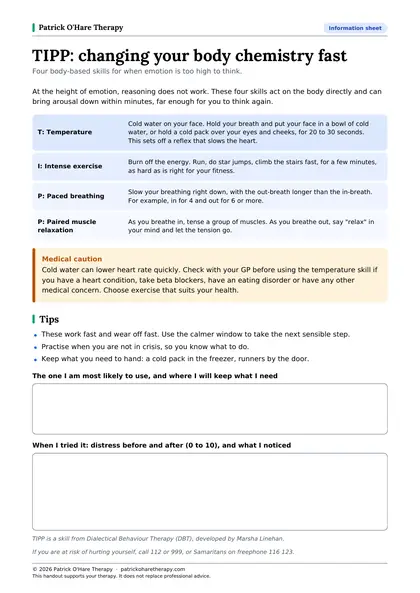 TIPP: changing your body chemistry fastInformation sheet, 1 pageFour fast ways to bring extreme emotion down through the body: cold temperature, intense exercise, paced breathing and muscle relaxation. With medical cautions.
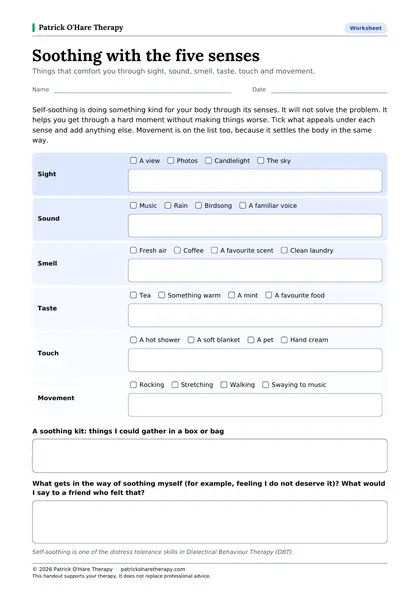 Soothing with the five sensesWorksheet, 1 pageA planner for comforting yourself through sight, sound, smell, taste and touch, plus movement. Build your own list, and a small soothing kit if you like.
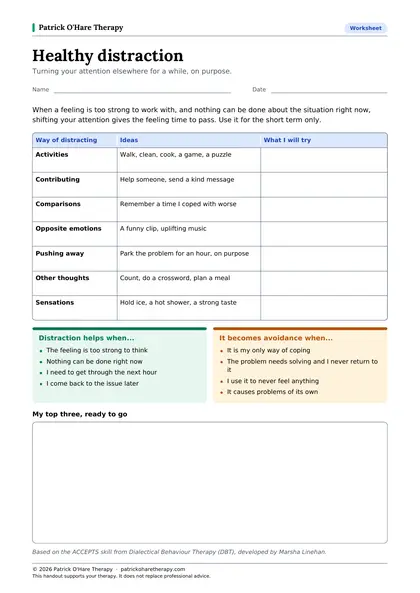 Healthy distractionWorksheet, 1 pageA planner for healthy distraction, with ideas in seven categories and a clear note on when distraction helps and when it turns into avoidance.
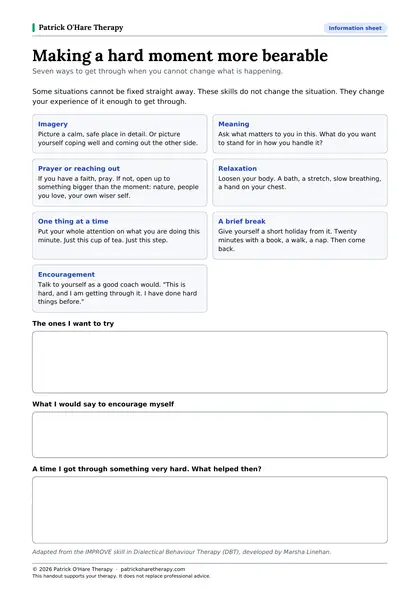 Making a hard moment more bearableInformation sheet, 1 pageSeven ways to make a hard moment more bearable when you cannot change what is happening, with examples and space for your own versions.
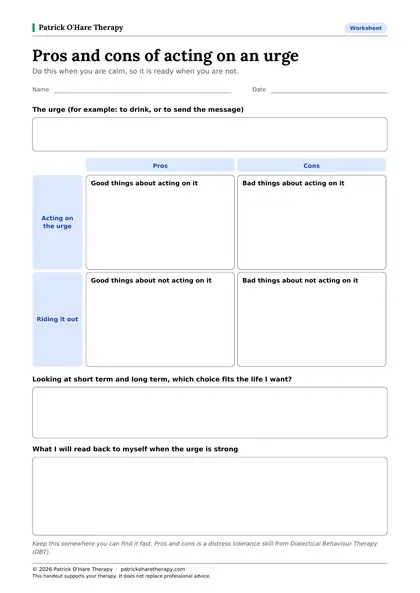 Pros and cons of acting on an urgeWorksheet, 1 pageA four-box grid for one harmful urge: the pros and cons of acting on it, and of riding it out. Fill it in when you are calm.
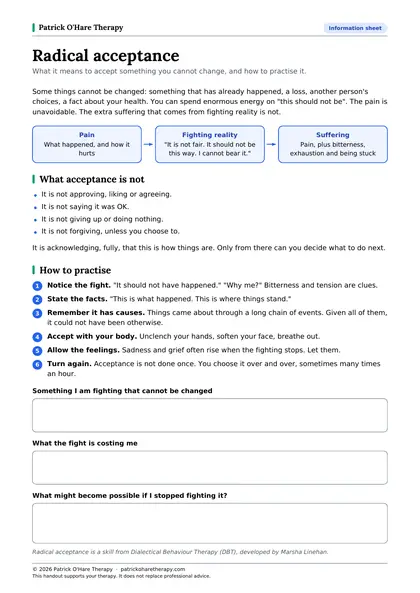 Radical acceptanceInformation sheet, 1 pageWhat radical acceptance is and is not, how fighting reality adds suffering to pain, and steps for practising it.
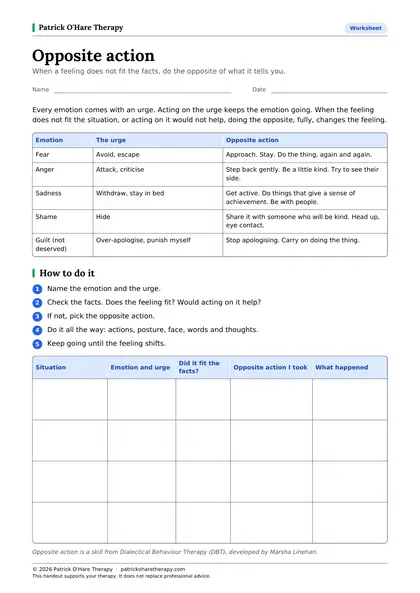 Opposite actionWorksheet, 1 pageExplains acting opposite to what an unhelpful emotion urges, with a table of emotions, urges and opposite actions, and a practice log.
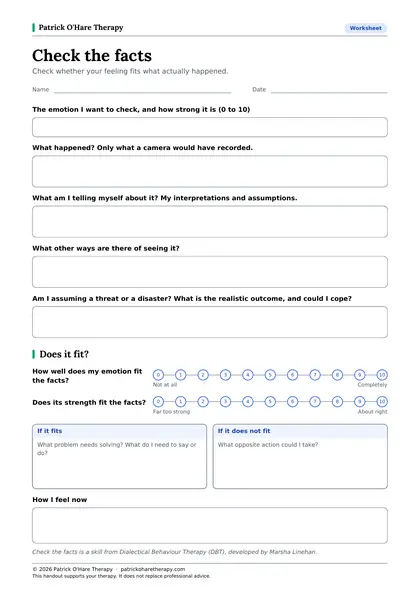 Check the factsWorksheet, 1 pageA worksheet for separating what happened from your reading of it, and deciding whether the feeling, and its strength, fit the facts.
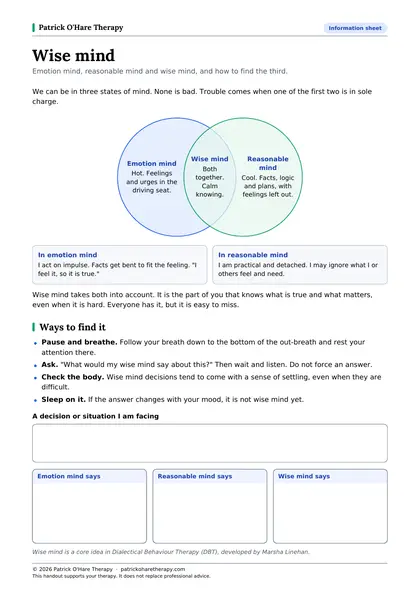 Wise mindInformation sheet, 1 pageIntroduces three states of mind (emotion mind, reasonable mind and wise mind) with a diagram and ways to find wise mind.
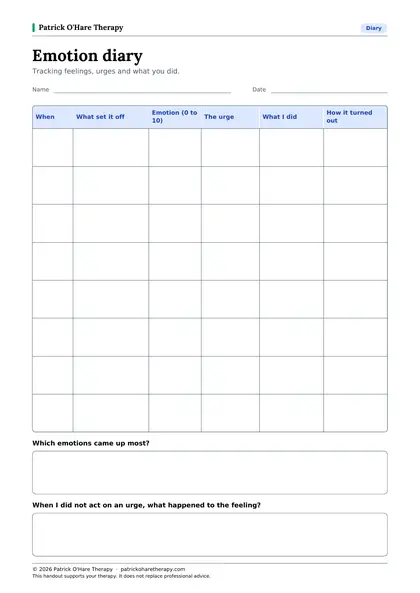 Emotion diaryDiary, 1 pageA daily log of what set a feeling off, how strong it was, what it urged you to do, what you did and how it turned out.
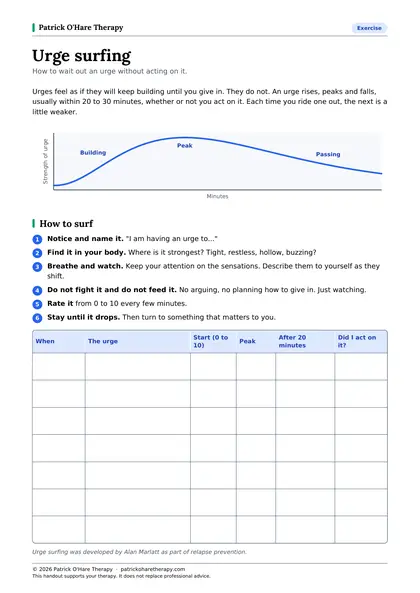 Urge surfingExercise, 1 pageA guided practice for riding out a craving or impulse without acting on it, with a record of how the urge rises and falls.
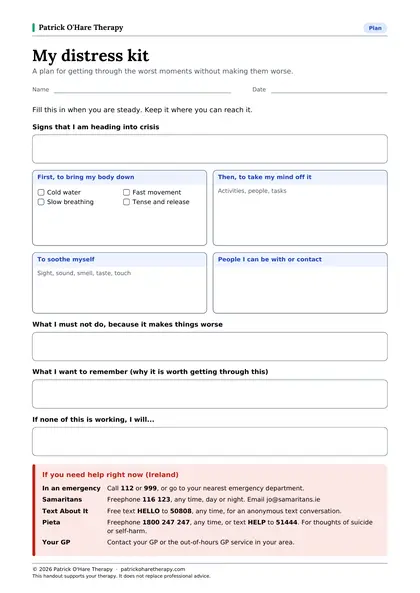 My distress kitPlan, 1 pageYour own plan for the worst moments: fast ways to calm the body, distraction, soothing, people to contact and reasons to hold on.
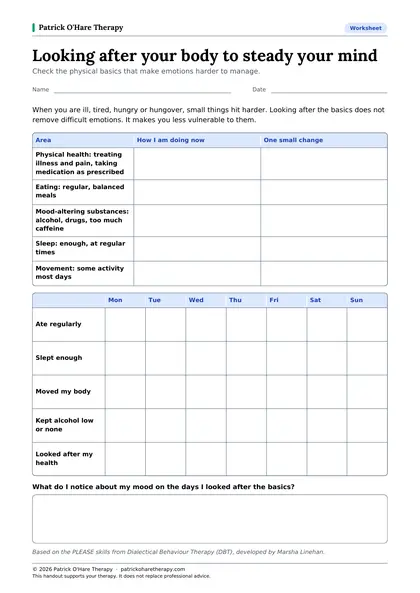 Looking after your body to steady your mindWorksheet, 1 pageA check on the body basics that steady your mood: illness, eating, alcohol and drugs, sleep and exercise, with a weekly tracker.
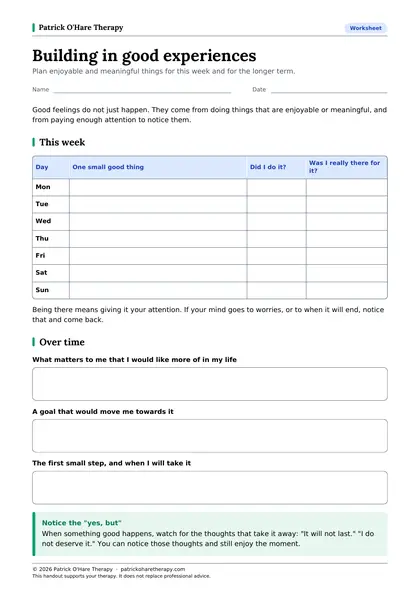 Building in good experiencesWorksheet, 1 pageA planner for adding small pleasant things to your days now, and working towards longer-term goals that matter to you.
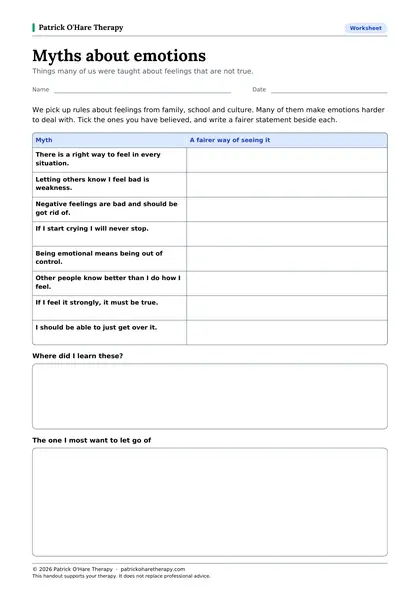 Myths about emotionsWorksheet, 1 pageA list of common beliefs about feelings that are not true, with space to write your answer to each. Especially useful if feelings were dismissed when you were growing up.
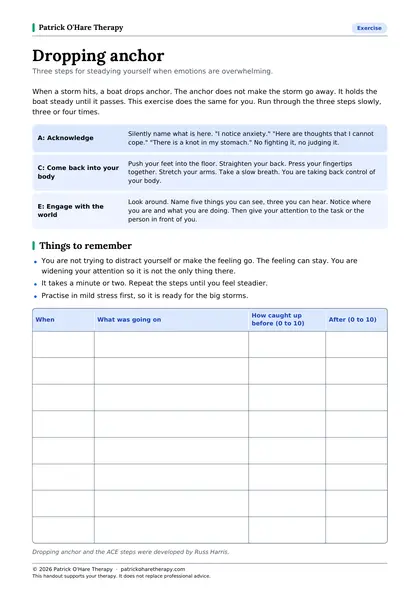 Dropping anchorExercise, 1 pageA three-step exercise for moments of overwhelm: acknowledge what is here, come back into your body, and engage with the world around you. With a practice record.
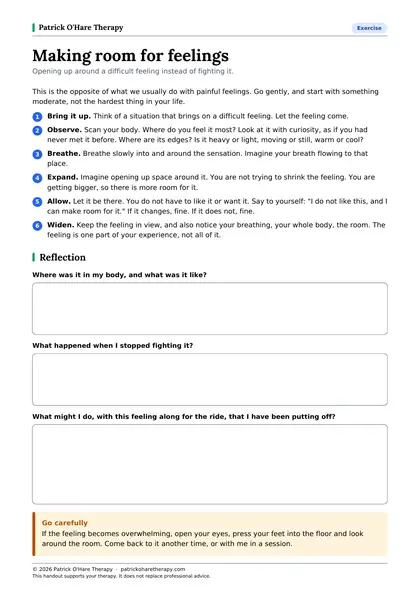 Making room for feelingsExercise, 1 pageA guided exercise for a difficult feeling: observe it, breathe into it, make room around it and let it be there. With questions to reflect on.
Self-esteem and self-criticism 33
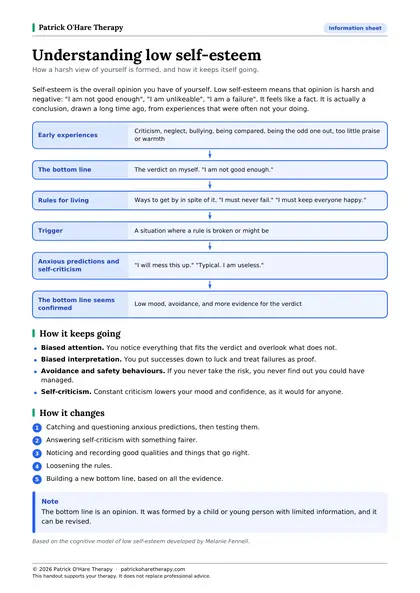 Understanding low self-esteemInformation sheet, 1 pageExplains how low self-esteem forms and keeps going: early experiences, the verdict you reached on yourself, the rules you live by, and where change is possible.
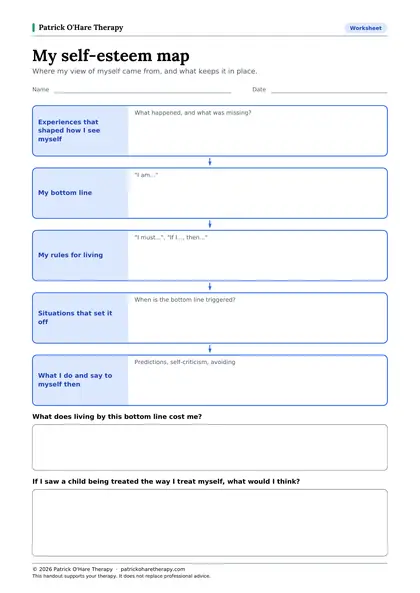 My self-esteem mapWorksheet, 1 pageA fill-in map of your own low self-esteem: the experiences behind it, your verdict on yourself, your rules, typical triggers and the reactions that keep it in place.
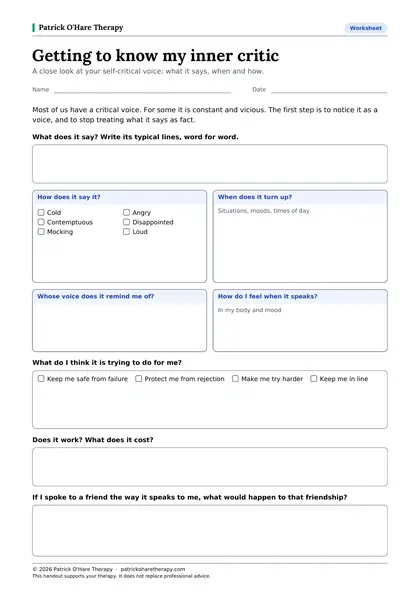 Getting to know my inner criticWorksheet, 1 pageA close look at your self-critical voice: its words, tone and triggers, where it came from, what it is trying to do and what it does to you.
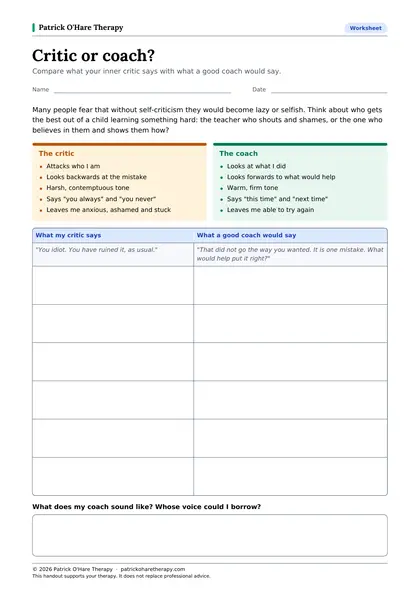 Critic or coach?Worksheet, 1 pageCompares harsh self-criticism with the way a good coach corrects, and gives practice in turning critic lines into coach lines.
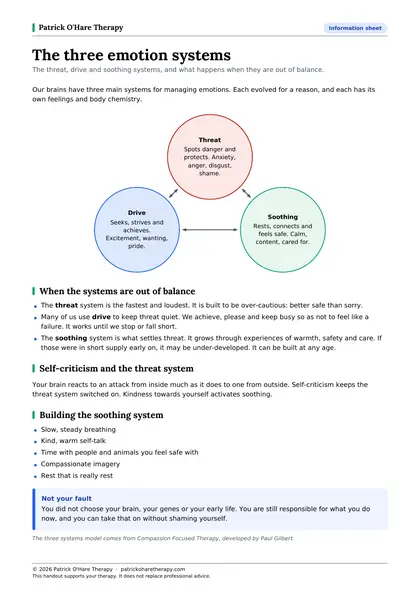 The three emotion systemsInformation sheet, 1 pageIntroduces the three emotion systems (threat, drive and soothing) with a diagram, and explains why the soothing system often needs building up.
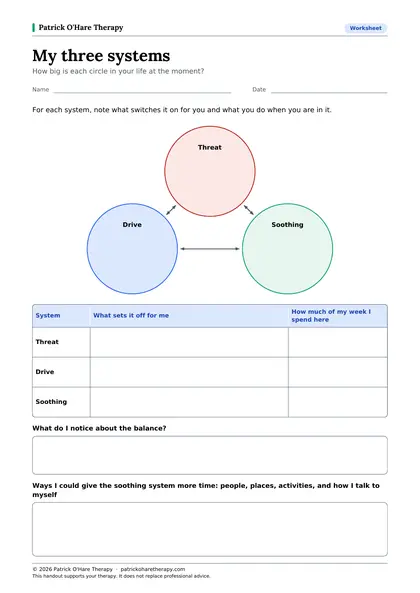 My three systemsWorksheet, 1 pageYour own three systems map: what sets each one off, how much time you spend in each, and how to grow the soothing one.
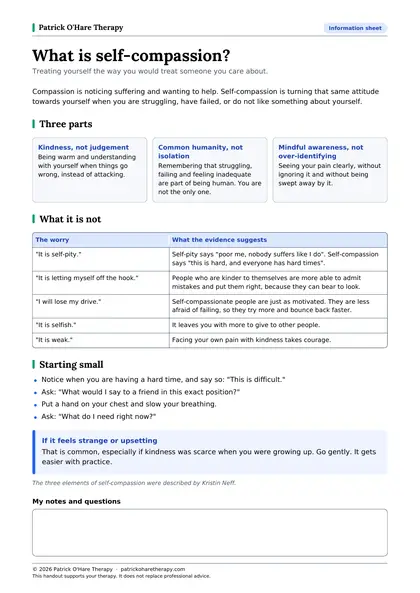 What is self-compassion?Information sheet, 1 pageWhat self-compassion is, its three parts, the common fears about it (that it is soft, selfish or self-pitying) and some first steps.
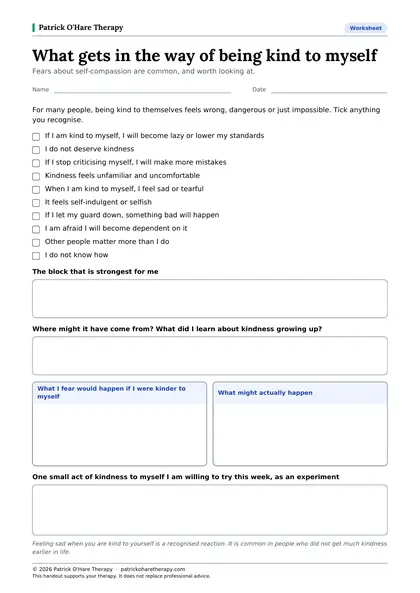 What gets in the way of being kind to myselfWorksheet, 1 pageA checklist of the common fears and blocks about being kind to yourself, with space to think about where yours came from and a small experiment.
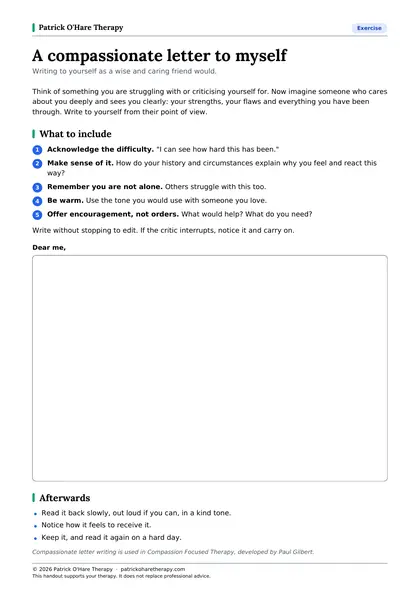 A compassionate letter to myselfExercise, 1 pageInstructions and prompts for writing yourself a compassionate letter about something you are struggling with, and space to write it.
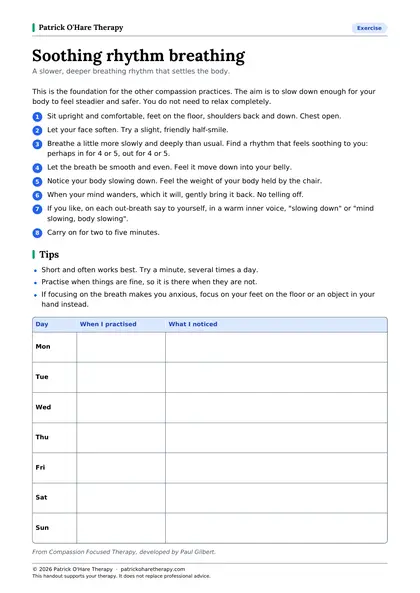 Soothing rhythm breathingExercise, 1 pageA script for slower, deeper breathing with a friendly face and a warm inner voice, as used in compassion-focused therapy, plus a practice log.
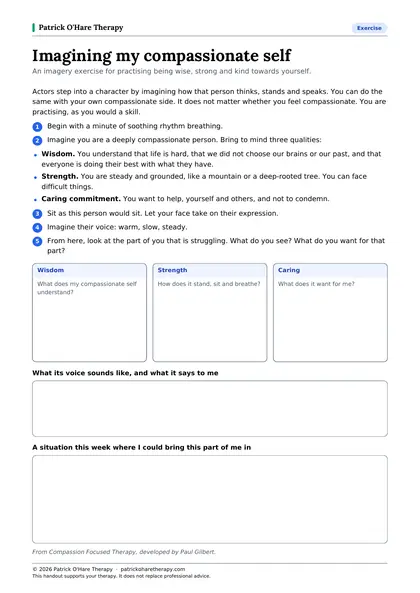 Imagining my compassionate selfExercise, 1 pageA guided imagery exercise for building your compassionate self, with prompts to describe its qualities, posture, voice and message.
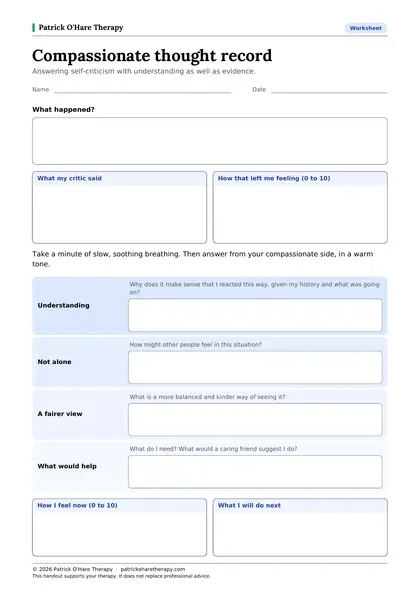 Compassionate thought recordWorksheet, 1 pageA thought record made for self-criticism. As well as the evidence, it asks what a compassionate way of seeing, thinking and acting would be.
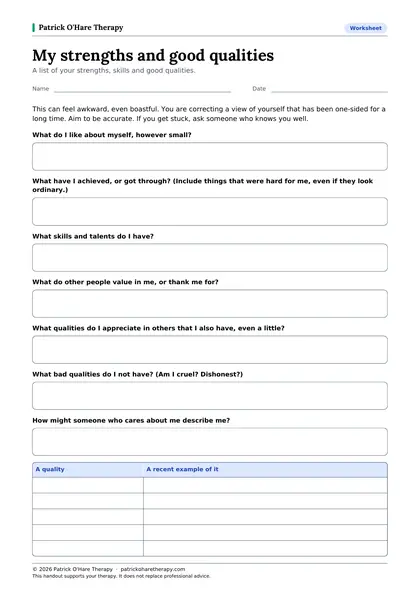 My strengths and good qualitiesWorksheet, 1 pageGuided prompts for building a list of your strengths, skills and good qualities, with the evidence for each.
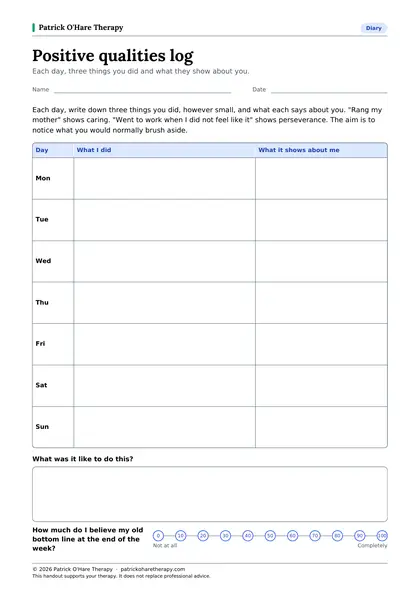 Positive qualities logDiary, 1 pageA daily log of something you did and the good quality it shows. Over a few weeks it builds a fairer picture of yourself.
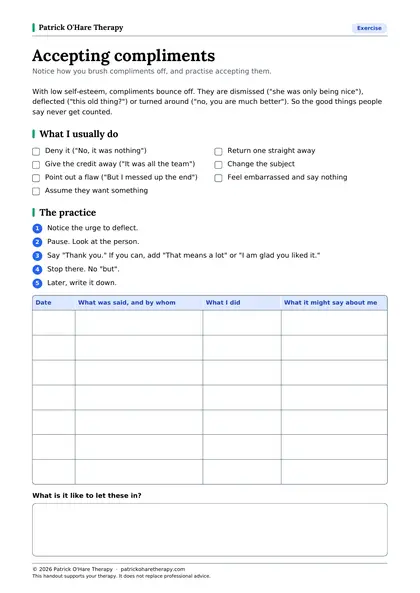 Accepting complimentsExercise, 1 pageA short exercise on noticing how you brush compliments off, practising accepting them, and keeping a note of the good things people say.
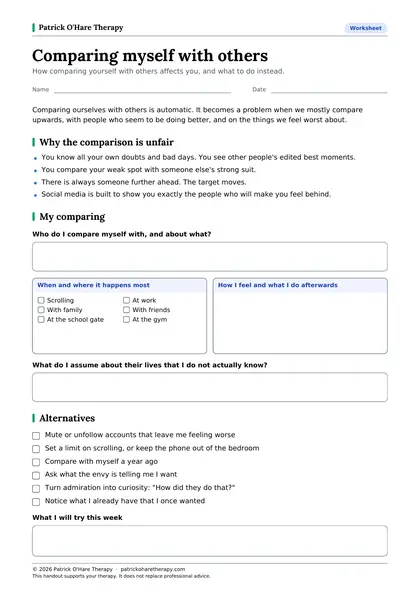 Comparing myself with othersWorksheet, 1 pageExplains how comparing yourself with people who seem to be doing better affects your self-worth, especially online, with a personal check and alternatives.
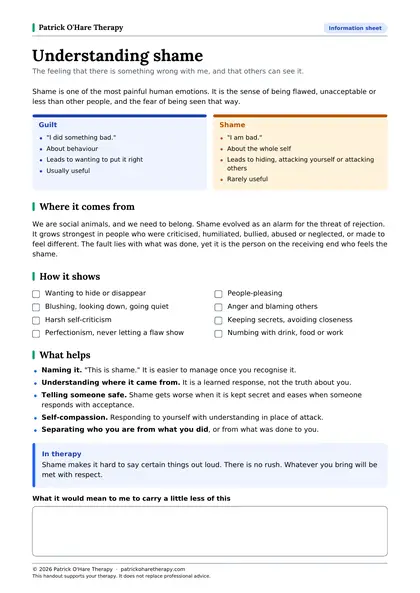 Understanding shameInformation sheet, 1 pageHow shame differs from guilt, where it comes from, how it shows up and what helps it heal.
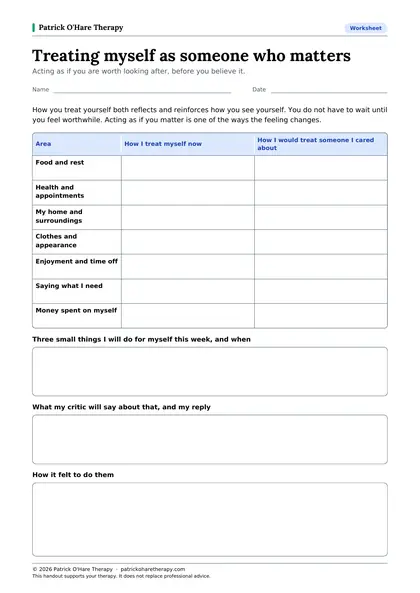 Treating myself as someone who mattersWorksheet, 1 pageA check of the everyday ways you may be neglecting yourself, with small acts of care to plan in. Acting as if you matter comes first, and the belief follows.
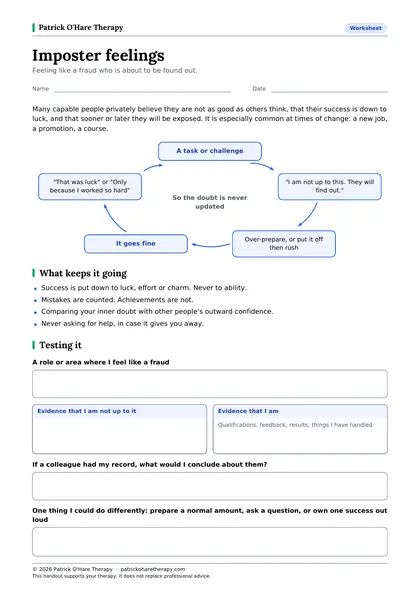 Imposter feelingsWorksheet, 1 pageExplains imposter feelings and the over-preparing and discounting that keep them going, with a worksheet to test the evidence.
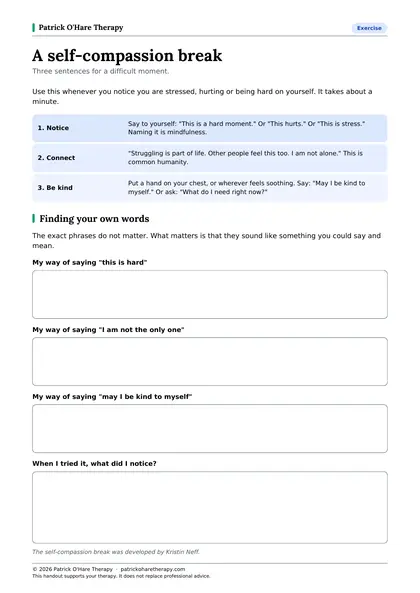 A self-compassion breakExercise, 1 pageA short practice in three steps: this is hard, I am not alone in it, may I be kind to myself. With space for your own wording.
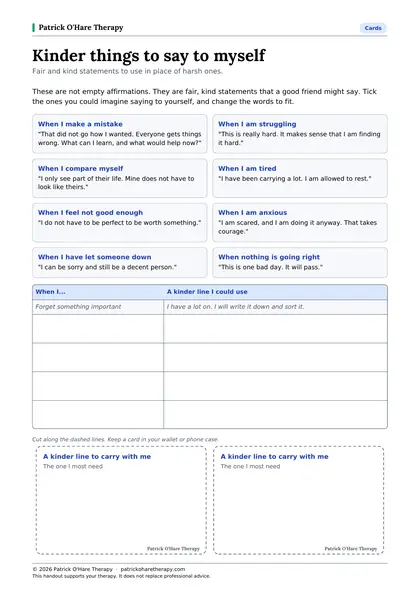 Kinder things to say to myselfCards, 1 pageKinder lines for common moments (mistakes, struggling, comparing, tiredness), with space to plan what you will say and two cards to carry with you.
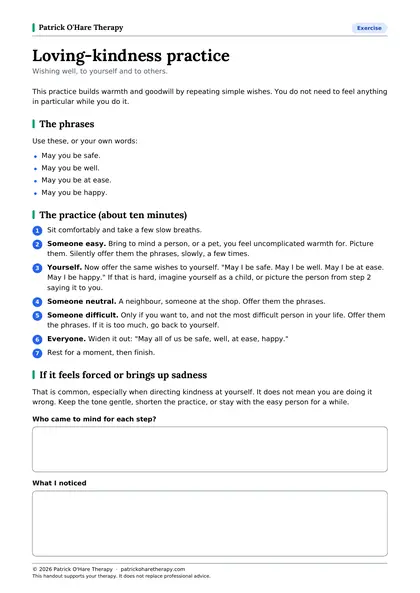 Loving-kindness practiceExercise, 1 pageA short script for wishing well to someone you love, yourself, a neutral person and someone difficult, with guidance for when it feels forced.
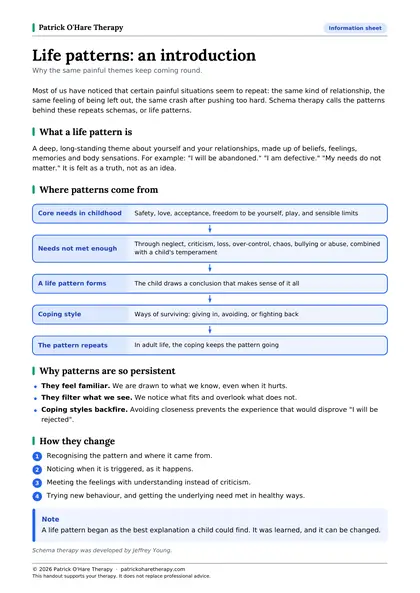 Life patterns: an introductionInformation sheet, 1 pageIntroduces life patterns (schemas) in plain language: what they are, how they grow from needs that were not met in childhood, and how they repeat.
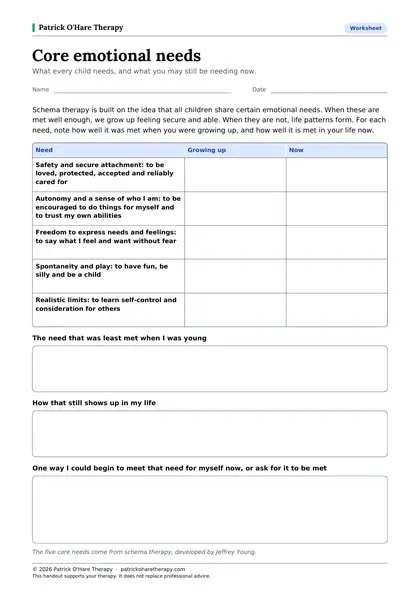 Core emotional needsWorksheet, 1 pageDescribes the five core emotional needs from schema therapy, with space to reflect on how each was met when you were a child and how it is met now.
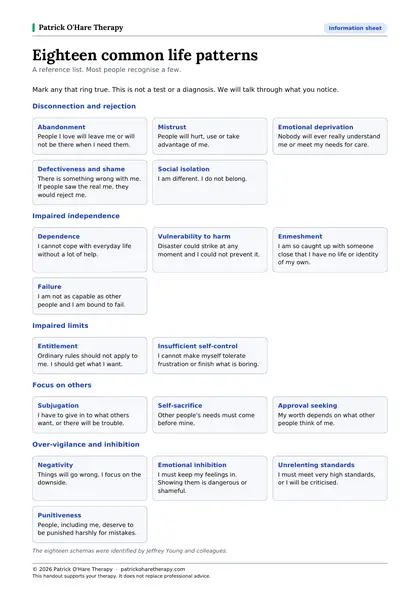 Eighteen common life patternsInformation sheet, 1 pageA short description of each of the eighteen life patterns (schemas), in groups. A reference list for spotting your own.
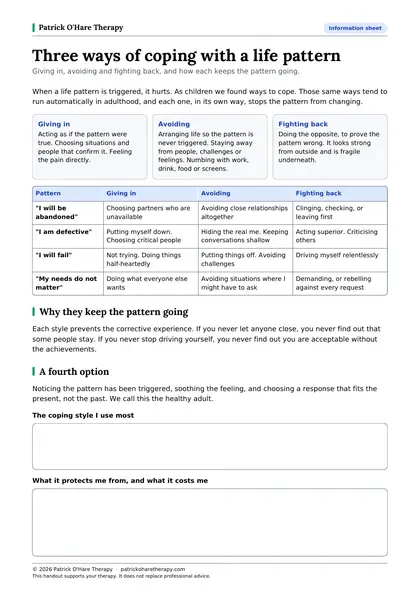 Three ways of coping with a life patternInformation sheet, 1 pageExplains giving in to a pattern, avoiding it and fighting back against it, with examples, and introduces a healthier alternative.
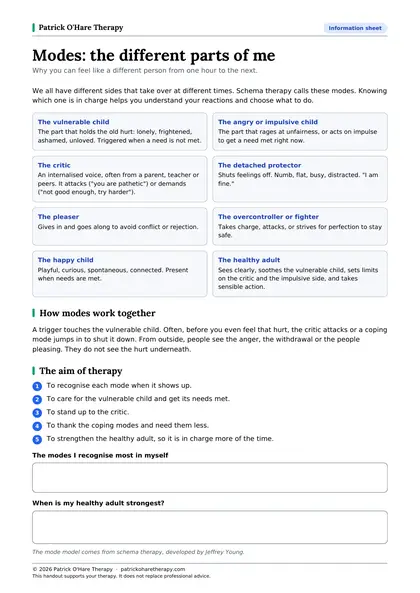 Modes: the different parts of meInformation sheet, 1 pageIntroduces the different parts of us in everyday language: the vulnerable child, the angry child, the critic, the coping parts and the healthy adult.
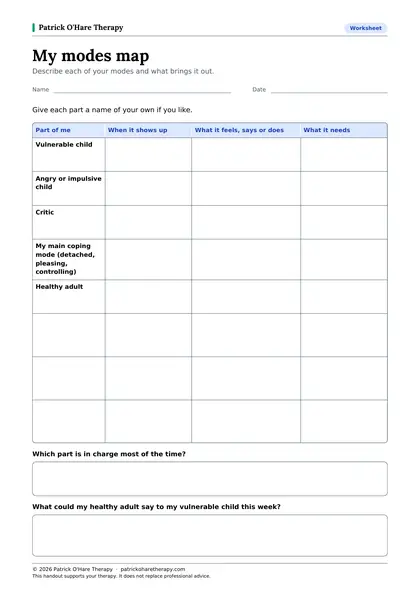 My modes mapWorksheet, 1 pageYour own map of your parts: what sets each one off, what it says or feels, what it does and what it needs.
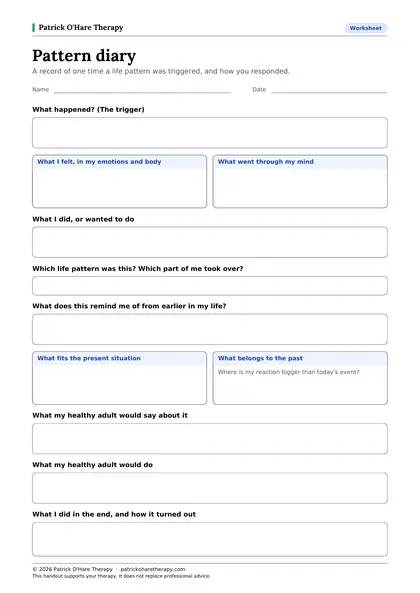 Pattern diaryWorksheet, 1 pageA diary for one upsetting event: your feelings and thoughts, the pattern and where it comes from, where you over-reacted, and a healthier view and response.
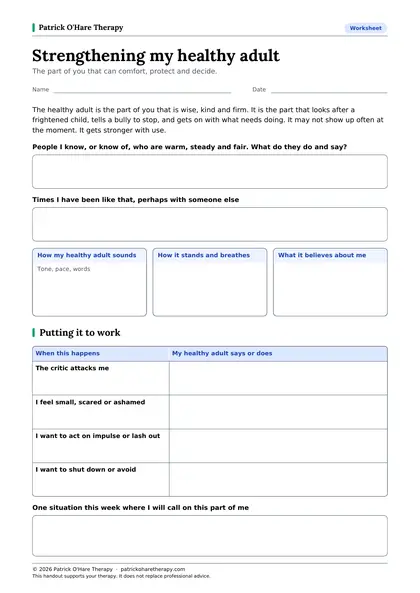 Strengthening my healthy adultWorksheet, 1 pageBuilds up your healthy adult side: describe it, borrow from people you admire, and script what it would say to your critic and to your vulnerable side.
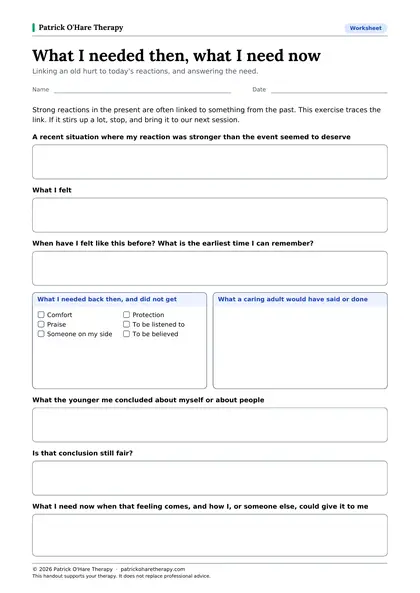 What I needed then, what I need nowWorksheet, 1 pageA worksheet that links a childhood experience to a present-day trigger, and works out how the need can be met now.
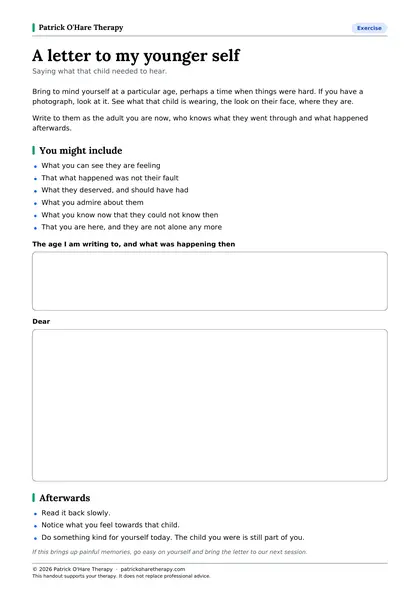 A letter to my younger selfExercise, 1 pageA guided letter from you as an adult to yourself at a particular age, with prompts and space to write.
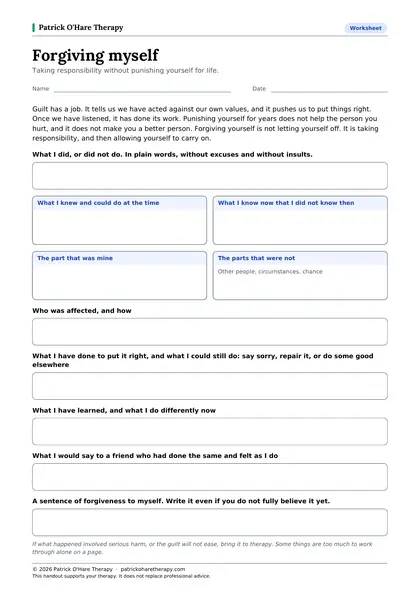 Forgiving myselfWorksheet, 1 pageA guided worksheet for guilt over something you did or did not do: own your part fairly, put right what you can, learn from it and let the self-punishment go.
Perfectionism and procrastination 11
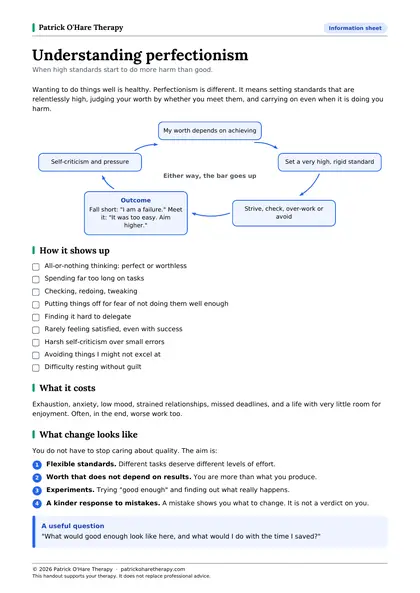 Understanding perfectionismInformation sheet, 1 pageExplains unhelpful perfectionism: self-worth tied to achievement, the cycle that keeps it going, and what change involves. Change means more flexible standards. It does not mean lower ones.
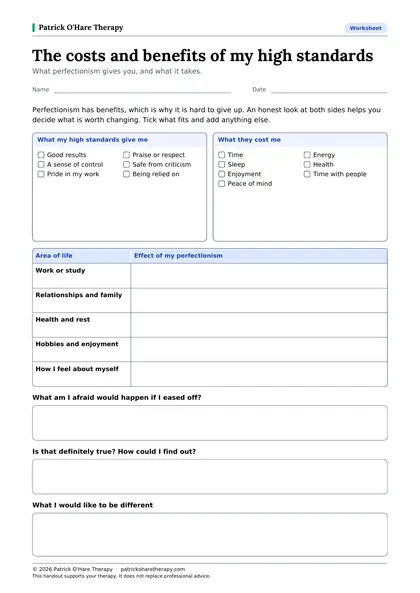 The costs and benefits of my high standardsWorksheet, 1 pageA balanced look at what perfectionism gives you and what it takes from you across the areas of your life.
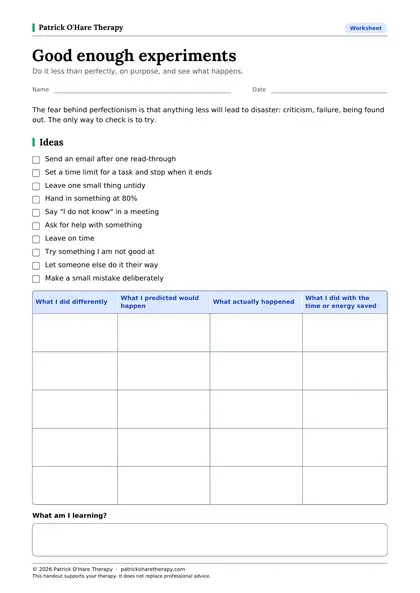 Good enough experimentsWorksheet, 1 pageA log for doing something less than perfectly on purpose, or checking it less, and comparing what you predicted with what happened.
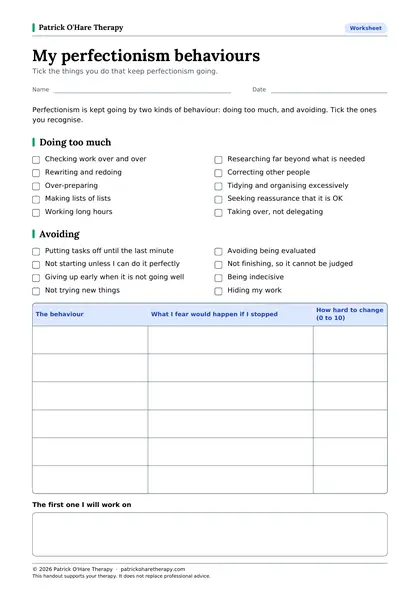 My perfectionism behavioursWorksheet, 1 pageA checklist of the overdoing and avoiding habits that go with perfectionism. Pick the first ones to change.
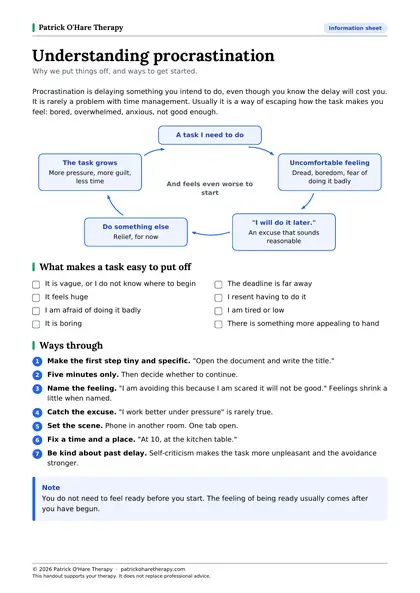 Understanding procrastinationInformation sheet, 1 pageExplains procrastination as a way of avoiding a feeling, with the cycle that keeps it going, the usual excuses and practical ways through.
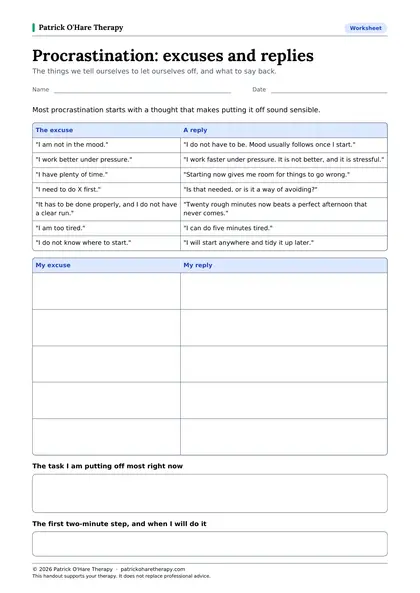 Procrastination: excuses and repliesWorksheet, 1 pageCommon excuses for putting things off, each with a realistic reply, then space to answer your own.
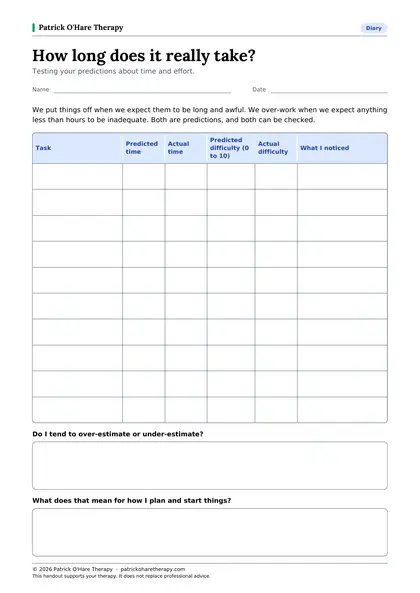 How long does it really take?Diary, 1 pageA log comparing how long and how hard you expect a task to be with how it turned out. Useful for putting things off and for overworking.
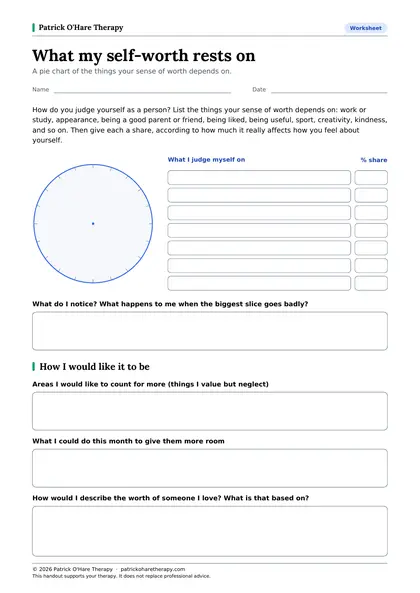 What my self-worth rests onWorksheet, 1 pageA pie chart of what your sense of worth rests on now, such as work, looks or achievement, and how you would like it to look.
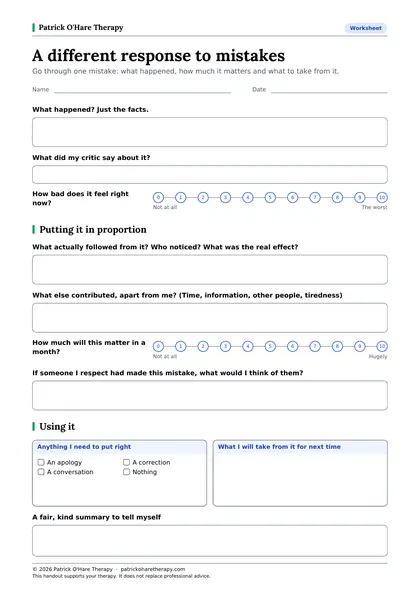 A different response to mistakesWorksheet, 1 pageA way to go back over one mistake: separate the facts from the self-attack, put it in proportion, and decide what to learn and what to put right.
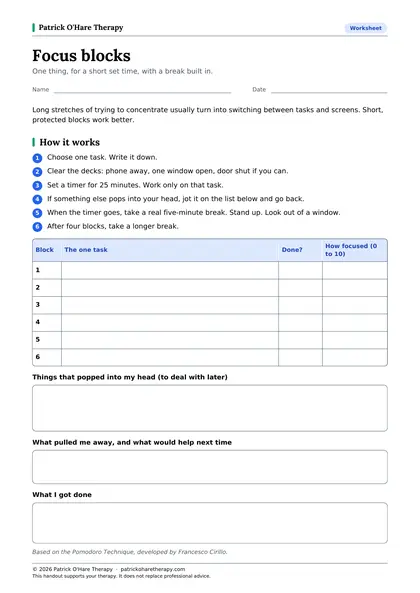 Focus blocksWorksheet, 1 pageA planner for working in short timed blocks with breaks, with a list for parking distractions and a review. For putting things off, overwhelm and scattered attention.
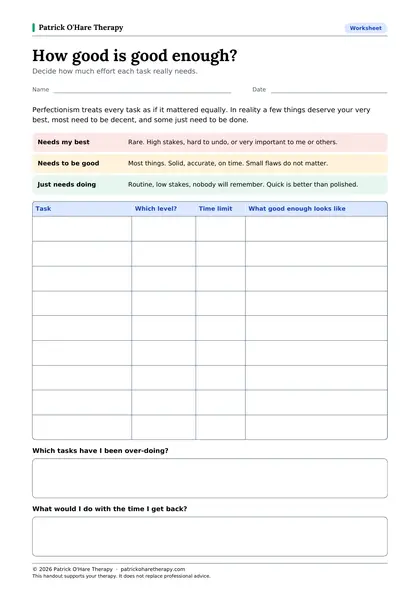 How good is good enough?Worksheet, 1 pageDecide what standard and how much time different tasks really deserve, instead of giving everything maximum effort.
Relationships and communication 29
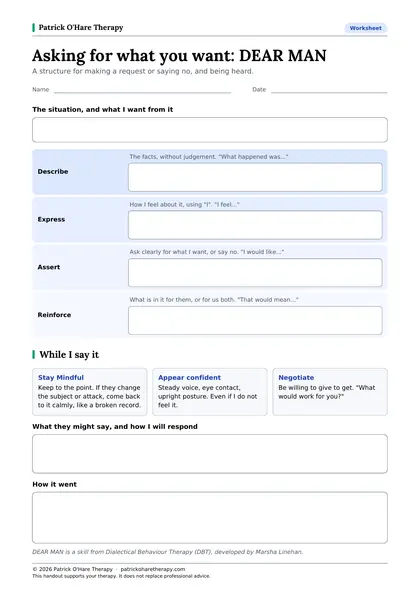 Asking for what you want: DEAR MANWorksheet, 1 pageA script builder for asking for something or saying no: describe, express, assert and reinforce, while staying mindful, confident and open to negotiating.
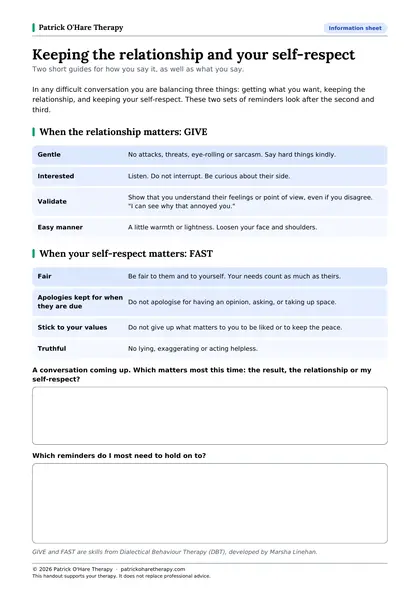 Keeping the relationship and your self-respectInformation sheet, 1 pageTwo short guides side by side: how to look after the relationship, and how to keep your self-respect, during a difficult conversation.
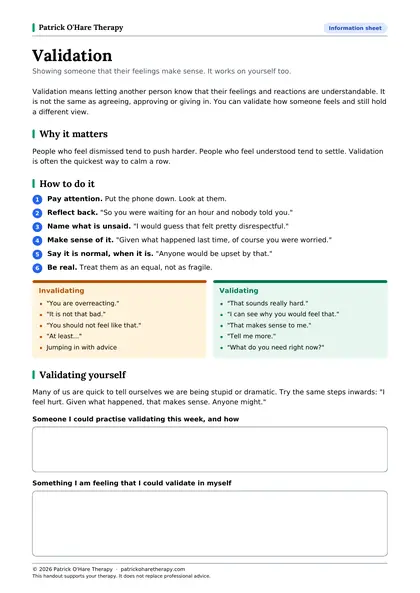 ValidationInformation sheet, 1 pageExplains what validation is, why it calms conflict, how to do it at different levels, and how to do it for yourself.
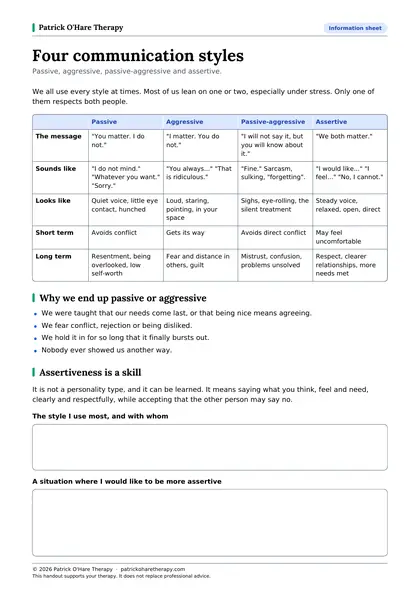 Four communication stylesInformation sheet, 1 pageDescribes the four communication styles: what each one says, looks like and leads to. A good starting point for becoming more assertive.
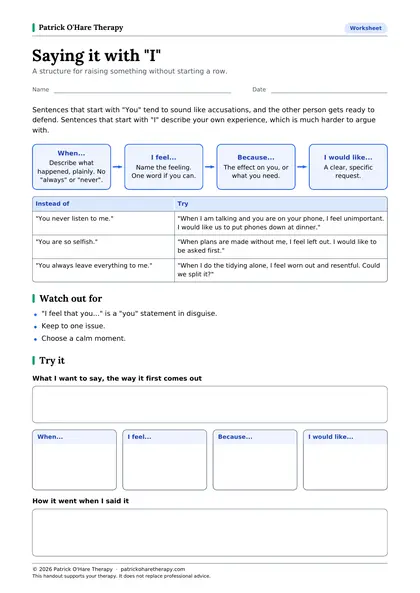 Saying it with "I"Worksheet, 1 pageTeaches the "I" statement formula with examples, then helps you turn your own "you always..." lines into "I" statements.
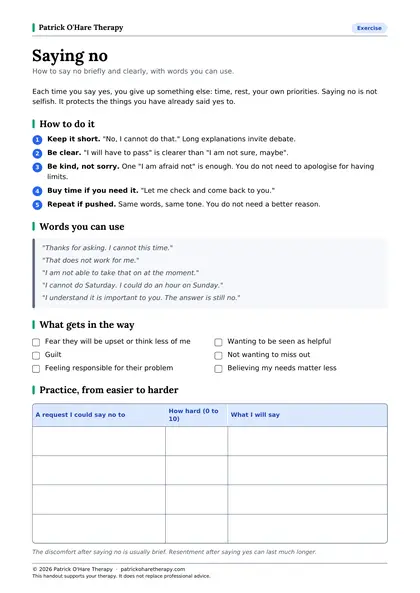 Saying noExercise, 1 pagePractical guidance and wording for turning down requests, handling pressure and sitting with the discomfort, with a list of steps to practise.
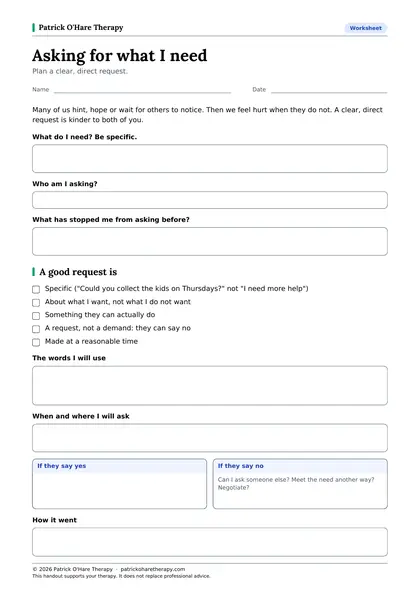 Asking for what I needWorksheet, 1 pageA planner for making a clear request: what you want, who to ask, how to word it and what to do if the answer is no.
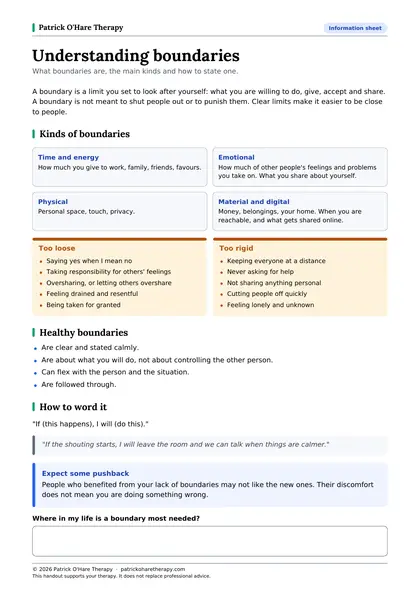 Understanding boundariesInformation sheet, 1 pageExplains personal boundaries: the different kinds, signs that yours are too loose or too rigid, and the principles of setting one.
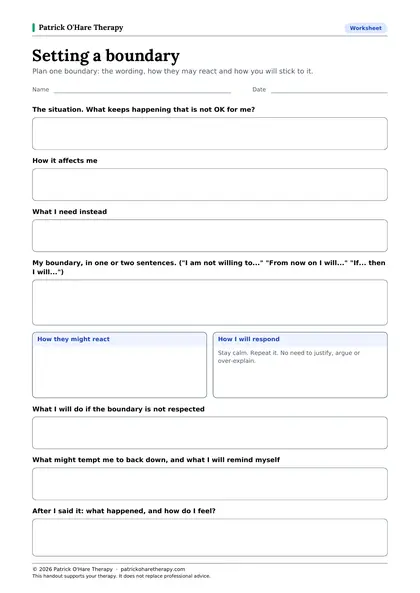 Setting a boundaryWorksheet, 1 pageA step-by-step planner for one boundary: the wording, how the other person may react, and how you will stick to it.
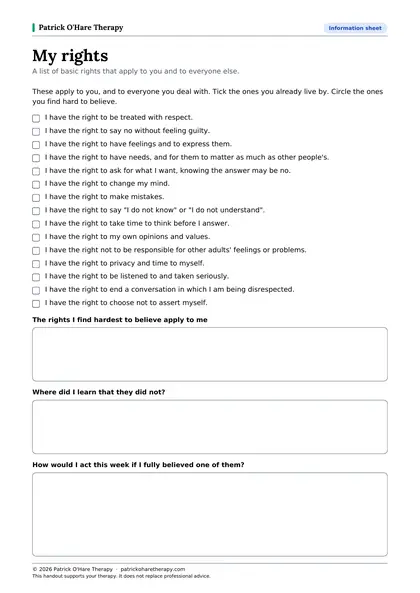 My rightsInformation sheet, 1 pageA list of the basic personal rights that assertiveness rests on. Mark the ones you find hard to believe.
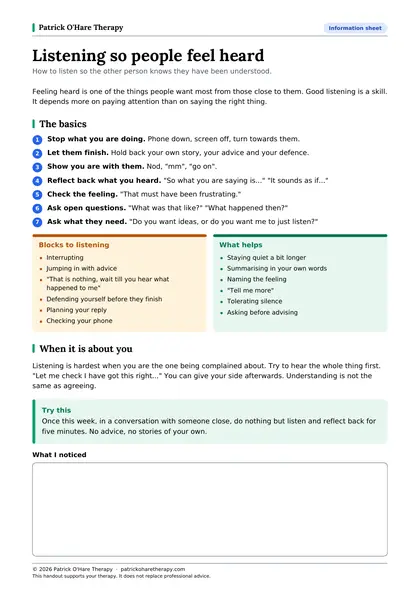 Listening so people feel heardInformation sheet, 1 pagePractical listening skills with examples of what helps and what gets in the way, and a short practice task.
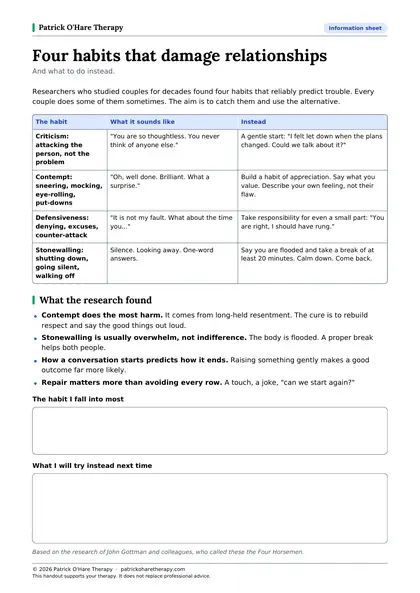 Four habits that damage relationshipsInformation sheet, 1 pageDescribes criticism, contempt, defensiveness and stonewalling, and what to do in place of each. Based on John Gottman's research with couples.
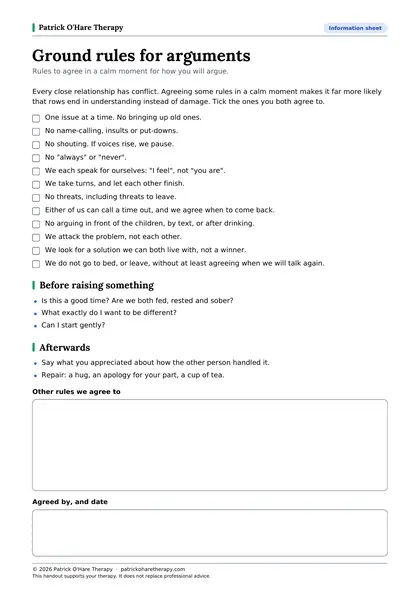 Ground rules for argumentsInformation sheet, 1 pageA set of rules for arguing constructively that couples or families can agree on, with space to add more and sign.
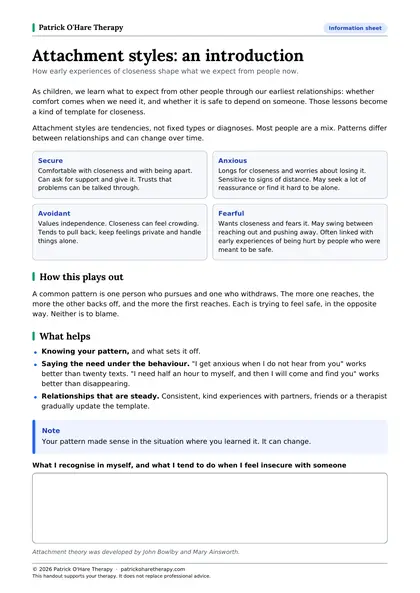 Attachment styles: an introductionInformation sheet, 1 pageA careful introduction to adult attachment patterns (secure, anxious, avoidant and fearful) without putting anyone in a box, and how patterns can shift.
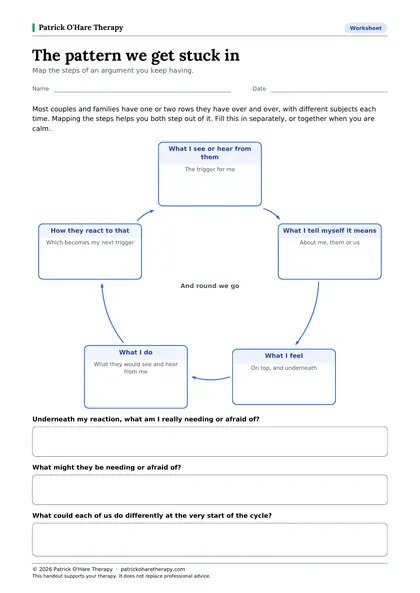 The pattern we get stuck inWorksheet, 1 pageA worksheet for mapping the loop two people get stuck in: what sets each of you off, what you feel, what you do, and how that lands on the other.
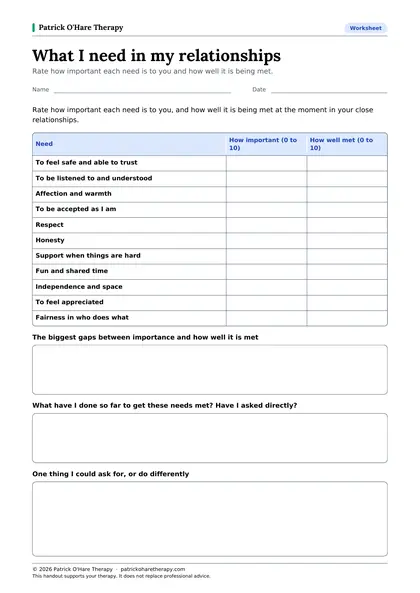 What I need in my relationshipsWorksheet, 1 pageWork out what you most need from the people close to you, rate how well each need is met, and plan what you can ask for or change.
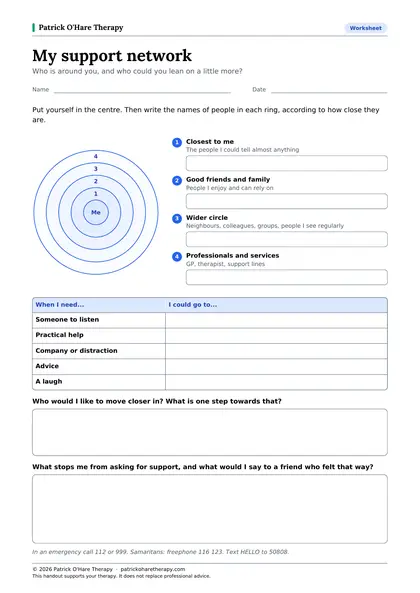 My support networkWorksheet, 1 pageA map of the people around you in circles, with prompts about who to turn to for what, and how to strengthen your network.
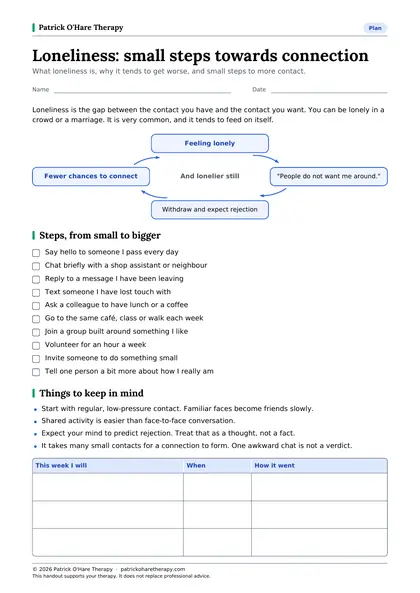 Loneliness: small steps towards connectionPlan, 1 pageExplains loneliness and the pulling back that keeps it going, then offers a menu of small steps towards people and a weekly plan.
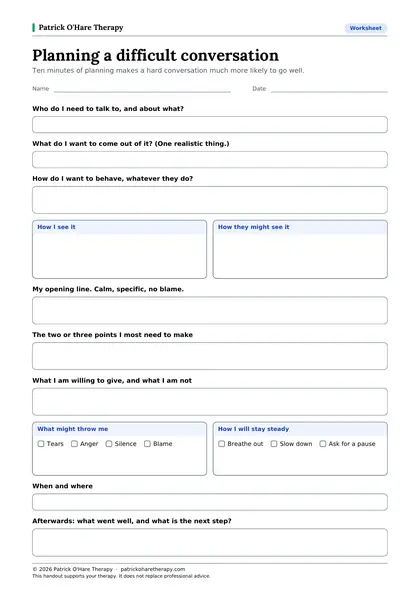 Planning a difficult conversationWorksheet, 1 pageA preparation sheet: your goal, your opening line, the main points, how the other person may see it and how you will stay steady.
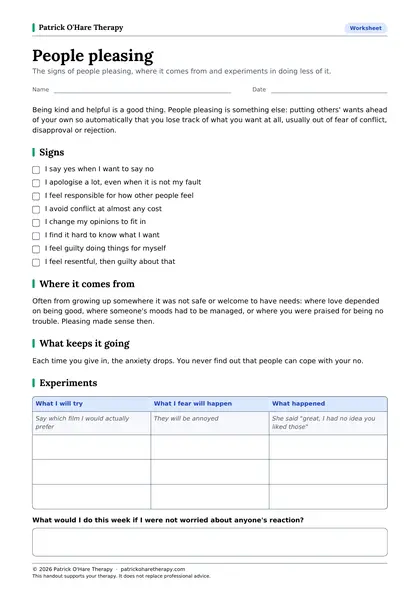 People pleasingWorksheet, 1 pageExplains people pleasing, where it comes from and what keeps it going, with a self-check and small experiments in doing less of it.
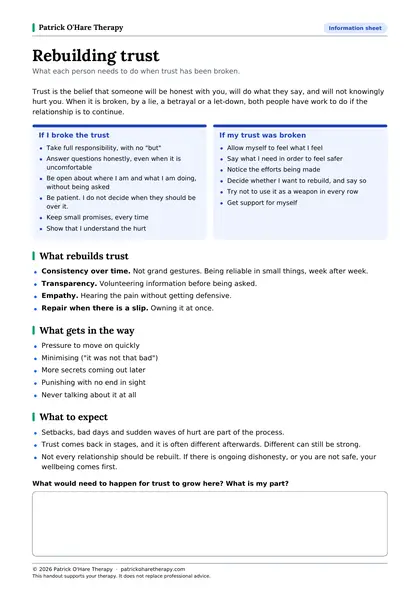 Rebuilding trustInformation sheet, 1 pageSets out what rebuilding trust asks of the person who broke it and of the person who was hurt, and what tends to get in the way.
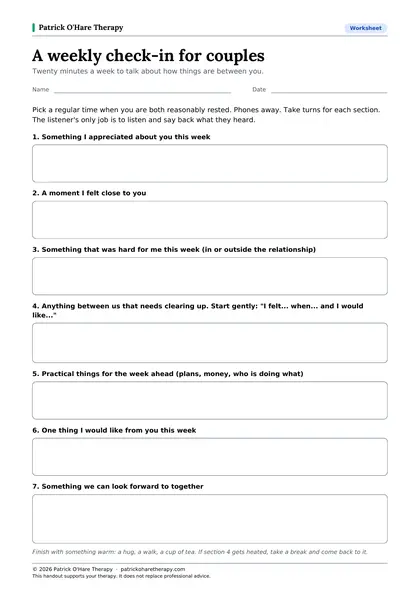 A weekly check-in for couplesWorksheet, 1 pageA weekly check-in for couples: what you appreciated, what went well, what was hard, practical matters and one request each.
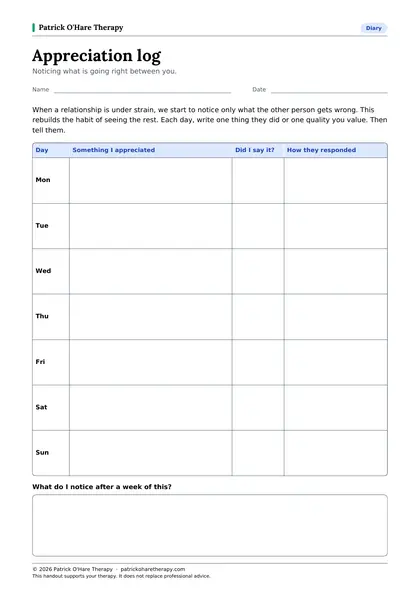 Appreciation logDiary, 1 pageA daily note of one thing you appreciated about a partner or family member, and whether you said it out loud.
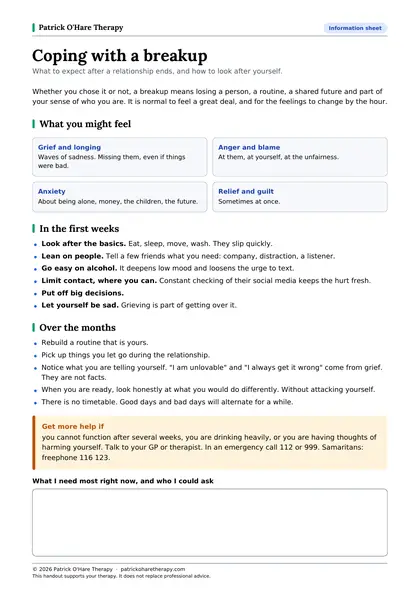 Coping with a breakupInformation sheet, 1 pageDescribes the common reactions to a breakup, gives practical guidance for the first weeks and months, and says when to look for more support.
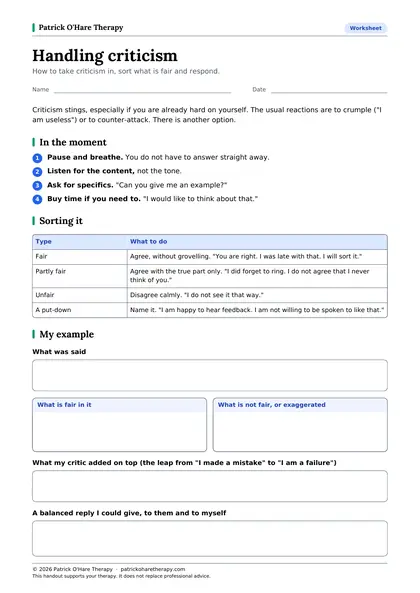 Handling criticismWorksheet, 1 pageA guide to taking criticism: pause, sort the fair from the unfair, respond assertively and look after yourself afterwards.
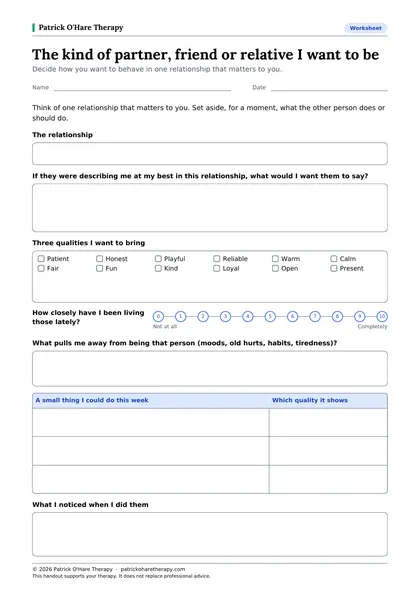 The kind of partner, friend or relative I want to beWorksheet, 1 pageA worksheet on the qualities you want to bring to your relationships, how closely you are living them now, and small actions to close the gap.
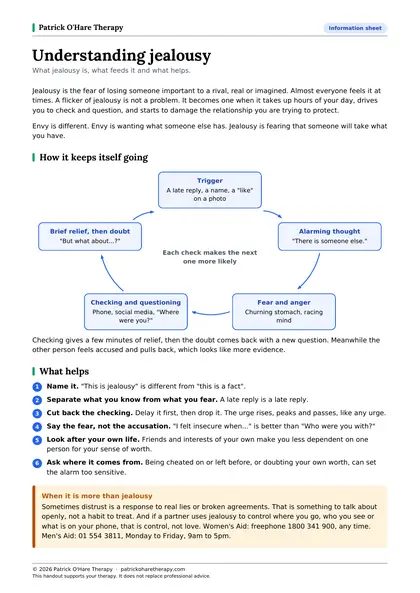 Understanding jealousyInformation sheet, 1 pageExplains jealousy in relationships, how checking and questioning keep it going, and what helps. With a clear note on the difference between jealousy and controlling behaviour.
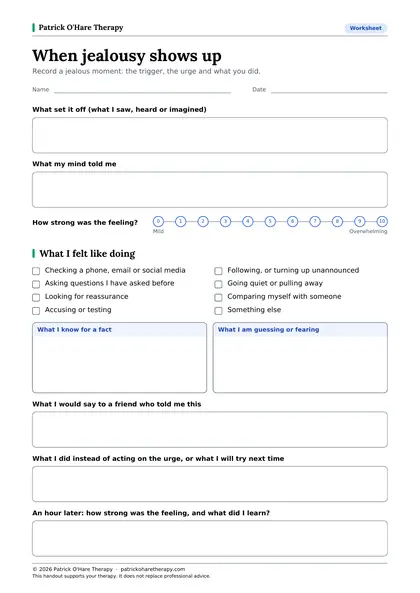 When jealousy shows upWorksheet, 1 pageA record for jealous moments: what set it off, what your mind said, what you felt like doing, the facts, and what you did instead.
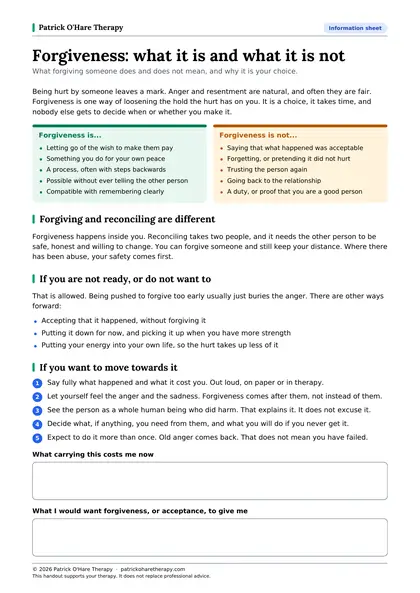 Forgiveness: what it is and what it is notInformation sheet, 1 pageClears up what forgiving someone does and does not mean: it is not excusing, forgetting or going back. Makes room for not being ready, with questions to reflect on.
Grief and loss 13
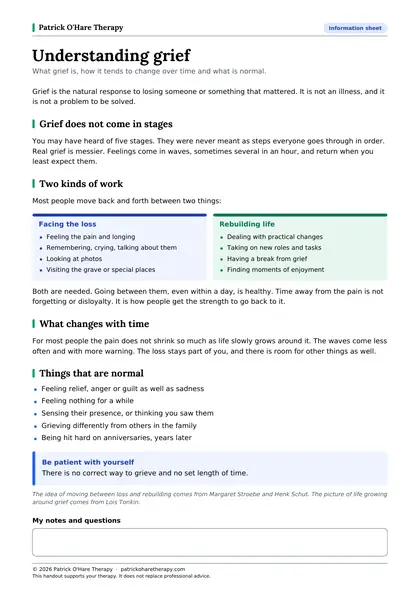 Understanding griefInformation sheet, 1 pageAn introduction to grief: what it involves, the back-and-forth between facing the loss and rebuilding your life, and some common misunderstandings.
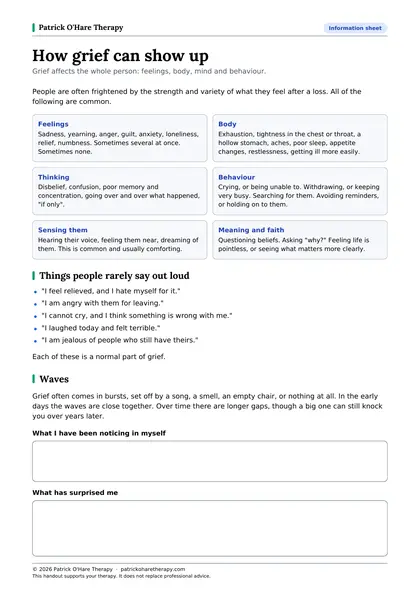 How grief can show upInformation sheet, 1 pageAn overview of the ways grief can show up in your feelings, body, thinking, behaviour and sense of meaning. All of them are normal.
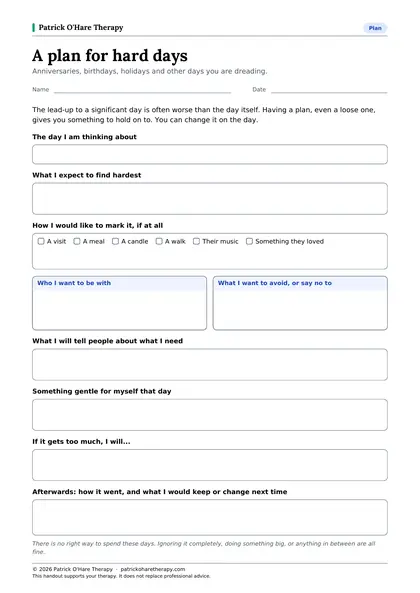 A plan for hard daysPlan, 1 pageA plan for anniversaries, birthdays and holidays after a loss: how to mark the day, who to be with, what to avoid and how to look after yourself.
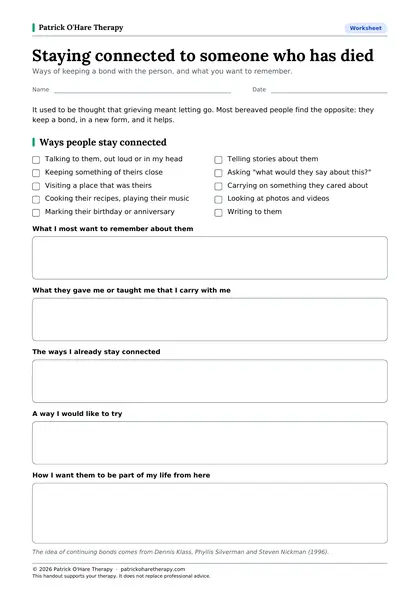 Staying connected to someone who has diedWorksheet, 1 pageWays of keeping a bond with someone who has died: through memory, ritual, the values they stood for and what they left behind.
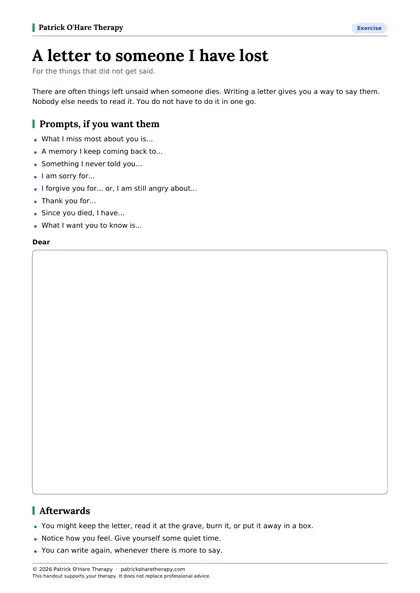 A letter to someone I have lostExercise, 1 pageA guided letter to someone who has died, with optional prompts about memories, regrets, thanks and what you want them to know.
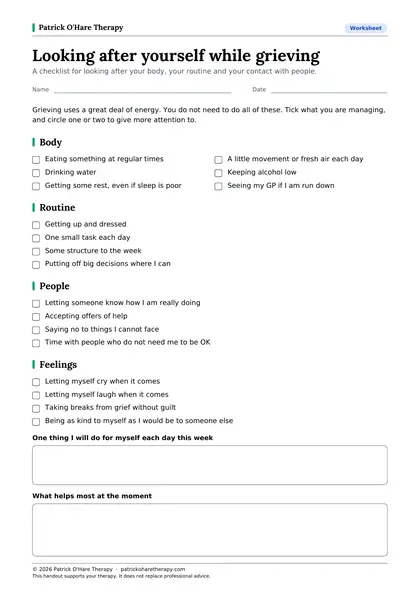 Looking after yourself while grievingWorksheet, 1 pageA self-care checklist and weekly plan for grief: your body, routine, people, feelings and permission to rest.
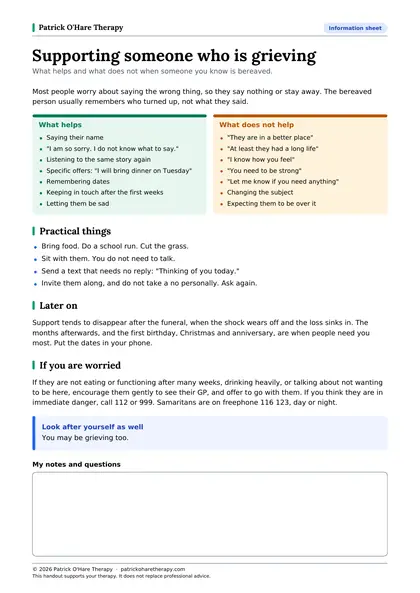 Supporting someone who is grievingInformation sheet, 1 pageFor friends and family: what to say and do, what to avoid, and how to keep showing up after the funeral.
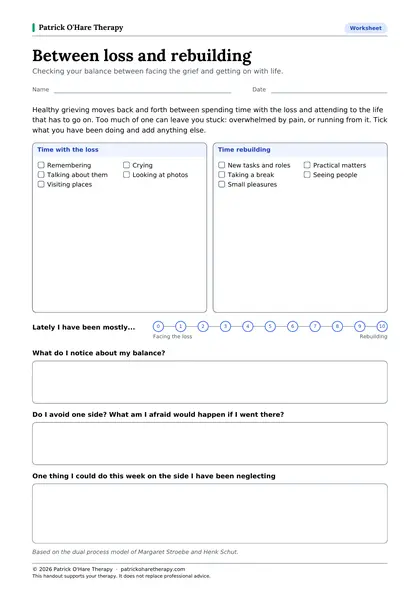 Between loss and rebuildingWorksheet, 1 pageList the ways you face the loss and the ways you rebuild your life, then consider which side needs more room. Based on the dual process idea.
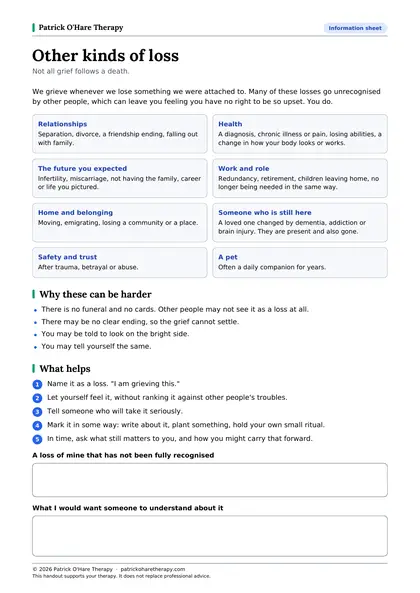 Other kinds of lossInformation sheet, 1 pageRecognises grief after losses that are not a death: separation, illness, a job, infertility, miscarriage, leaving a country, estrangement or a pet.
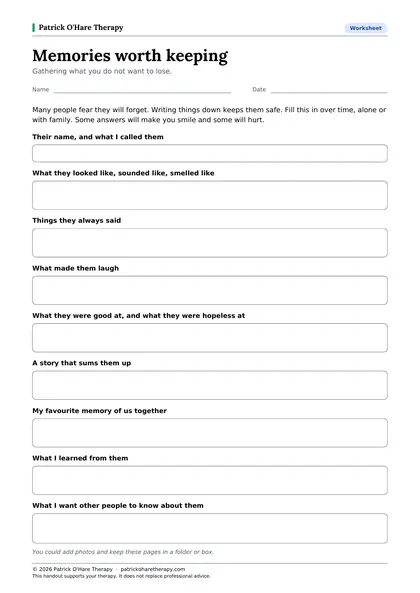 Memories worth keepingWorksheet, 1 pageA place to gather what you do not want to lose about the person who died: what they were like, their sayings, stories, shared moments and what they meant to you.
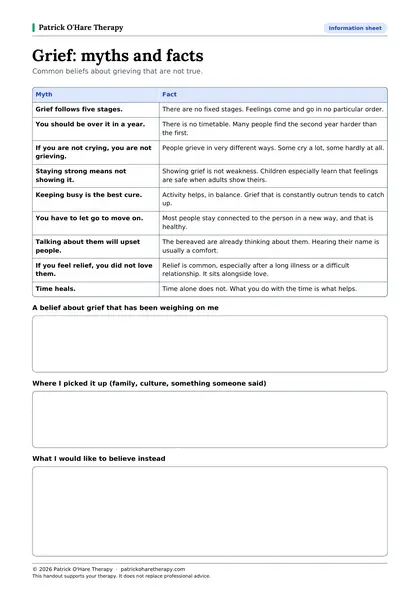 Grief: myths and factsInformation sheet, 1 pageA myth-and-fact sheet on stages of grief, timelines, being strong, crying and moving on.
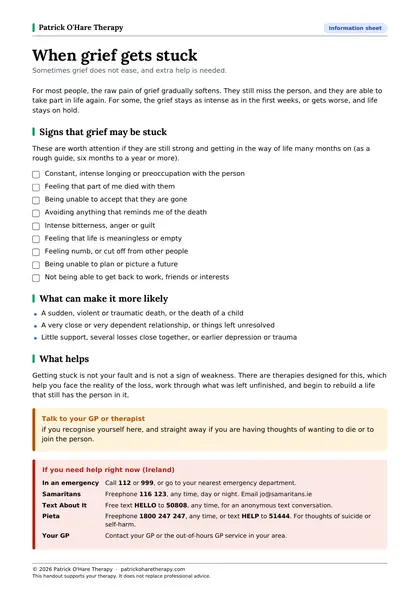 When grief gets stuckInformation sheet, 1 pageDescribes grief that does not ease with time, the signs that set it apart from ordinary grieving, what can feed into it and what help is available.
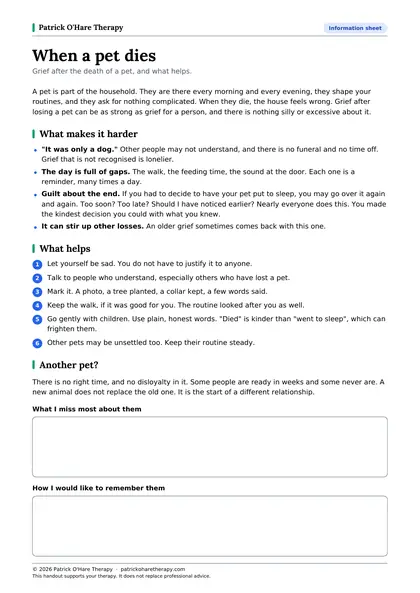 When a pet diesInformation sheet, 1 pageFor grief after the death of a pet, including guilt about decisions at the end and the feeling that other people do not understand, with ways to cope and to remember.
Habits, urges and alcohol 14
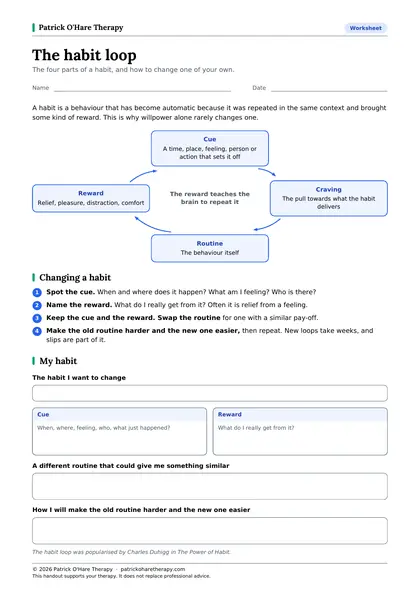 The habit loopWorksheet, 1 pageExplains the loop of cue, craving, routine and reward, then helps you map one habit of your own and plan a different routine.
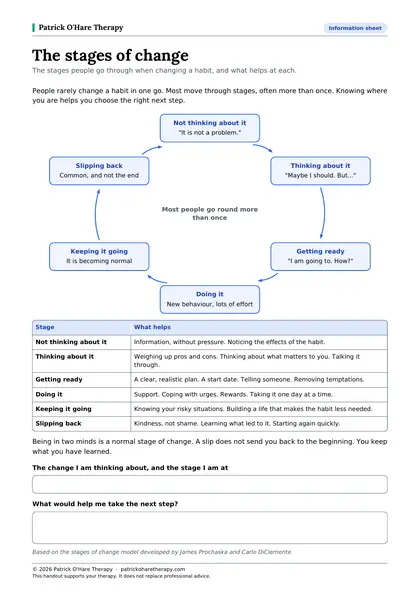 The stages of changeInformation sheet, 1 pageDescribes the stages people move through when they change, what helps at each one, and why going round more than once is normal.
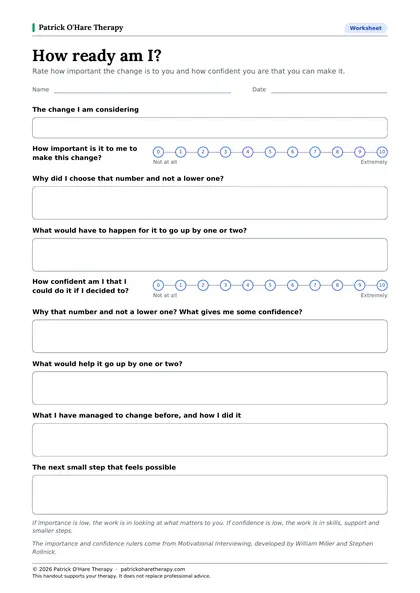 How ready am I?Worksheet, 1 pageTwo rulers, one for how important a change is to you and one for how confident you are, with questions that show where the work is.
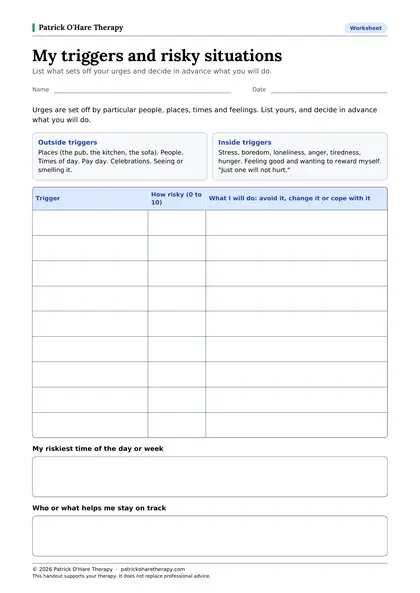 My triggers and risky situationsWorksheet, 1 pageWork out the outside and inside triggers for a habit, or for drinking or drug use, and plan what you will do at each.
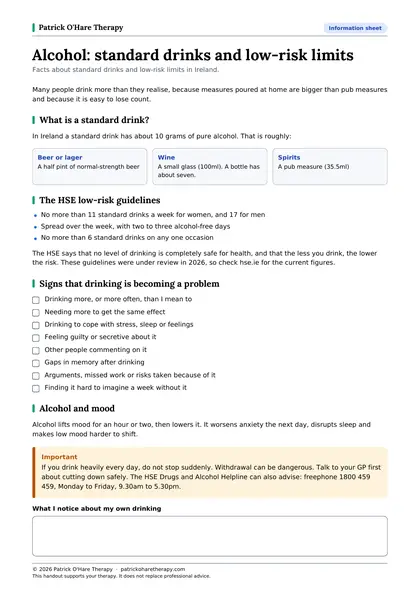 Alcohol: standard drinks and low-risk limitsInformation sheet, 1 pageSets out Irish standard drink measures and the current HSE low-risk guidelines, signs that drinking is becoming a problem, and safety advice about stopping.
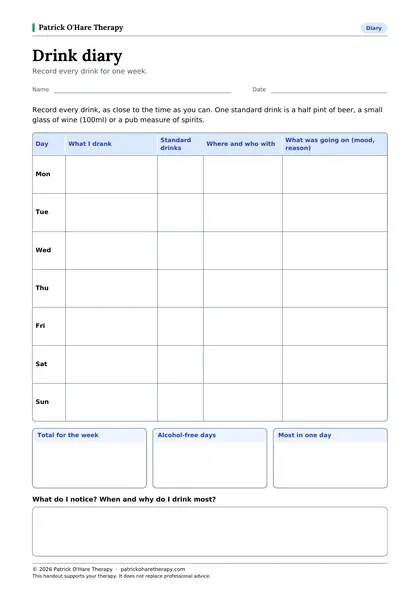 Drink diaryDiary, 1 pageA one-week record of what you drank, how much, where, who with and why, with a weekly total in standard drinks.
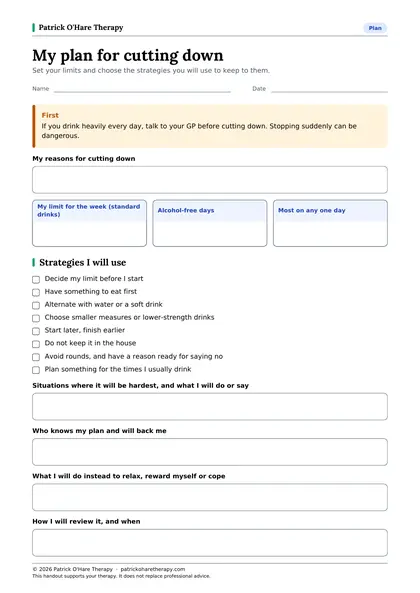 My plan for cutting downPlan, 1 pageA plan for cutting down on alcohol: your reasons, weekly limits, strategies, risky situations and support.
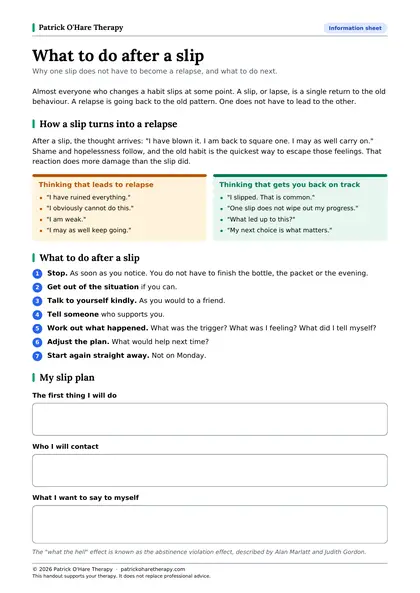 What to do after a slipInformation sheet, 1 pageExplains the difference between a slip and going back to square one, the "what the hell" effect, and steps for getting back on track without shame.
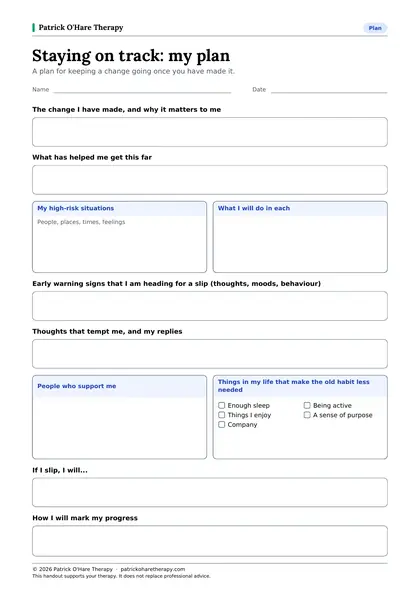 Staying on track: my planPlan, 1 pageA plan for keeping a change going: your reasons, warning signs, risky situations, ways of coping, support and balance in the rest of life.
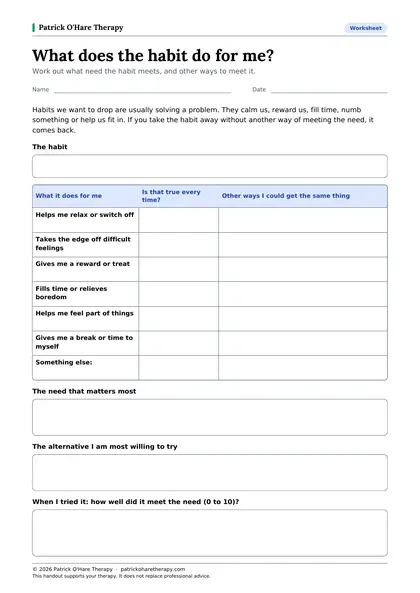 What does the habit do for me?Worksheet, 1 pageLooks at what a habit gives you (relief, reward, company, escape) and comes up with healthier ways to get each one.
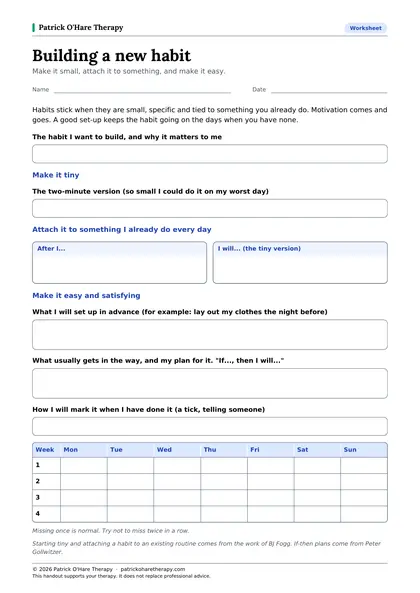 Building a new habitWorksheet, 1 pageA planner for a new habit: start tiny, attach it to something you already do, and set things up so it is easy.
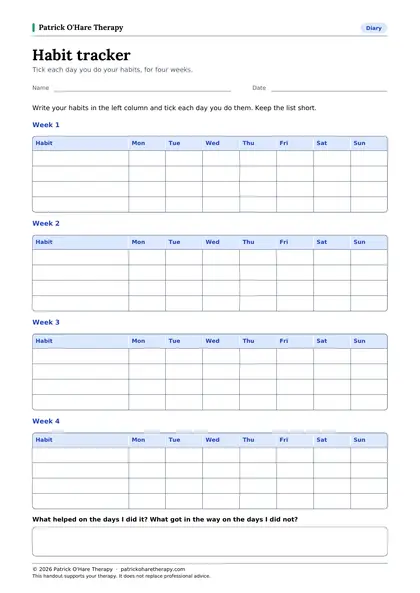 Habit trackerDiary, 1 pageA four-week tick chart for up to four habits or daily practices. Seeing the run of ticks is half the motivation.
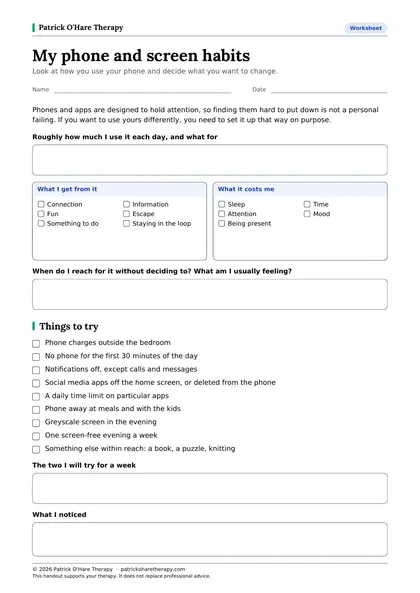 My phone and screen habitsWorksheet, 1 pageA check on how you use your phone and screens, what it gives you and what it costs, and a menu of practical limits to try.
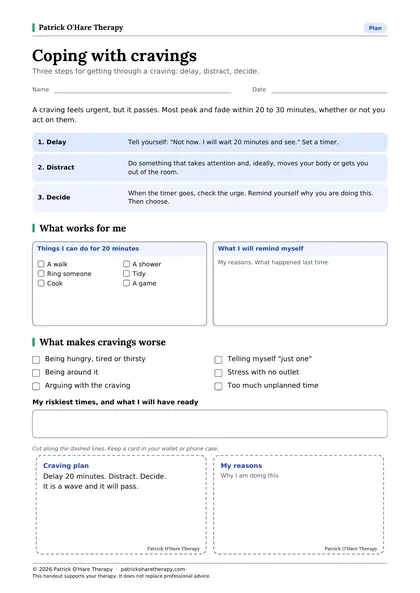 Coping with cravingsPlan, 1 pageA short plan for cravings built on delay, distraction and a deliberate choice, with your own list of what works and a card for your wallet.
Body image 6
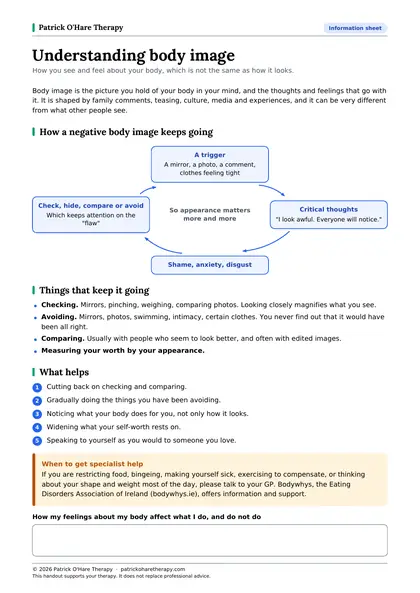 Understanding body imageInformation sheet, 1 pageExplains body image, what shapes it and what keeps a negative one going (checking, avoiding, comparing), and what helps. With a note on when to get specialist help.
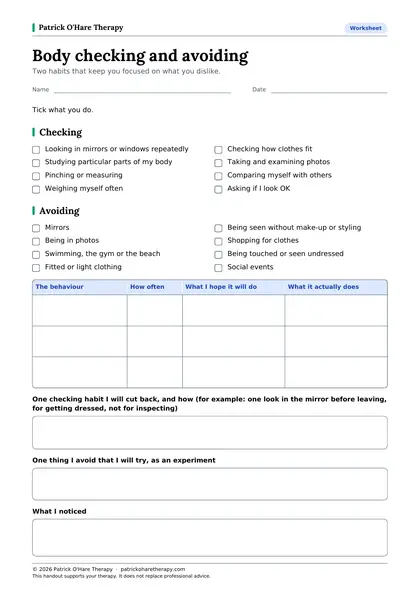 Body checking and avoidingWorksheet, 1 pageA way to track body checking and the things you avoid because of how you look, and a plan to cut both down.
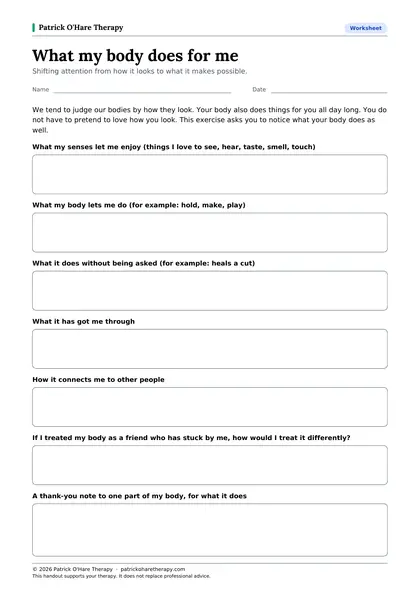 What my body does for meWorksheet, 1 pageAn exercise in appreciating your body for what it does, senses and makes possible, instead of how it looks.
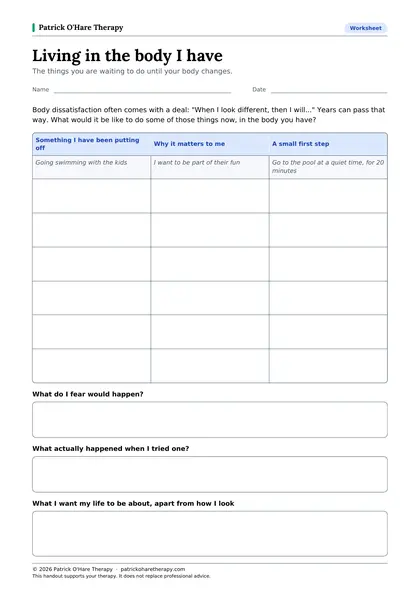 Living in the body I haveWorksheet, 1 pageList the things you have been putting off until your body changes, and plan small steps to do them now.
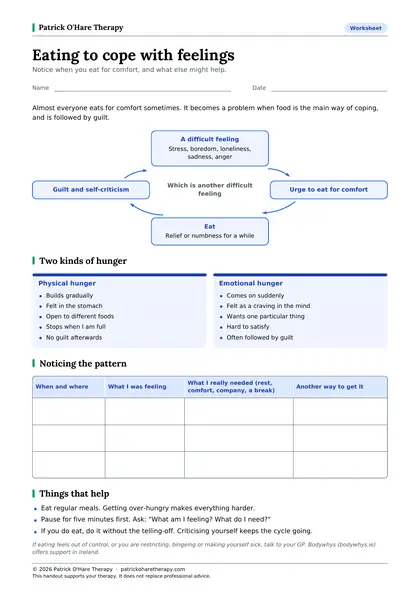 Eating to cope with feelingsWorksheet, 1 pageExplains eating as a way of coping with feelings, helps you track the triggers and feelings (not the food) and find other ways to meet the need.
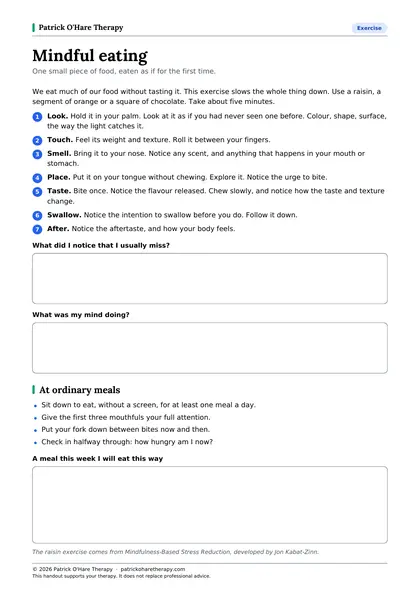 Mindful eatingExercise, 1 pageA short exercise in eating one raisin or one square of chocolate with full attention, then ideas for bringing that attention to ordinary meals.
Pain, fatigue and health 12
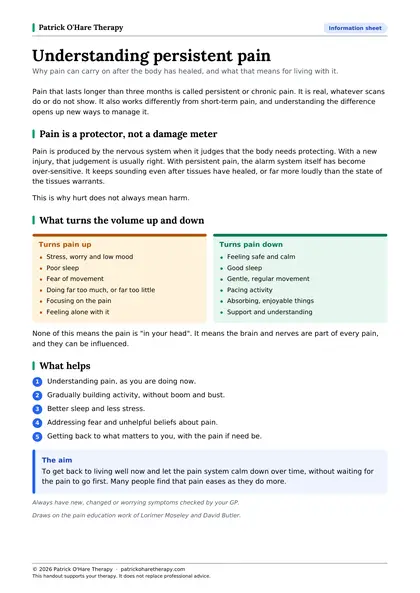 Understanding persistent painInformation sheet, 1 pageUp-to-date pain science in plain language: pain as the nervous system's protection, how the system gets over-sensitive, and what turns pain up and down.
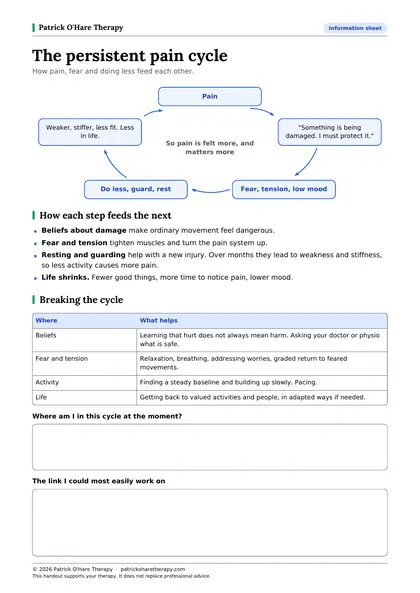 The persistent pain cycleInformation sheet, 1 pageA diagram of how pain, fear of movement and doing less feed each other, and the points where the cycle can be broken.
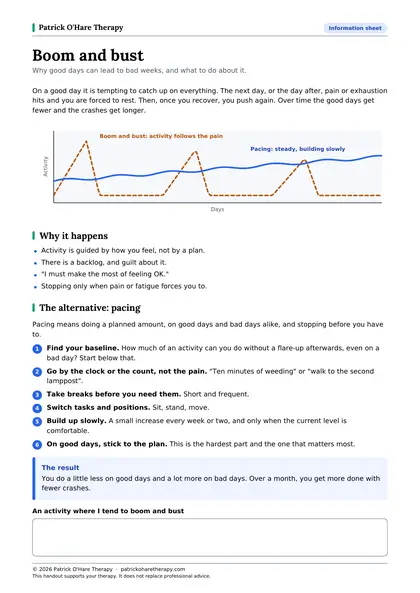 Boom and bustInformation sheet, 1 pageExplains the pattern of overdoing it on good days and crashing afterwards, common with pain and fatigue, with a graph and an introduction to pacing.
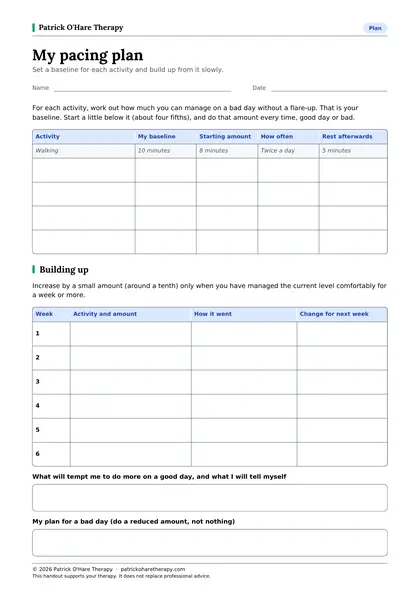 My pacing planPlan, 1 pageA pacing planner for particular activities: your baseline, a starting level a little below it, planned rests and gradual increases.
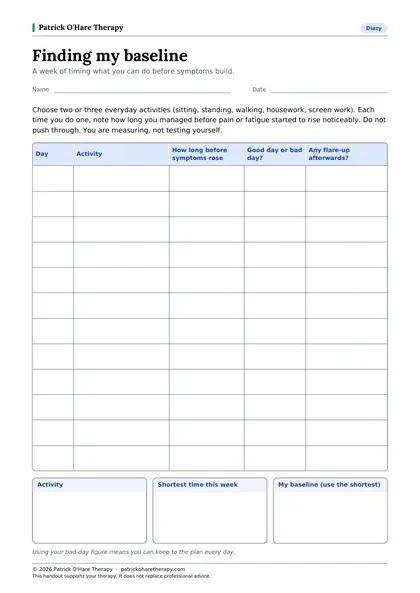 Finding my baselineDiary, 1 pageA sheet for timing what you can comfortably do before symptoms build. The groundwork for a pacing plan.
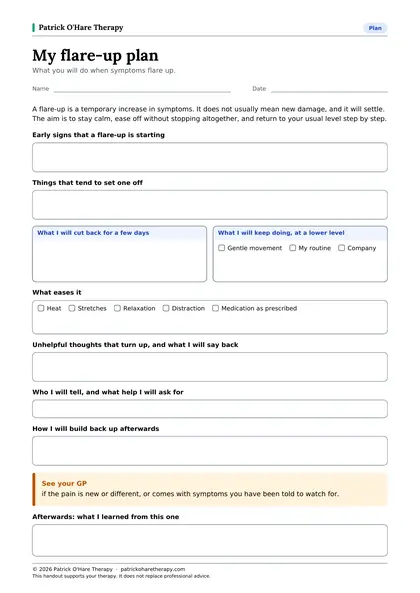 My flare-up planPlan, 1 pageA plan for flare-ups of pain or fatigue: the early signs, what to cut back and what to keep, comfort measures, helpful thoughts and the way back to your usual level.
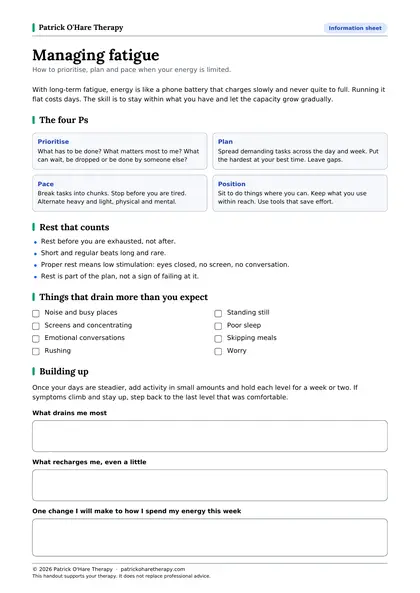 Managing fatigueInformation sheet, 1 pageExplains pacing for fatigue as an energy budget: planning, choosing priorities, positioning yourself well and resting properly.
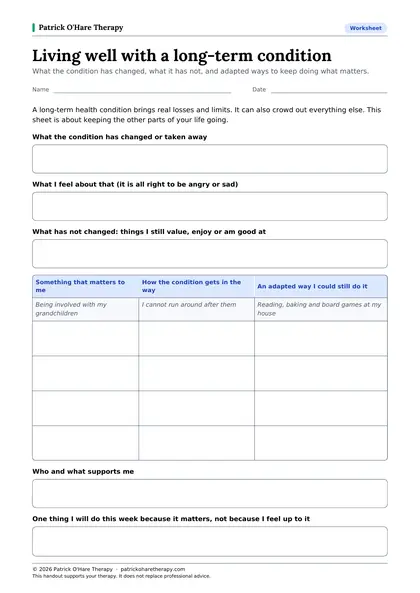 Living well with a long-term conditionWorksheet, 1 pageA worksheet for thinking through what the condition has changed, what still matters, and adapted ways to keep doing the things you value.
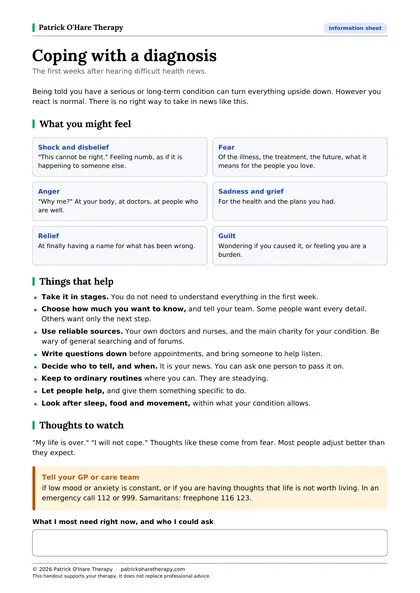 Coping with a diagnosisInformation sheet, 1 pageDescribes common reactions to a new diagnosis, with practical guidance on information, questions to ask, telling people and looking after yourself.
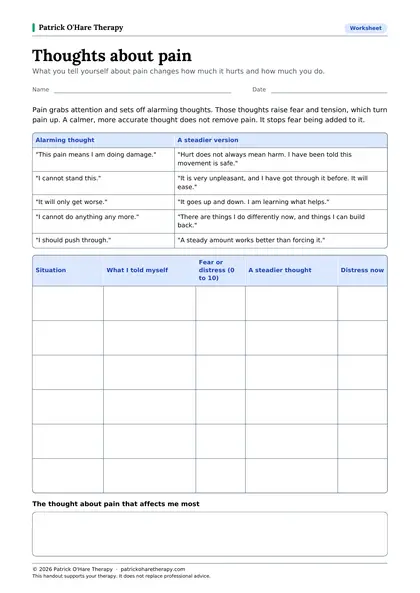 Thoughts about painWorksheet, 1 pageLists common alarming thoughts about pain with steadier alternatives, then helps you rework your own.
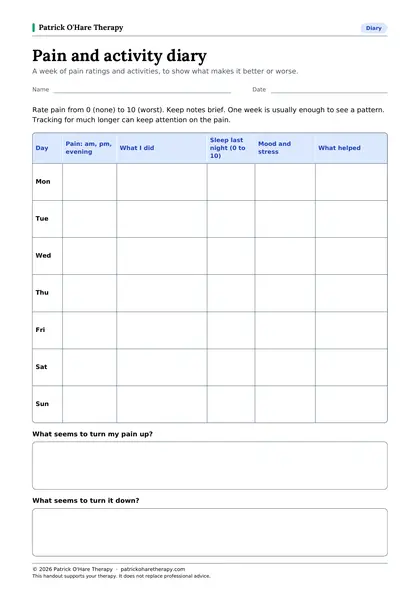 Pain and activity diaryDiary, 1 pageA daily diary linking your pain to activity, sleep, mood and stress, to show the patterns and guide your pacing.
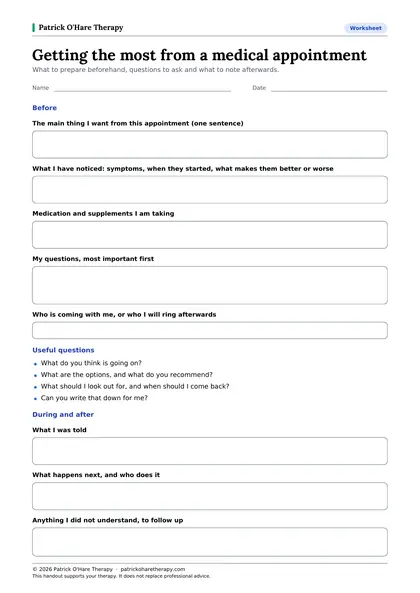 Getting the most from a medical appointmentWorksheet, 1 pageA sheet to prepare for a GP or hospital appointment and take notes: your main concern, symptoms, questions, and what you were told.
Values, goals and change 34
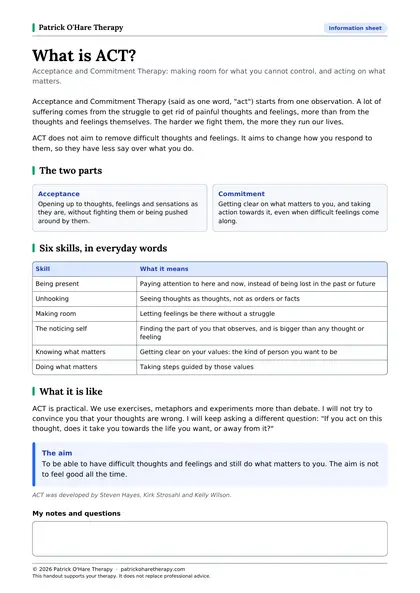 What is ACT?Information sheet, 1 pageA plain-language introduction to Acceptance and Commitment Therapy: why struggling for control backfires, its six skills in everyday words, and what the work involves.
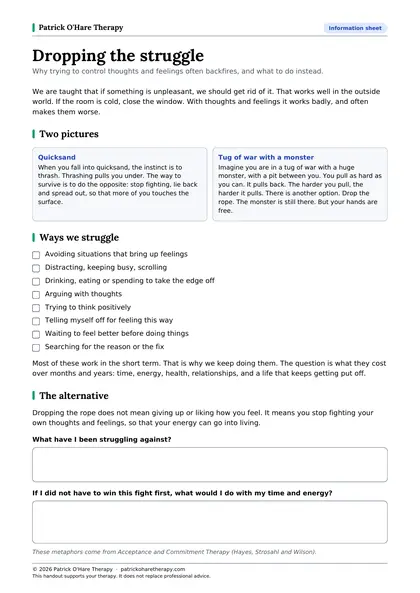 Dropping the struggleInformation sheet, 1 pageUses two well-known pictures, quicksand and a tug of war, to show what fighting your feelings costs, with a question to think about.
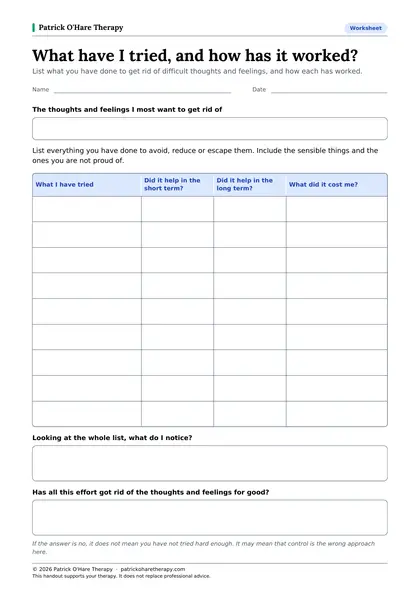 What have I tried, and how has it worked?Worksheet, 1 pageList everything you do to get rid of difficult thoughts and feelings, and note how each works in the short term, in the long term, and what it costs.
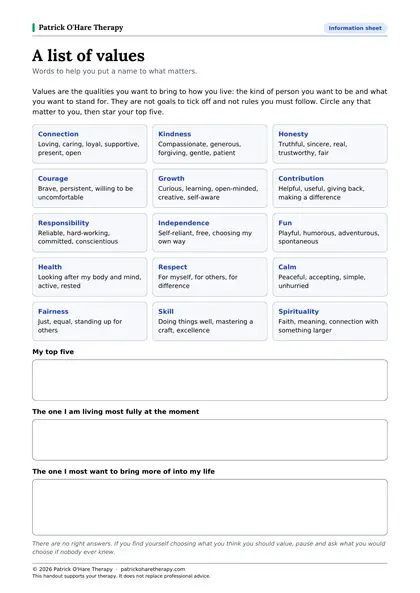 A list of valuesInformation sheet, 1 pageA list of common values. Circle the ones that speak to you and narrow them down to your top five.
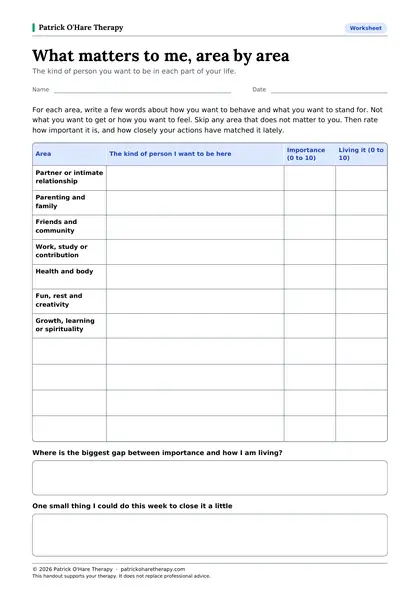 What matters to me, area by areaWorksheet, 1 pageA worksheet on what matters to you in relationships, work, health, leisure and growth, with ratings for how important each is and how closely you are living it.
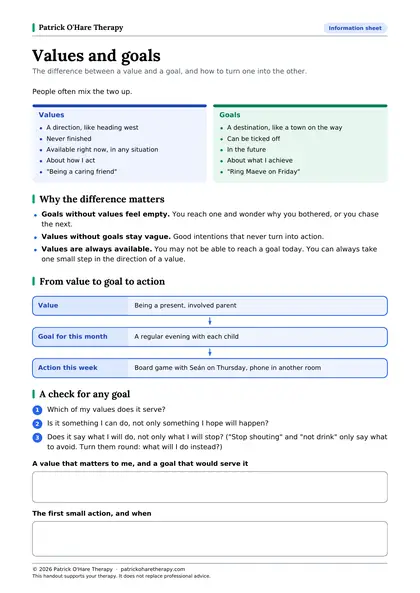 Values and goalsInformation sheet, 1 pageExplains the difference between values and goals using a compass, and shows how to set goals that serve your values.
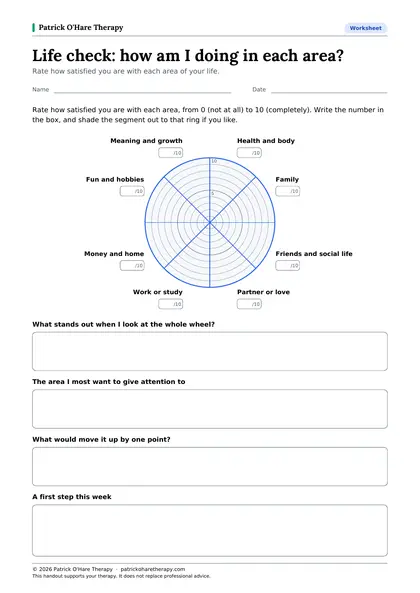 Life check: how am I doing in each area?Worksheet, 1 pageA wheel of eight life areas to rate for satisfaction, then prompts for choosing one area and a first step.
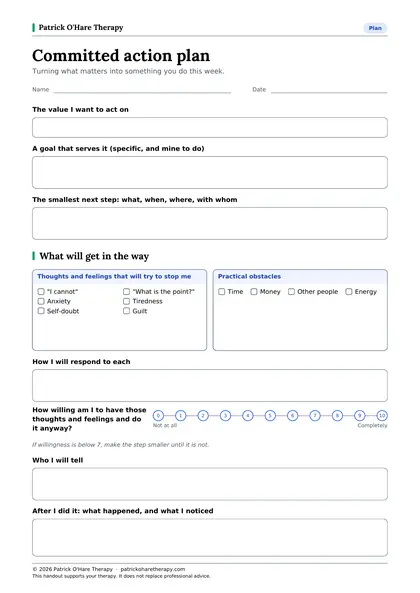 Committed action planPlan, 1 pageAn action planner that starts from a value: the goal, a specific step, the obstacles you expect, inside and out, and how willing you are to have them.
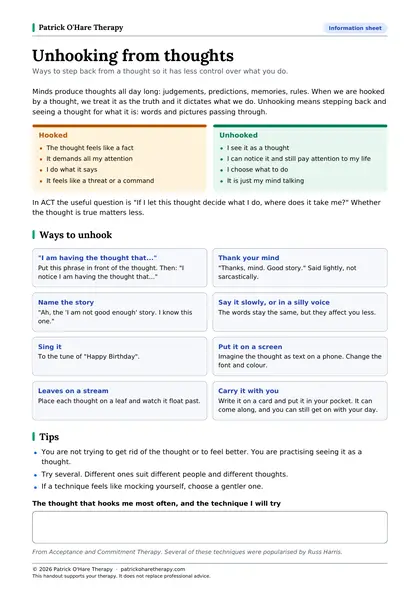 Unhooking from thoughtsInformation sheet, 1 pageExplains how to get some distance from sticky thoughts, with a menu of quick techniques to try.
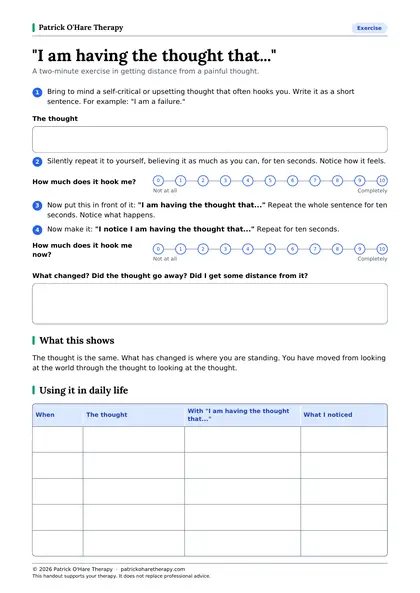 "I am having the thought that..."Exercise, 1 pageA two-minute exercise that uses the phrase "I am having the thought that..." to get some distance from a painful thought, with space to reflect.
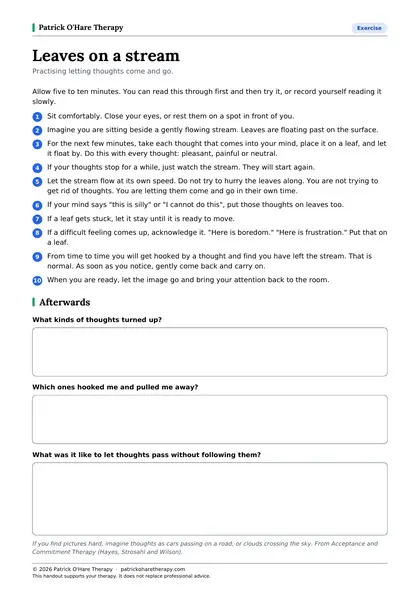 Leaves on a streamExercise, 1 pageA script for the leaves on a stream exercise: placing each thought on a leaf and letting it float by, with guidance for when you get caught up.
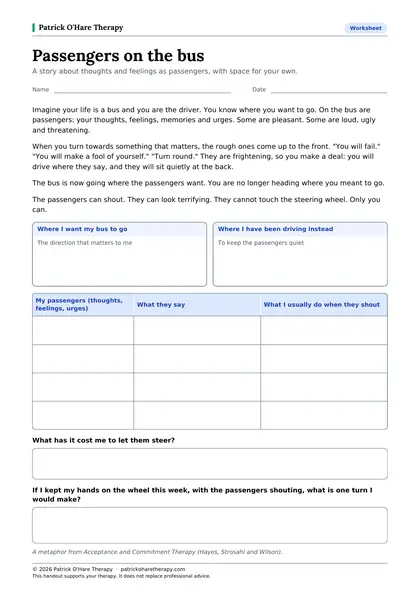 Passengers on the busWorksheet, 1 pageThe passengers on the bus story, with a worksheet for naming your own passengers, what they shout, and where you want to drive.
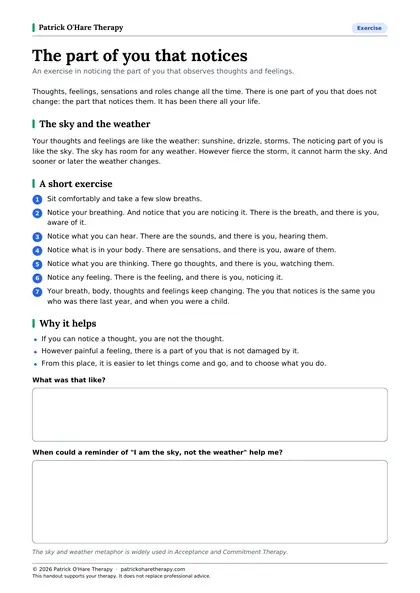 The part of you that noticesExercise, 1 pageA short exercise using the sky and the weather to find the steady part of you that notices thoughts and feelings come and go.
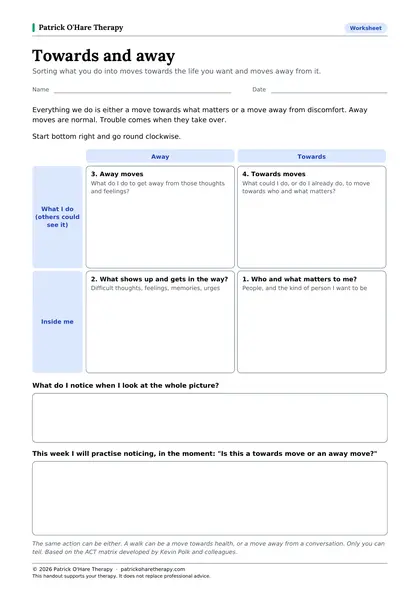 Towards and awayWorksheet, 1 pageA four-box map: what matters to you, what shows up inside and gets in the way, what you do to move away, and what you do to move towards.
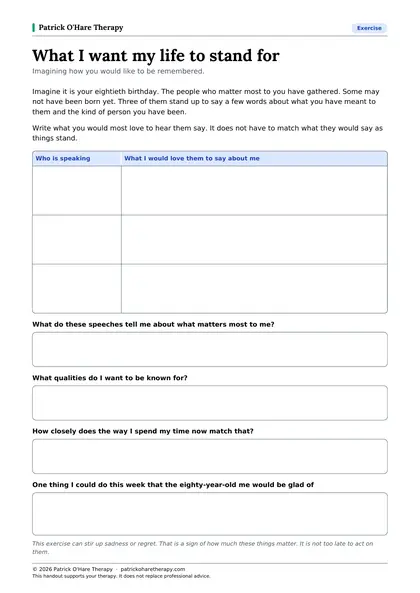 What I want my life to stand forExercise, 1 pageImagine your eightieth birthday and what you hope the people who matter would say about you. Then ask what that means for now.
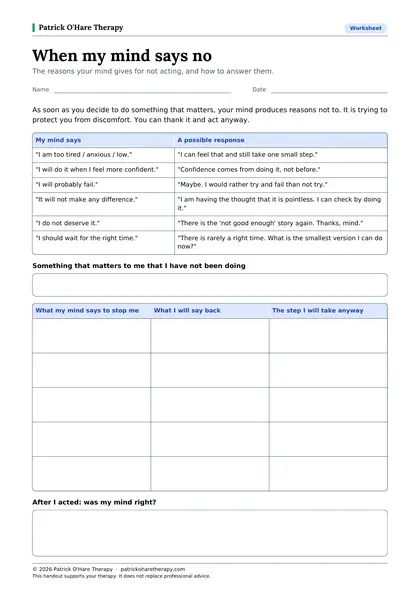 When my mind says noWorksheet, 1 pageNames the reasons, feelings, rules and self-judgements your mind uses to stop you acting on what matters, and gives a way to answer each.
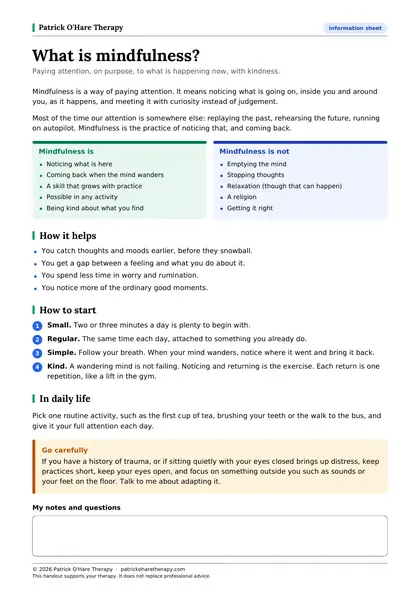 What is mindfulness?Information sheet, 1 pageA clear introduction to mindfulness: what it is and is not, how it helps and how to start, with cautions if you have been through trauma.
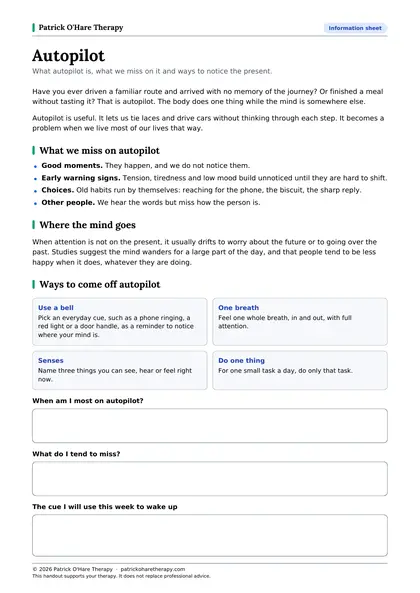 AutopilotInformation sheet, 1 pageExplains living on automatic pilot, why it matters for mood and habits, and ways to notice the present during the day.
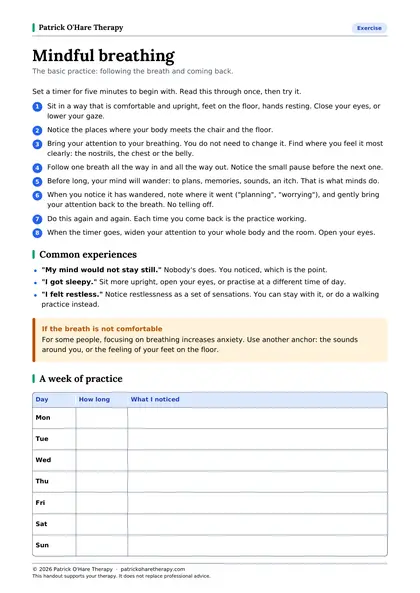 Mindful breathingExercise, 1 pageA five to ten minute breathing script, with guidance on a wandering mind, alternatives if focusing on the breath is uncomfortable, and a log for a week of practice.
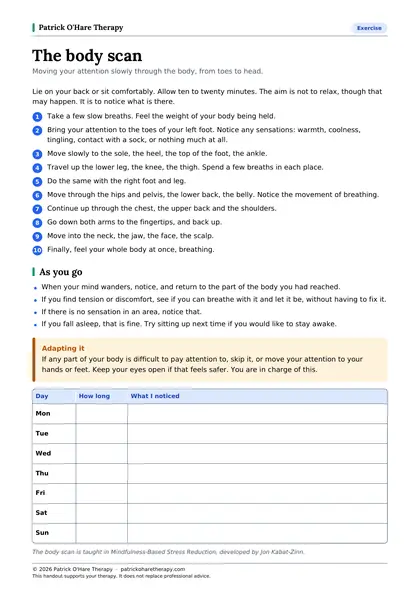 The body scanExercise, 1 pageA ten to twenty minute script for moving attention through the body, to build body awareness and settle the nervous system. With gentler options if you have been through trauma.
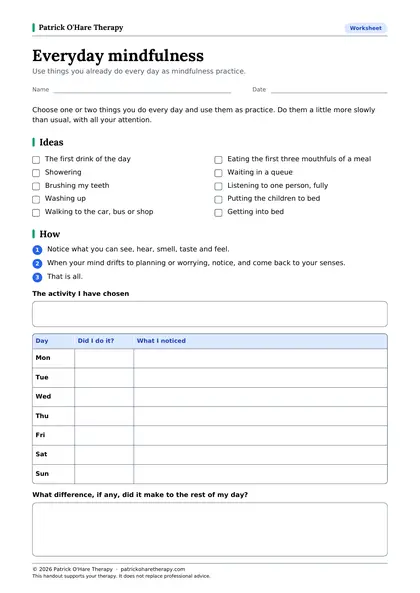 Everyday mindfulnessWorksheet, 1 pageA planner for bringing mindfulness into ordinary activities like making tea or brushing your teeth, with a how-to and a weekly record.
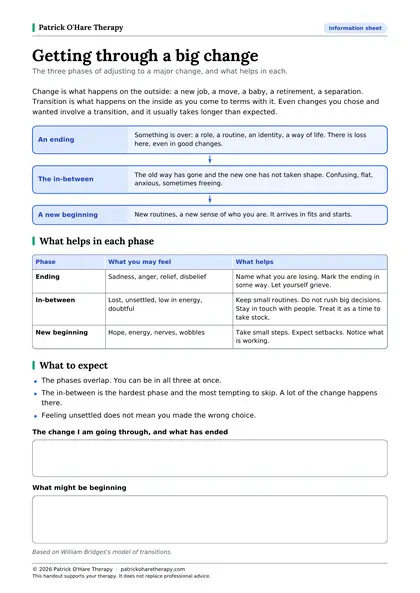 Getting through a big changeInformation sheet, 1 pageExplains the three phases of a big life change and what helps in each. For job changes, moves, retirement, separation or becoming a parent.
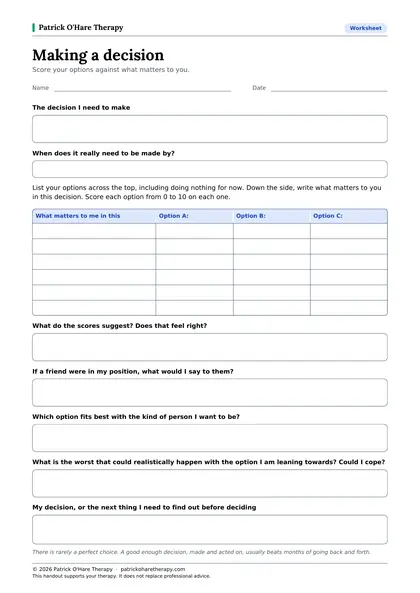 Making a decisionWorksheet, 1 pageA grid for weighing your options against the things that matter most to you, with a gut check and a values check.
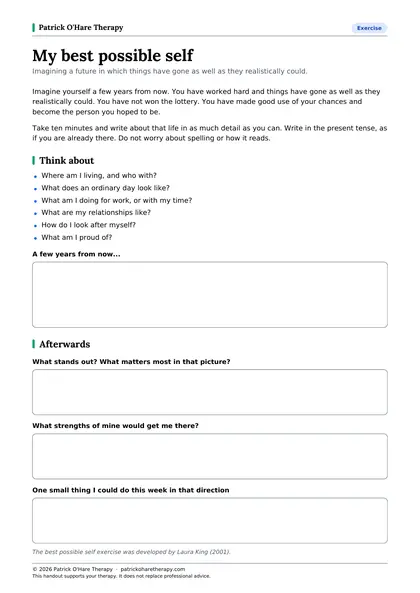 My best possible selfExercise, 1 pageA writing exercise from positive psychology that builds optimism and makes your goals clearer, with prompts on next steps.
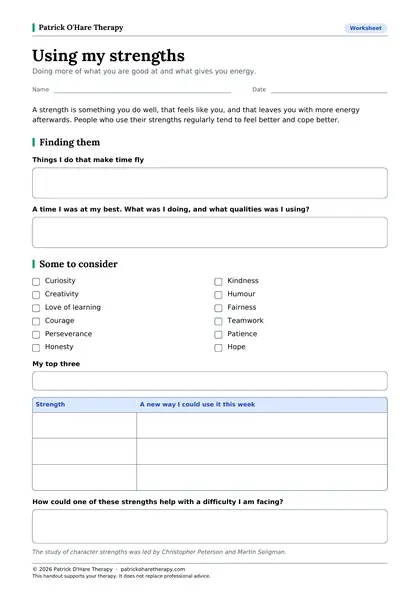 Using my strengthsWorksheet, 1 pageWork out your main strengths from your own experience, and plan new ways to use them at work, at home and when things are hard.
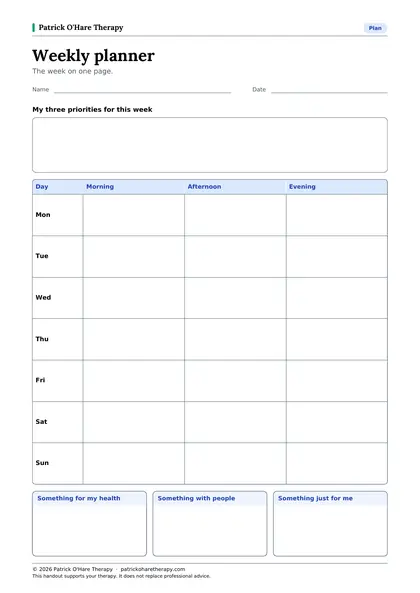 Weekly plannerPlan, 1 pageA one-page week with three priorities, a daily grid, and reminders for rest, movement and seeing people.
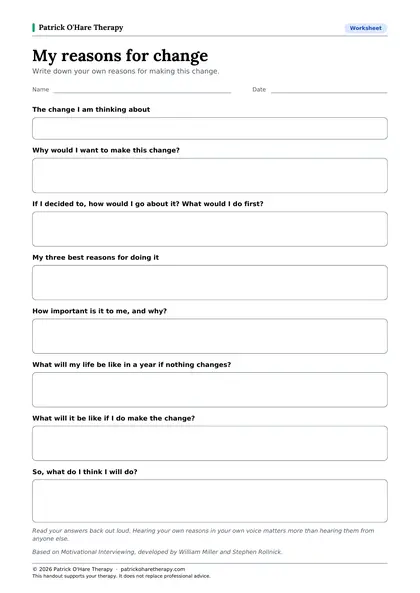 My reasons for changeWorksheet, 1 pageDraws out your own wish, ability, reasons and need for a change, and the first thing you are willing to commit to.
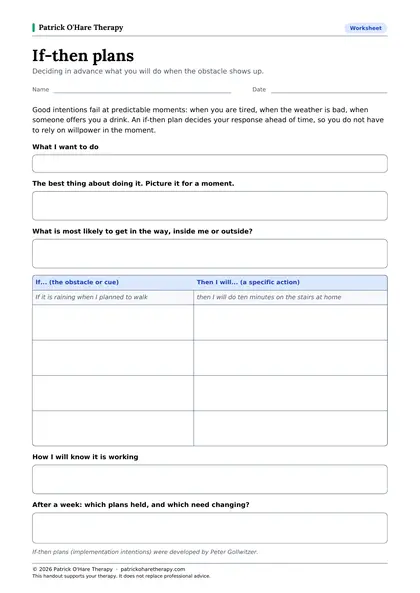 If-then plansWorksheet, 1 pageA planner for deciding in advance: your goal, the obstacles you can see coming, and a specific "if this, then I will" for each.
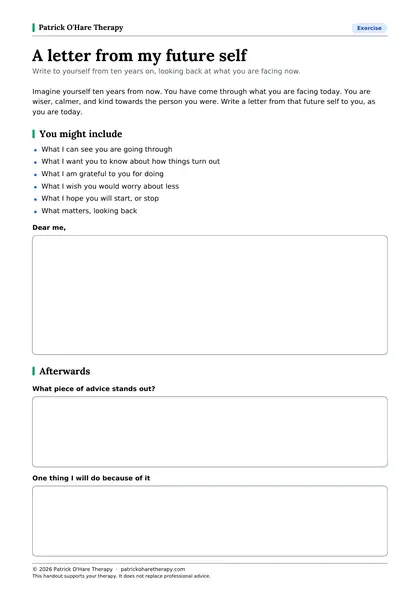 A letter from my future selfExercise, 1 pageA writing exercise: a letter to you now from an older, wiser you who has come through this.
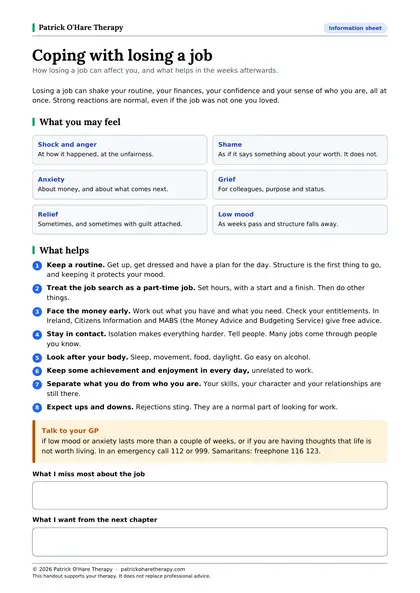 Coping with losing a jobInformation sheet, 1 pageDescribes common reactions to losing a job, with practical guidance on routine, money worries, your sense of who you are and keeping going with the job search.
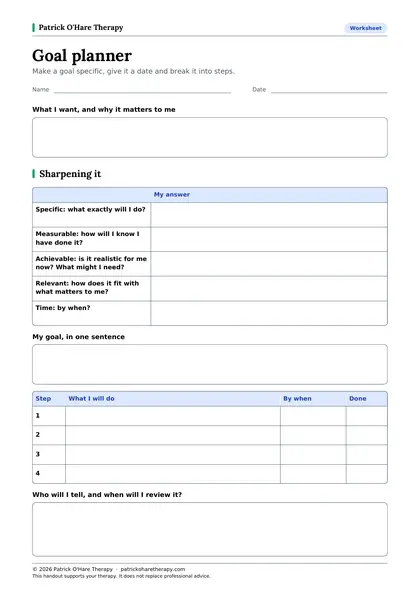 Goal plannerWorksheet, 1 pageA sheet that makes a goal specific and measurable, gives it a date, links it to what matters to you and breaks it into steps.
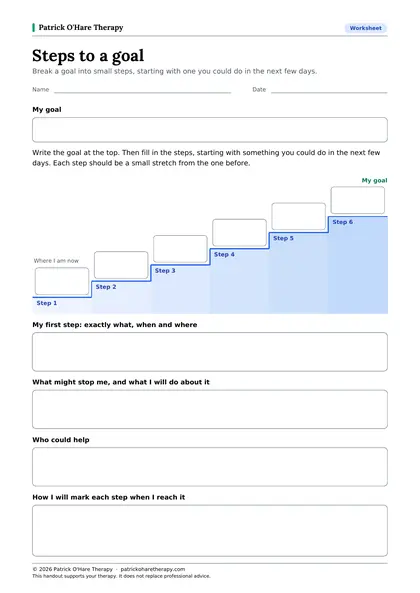 Steps to a goalWorksheet, 1 pageA staircase of six steps to a goal, with prompts for the first step, the obstacles and how you will mark progress.
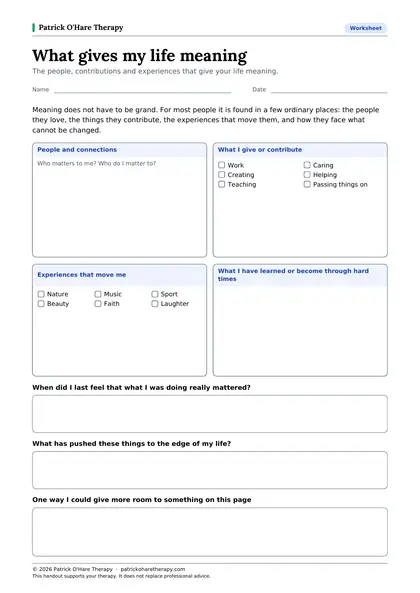 What gives my life meaningWorksheet, 1 pageA worksheet on where your sense of meaning comes from (people, contributing, experiences, growth, belief) and how to give those things more room.
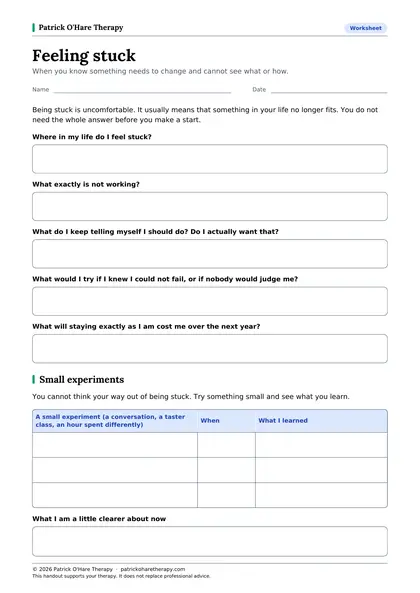 Feeling stuckWorksheet, 1 pageA set of questions for when you feel stuck: what is not working, what you are avoiding, small experiments to try, and the cost of staying put.
Getting the most from therapy 12
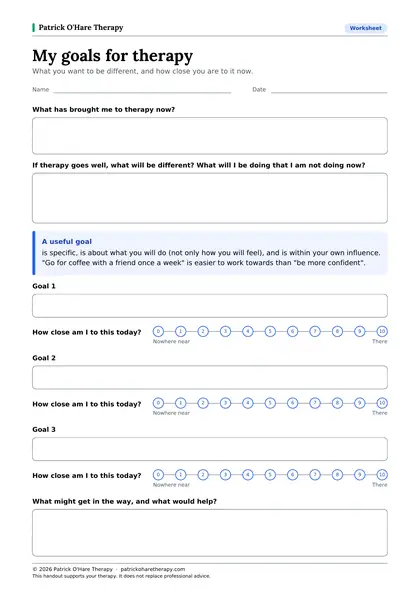 My goals for therapyWorksheet, 1 pageA sheet for working out what you want to be different, and how close you are to it now. Useful to come back to at reviews.
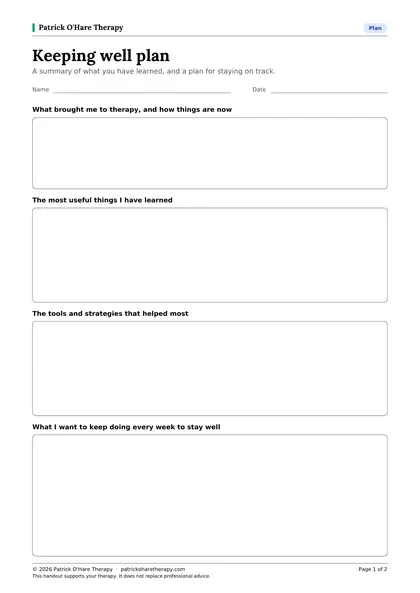 Keeping well planPlan, 2 pagesA two-page summary for the end of therapy: what helped, your warning signs, a plan for setbacks and goals for the months ahead.
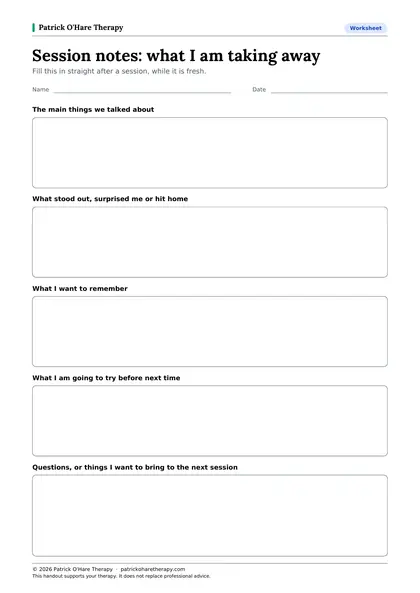 Session notes: what I am taking awayWorksheet, 1 pageA short sheet to fill in after a session: the main points, what you will try, and what to bring next time.
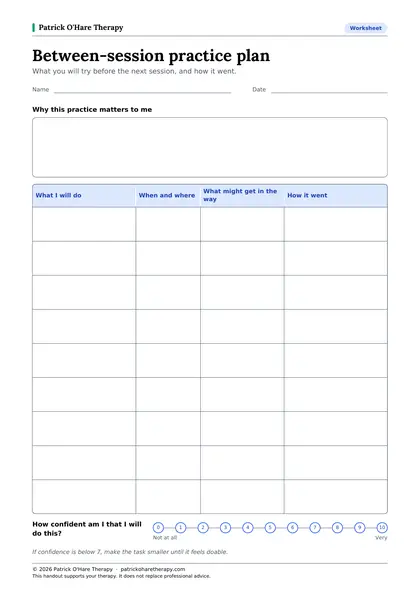 Between-session practice planWorksheet, 1 pageA planner for what you agreed to try between sessions, what might get in the way, and how it went.
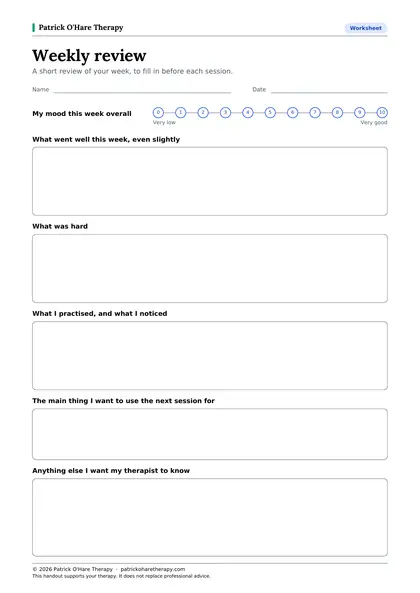 Weekly reviewWorksheet, 1 pageA quick review of your week before a session: what went well, what was hard, what you practised and what you most want to talk about.
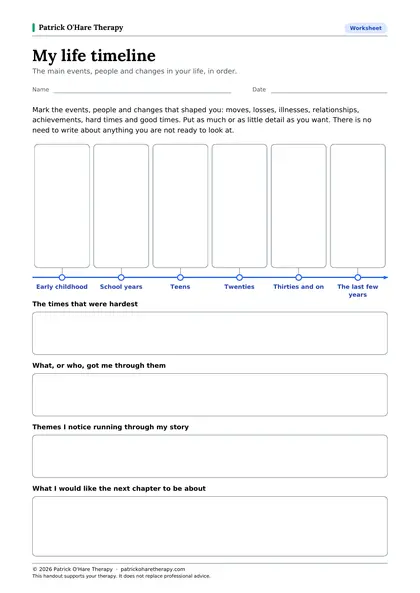 My life timelineWorksheet, 1 pageA timeline for mapping the important events, relationships and turning points in your life, then reflecting on the themes and strengths in it.
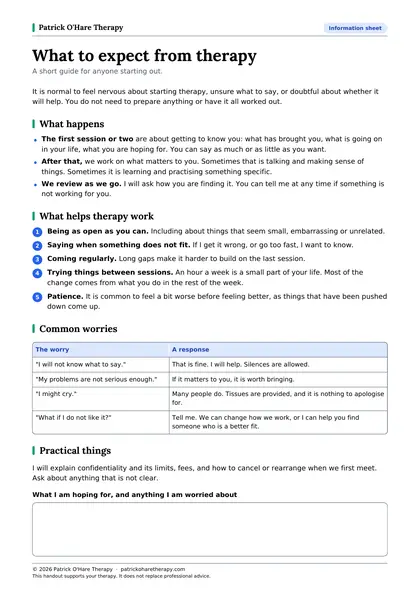 What to expect from therapyInformation sheet, 1 pageA general introduction for anyone starting therapy: what happens in sessions, what helps it work, common worries and how to raise concerns.
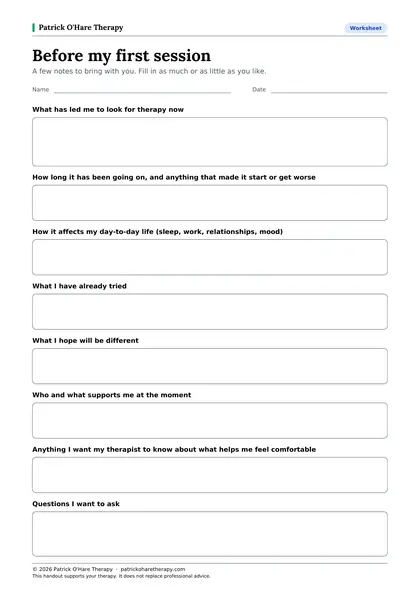 Before my first sessionWorksheet, 1 pageNotes to bring to a first session: your main concerns, how long they have been going on, what you hope for, who supports you and your questions.
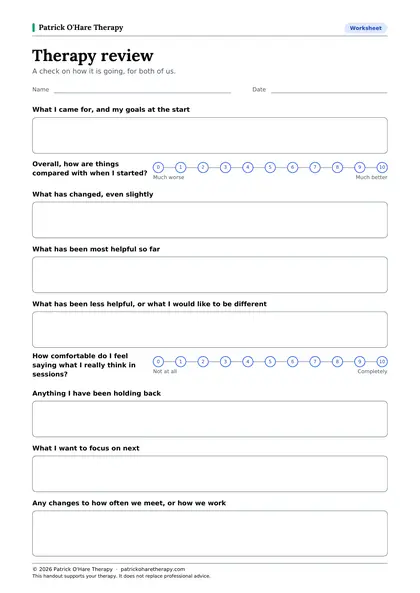 Therapy reviewWorksheet, 1 pageA mid-therapy review: progress on your goals, what is helping, what is not, how we are working together and what to focus on next.
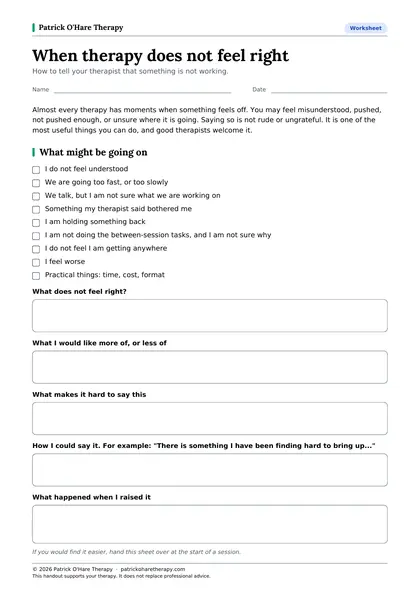 When therapy does not feel rightWorksheet, 1 pageHelps you put into words what is not working in therapy and plan how to say it. Feedback is part of the work.
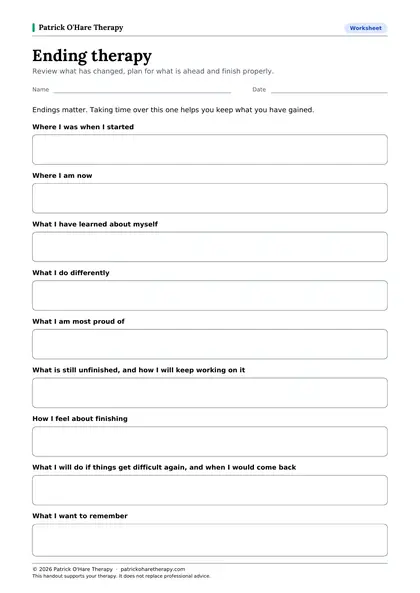 Ending therapyWorksheet, 1 pageA worksheet for the final sessions: looking back over the work, holding on to what you have gained, how you feel about finishing and what comes next.
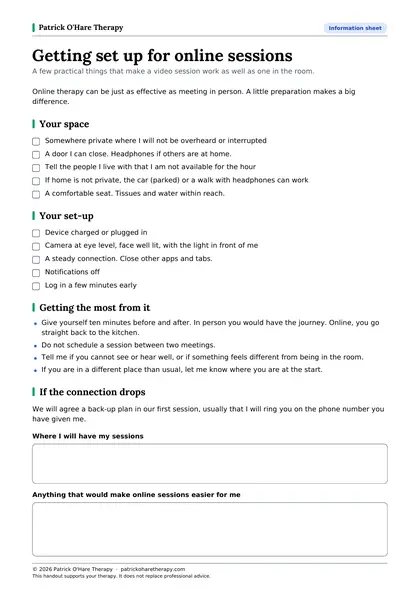 Getting set up for online sessionsInformation sheet, 1 pageA practical checklist for therapy by video: privacy, technology, comfort, safety and what to do if the connection drops.
Staying safe 6
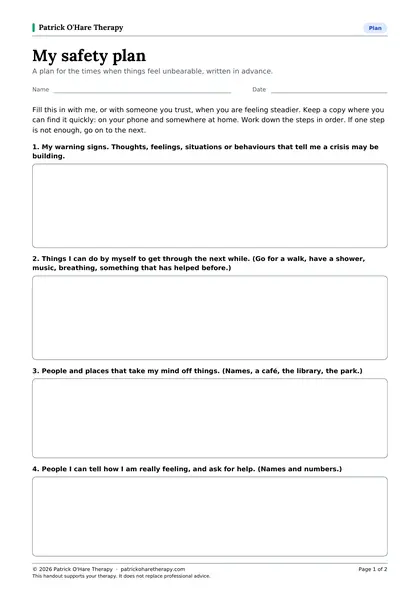 My safety planPlan, 2 pagesA six-step plan for times when you feel suicidal or unsafe: warning signs, things to do, places and people that help, professionals to contact and making your surroundings safer. Best filled in with someone you trust.
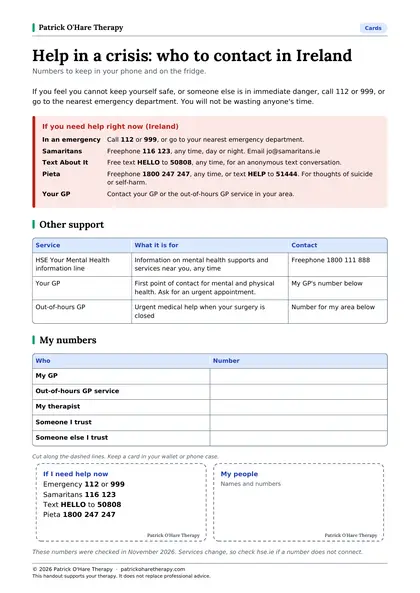 Help in a crisis: who to contact in IrelandCards, 1 pageA one-page list of Irish crisis and support numbers, with space for your own and a cut-out card for your wallet.
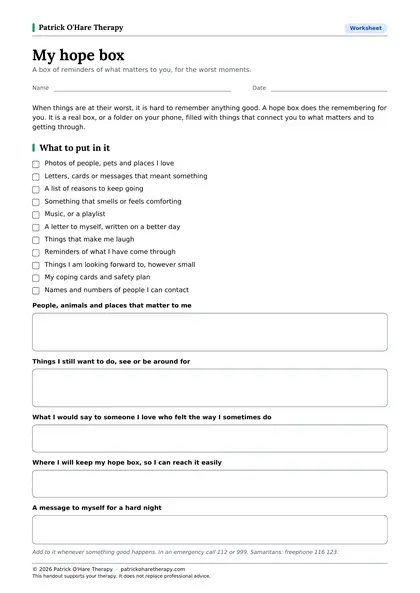 My hope boxWorksheet, 1 pageA planner for putting together a hope box, physical or on your phone: reasons for living, comforting objects, photos, messages and reminders of what helps.
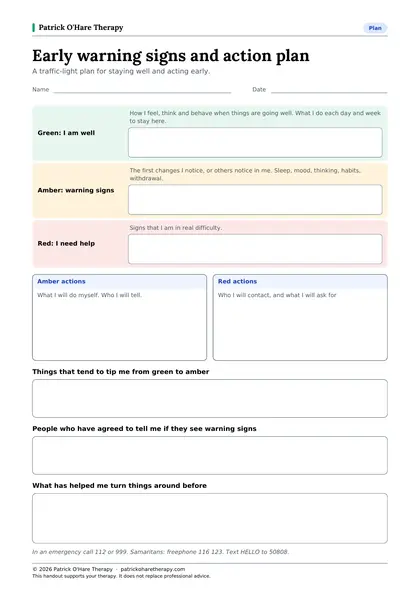 Early warning signs and action planPlan, 1 pageA plan in three zones (green, amber, red) with the signs and the actions for each. Works for any difficulty.
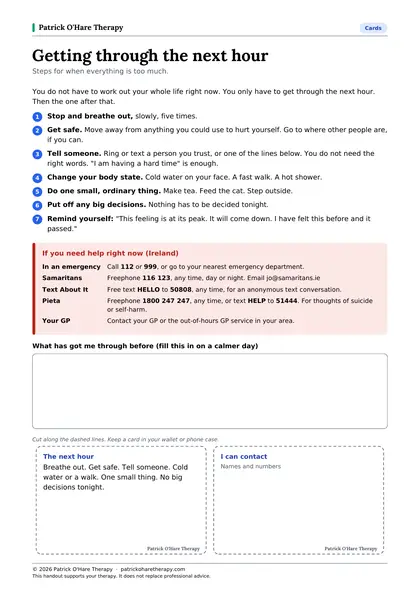 Getting through the next hourCards, 1 pageA few steps for when everything is too much, bringing your focus down to the next hour, with a card for your wallet and crisis numbers.
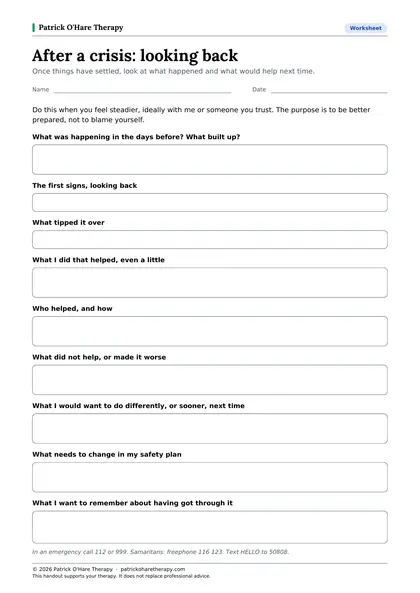 After a crisis: looking backWorksheet, 1 pageA look back once a crisis has passed, to update your safety plan and be better prepared another time.
Session packs
Sets of handouts that go together. Each pack can be downloaded as one PDF.
Two-sided sheets
Pairs of handouts that follow on from each other, to print double-sided on one sheet of paper. 87 pairs.- The five areas: how it all links up with My five areas map PDF
- Unhelpful thinking styles with Spot the thinking style PDF
- Catching automatic thoughts with Thought record (simple) PDF
- Questions to test a thought with Thought record (step by step) PDF
- Core beliefs: the deeper layer with Evidence log for a new belief PDF
- Safety behaviours with Dropping a safety behaviour PDF
- Avoidance: why it keeps anxiety going with What am I avoiding? PDF
- The anxiety cycle with My anxiety cycle PDF
- Understanding worry with Two kinds of worry PDF
- Worry time with Postponed worries PDF
- Tolerating uncertainty with Uncertainty experiments PDF
- Facing fears: how exposure works with My exposure ladder PDF
- The panic cycle with My panic cycle PDF
- What is a panic attack? with Panic diary PDF
- Panic: myths and facts with Testing a panic prediction PDF
- Practising panic sensations with Sensation practice record PDF
- Understanding agoraphobia with Going out again: my step plan PDF
- Understanding social anxiety with My social anxiety map PDF
- Understanding health anxiety with My health anxiety cycle PDF
- The OCD cycle with My OCD cycle PDF
- Exposure and response prevention explained with My ERP ladder PDF
- Response prevention plan with ERP practice record PDF
- The window of tolerance with My window of tolerance PDF
- Why trauma memories are different with Triggers: then and now PDF
- Coping with flashbacks with Trigger log PDF
- Understanding dissociation with What keeps me steady PDF
- Looking after yourself after trauma with Reclaiming your life PDF
- The low mood cycle with My low mood cycle PDF
- Action before motivation with The five-minute start PDF
- Activity ideas with Planning my week PDF
- Understanding rumination with Stepping out of rumination PDF
- Sleep diary with Working out my sleep efficiency PDF
- The insomnia cycle with Sleep habits checklist PDF
- Sleep: myths and facts with Unhelpful thoughts about sleep PDF
- What is stress? with The stress bucket PDF
- Understanding burnout with Energy audit PDF
- Micro-breaks with The two-minute reset PDF
- Understanding anger with My anger warning signs PDF
- The anger cycle with Anger diary PDF
- Cooling down: a menu with Time out plan PDF
- What emotions are for with Feelings check-in PDF
- The emotion wave with Urge surfing PDF
- TIPP: changing your body chemistry fast with My distress kit PDF
- Check the facts with Opposite action PDF
- Asking for what you want: DEAR MAN with Keeping the relationship and your self-respect PDF
- Understanding low self-esteem with My self-esteem map PDF
- Getting to know my inner critic with Critic or coach? PDF
- The three emotion systems with My three systems PDF
- What is self-compassion? with What gets in the way of being kind to myself PDF
- Soothing rhythm breathing with Imagining my compassionate self PDF
- My strengths and good qualities with Positive qualities log PDF
- Understanding perfectionism with The costs and benefits of my high standards PDF
- My perfectionism behaviours with Good enough experiments PDF
- Understanding procrastination with Procrastination: excuses and replies PDF
- Four communication styles with Saying it with "I" PDF
- My rights with Saying no PDF
- Understanding boundaries with Setting a boundary PDF
- Attachment styles: an introduction with The pattern we get stuck in PDF
- A weekly check-in for couples with Appreciation log PDF
- Understanding grief with Between loss and rebuilding PDF
- How grief can show up with Looking after yourself while grieving PDF
- Staying connected to someone who has died with Memories worth keeping PDF
- The stages of change with How ready am I? PDF
- Alcohol: standard drinks and low-risk limits with Drink diary PDF
- My triggers and risky situations with Coping with cravings PDF
- What to do after a slip with Staying on track: my plan PDF
- Building a new habit with Habit tracker PDF
- Understanding body image with Body checking and avoiding PDF
- Understanding persistent pain with Pain and activity diary PDF
- The persistent pain cycle with Thoughts about pain PDF
- Boom and bust with My pacing plan PDF
- Coping with a diagnosis with Getting the most from a medical appointment PDF
- Dropping the struggle with What have I tried, and how has it worked? PDF
- A list of values with What matters to me, area by area PDF
- Values and goals with Committed action plan PDF
- Unhooking from thoughts with "I am having the thought that..." PDF
- What is mindfulness? with Mindfulness practice log PDF
- Autopilot with Everyday mindfulness PDF
- Eighteen common life patterns with Pattern diary PDF
- Three ways of coping with a life pattern with Strengthening my healthy adult PDF
- Modes: the different parts of me with My modes map PDF
- Goal planner with Steps to a goal PDF
- What to expect from therapy with Before my first session PDF
- Your brain's alarm system with Box breathing PDF
- Nerves before a big moment with My plan for a big moment PDF
- Understanding jealousy with When jealousy shows up PDF
- Forgiveness: what it is and what it is not with Forgiving myself PDF
Starting CBT
The first few sessions: the model, goals and noticing thoughts. 9 handouts.Working with thoughts
From catching a thought to testing it. 8 handouts.Worry
For constant worry and generalised anxiety. 10 handouts.Panic
Understanding panic and losing the fear of it. 11 handouts.Agoraphobia and getting back out
Graded steps back into places you have been avoiding, including sessions out in the real world. 9 handouts.Social anxiety
Self-focus, safety behaviours and experiments with people. 10 handouts.Health anxiety
Checking, reassurance and living with uncertainty about health. 9 handouts.OCD
Understanding OCD and doing exposure and response prevention. 12 handouts.After trauma: steadying
Understanding trauma reactions and building ways to stay grounded. 10 handouts.Low mood
Getting moving again when everything feels like too much. 11 handouts.Stress and burnout
Spotting overload and making room to recover. 8 handouts.Anger
Catching anger early and choosing what to do with it. 9 handouts.Coping with strong feelings
Skills for getting through intense emotion without making things worse. 10 handouts.Assertiveness and boundaries
Saying what you need, and saying no. 8 handouts.Values and direction
Working out what matters and moving towards it. 8 handouts.Ending therapy well
Reviewing the work and planning for staying well. 5 handouts.After trauma: making sense of it
Beliefs, guilt and avoidance after trauma. 9 handouts.Grief and loss
Understanding grief and living with loss. 9 handouts.Self-compassion
Ways to be less harsh with yourself. 10 handouts.Perfectionism and procrastination
Flexible standards and getting started. 10 handouts.For couples
Communication, conflict and a weekly check-in. 9 handouts.Mindfulness: getting started
Short practices and help with the common obstacles. 9 handouts.Changing a habit
Motivation, triggers, cravings and getting back on track. 10 handouts.Cutting down on alcohol
Standard drinks, low-risk limits and a plan for cutting down. 7 handouts.Living with persistent pain
Understanding pain, pacing and handling flare-ups. 9 handouts.Life patterns
Schema-informed work on long-standing themes. 10 handouts.Calming the body
Ways to calm the body, for any kind of anxiety or stress. 9 handouts.Interviews, presentations and exams
Preparing for a high-pressure event and coping on the day. 7 handouts.Jealousy and trust
Understanding jealousy and cutting down on checking. 5 handouts.Guilt, shame and forgiveness
Guilt, shame, responsibility and forgiveness. 5 handouts.Staying safe
Plans and contacts for the hardest moments. 7 handouts.Starting therapy
For the first couple of sessions. 6 handouts.
About these handouts
Each handout covers one idea or skill on one or two pages. Some explain how a difficulty works. Others are forms to fill in during a session or in between.
Using them
- Print on A4, or type into the boxes on screen and save a copy. They work in any PDF reader, on a computer or a phone.
- They print clearly in black and white as well as in colour.
- They are a support, not a substitute for therapy or medical care.
- Therapists are welcome to use them with clients. Please leave the name on them and do not sell them.
Download the whole library as one PDF (399 pages, 1.7 MB)
Working with me
I see clients in person in Ballsbridge, Dublin 4, and online. Get in touch.
If you need help now
- In an emergency, call 112 or 999, or go to your nearest emergency department.
- Samaritans: freephone 116 123, any time, or email jo@samaritans.ie.
- Text About It: text HELLO to 50808, free, any time.
- Pieta: freephone 1800 247 247, any time, or text HELP to 51444.
- Your GP, or the out-of-hours GP service in your area.